Diary of the War: July 1918 (continued)

1918/1928

Q-ship Stock Force was the only ship to sink off the coast of Devon on 30th July 1918, despite her best efforts to sink the attacking U-boat. In fact it seems she may have been the only Allied vessel to have sunk anywhere in the world that day (although there were some unsuccessful U-boat attacks on the same day that damaged, but did not sink, the victims). (1)

Yet it could be said that Stock Force was not the only ship which sank as a result of that day’s engagement. There was a (very) delayed knock-on effect which came about through the post-war publicity generated by news of the event and the celebrity attached to her successor Suffolk Coast, which went on tour with the same crew. There were many popular naval memoirs, too, including Auten’s own. (2)

This suggested that even in the crowded market of wartime films a movie on the theme of Q-ships would be popular, and it was announced in late 1927. (3)

Its authenticity was a major selling point: ‘Reality and not “fake” will be the keynote of this production’. (4) Genuine and re-enactment footage were spliced together: as a review stated, ‘It is difficult to know at times when the “official topical” finishes and when the reconstruction of today starts, so fine is the production work and the editing.’ (5)

Harold Auten was a key stakeholder in the production: the film was largely based on his  Q-boat Adventures and Stock Force‘s final battle, he was the film’s naval consultant, and he and five of his crew also reprised their wartime roles ten years on for the purposes of the film, together with ‘the actual gun’ from Stock Force.

Historic black and white photograph of two men in shabby merchant seamen's clothes, shaking hands in front of a gun.
William Butland, Chief Petty Officer of Stock Force (l), and Harold Auten (r), her commanding officer, shake hands during filming. By kind permission of the Butland family.

After all, they had form as actors in keeping up the role of merchant seamen for months on end while on the lookout for U-boats! A U-boat captain, Hermann Rohne, was taken on board as U-boat consultant, while Earl Jellicoe played himself as Admiral Jellicoe of Jutland fame.

The cast was the easy part. Re-enacting naval engagements was much harder, with a number of practical hurdles to overcome. First of all, the 1917-built Southwick replaced Stock Force, now at the bottom of the sea.

There were no longer any genuine U-boats, which had all been surrendered in 1918-19 and broken up in the early 1920s as directed by the Treaty of Versailles. However, two obsolete submarines were placed on the disposal list in 1927 and H-52 was accordingly purchased by producer E Gordon Craig as a stand-in for a U-boat.

She was intended to be sunk in a set-piece battle off the Eddystone in January 1928. but she was very nearly wrecked en route to being sunk (and in this resembles the real U-boats so often taken in tow post-war for breaking, when the sea accomplished the task intended for the breaker’s yard: see our previous post on this subject).

Under tow out to sea, she missed the harbourmaster’s launch by inches, crashed into a jetty without somehow managing to set off the demolition explosives with which she was packed, then broke tow. Arriving on location, they were forced to turn back and nearly lost the craft again when she went aground. (6)

On the final successful attempt, the submarine lay off the Eddystone, while guns from the Southwick, representing the Stock Force, fired 8 rounds into H-52, sinking the submarine and reversing the fortunes of the original event. ‘There was a sudden explosion and a high column of smoke and debris as the submarine blew up just fore of the conning tower. One hundred pounds of TNT had been stacked in her for this realistic touch, and this was set off by an electric lead to the naval boat.’ (7)

The wreck has been charted ever since January 1928, and has a detached bow and associated debris field consistent with her manner of loss. (8) 

She joined a long heritage of naval vessels being repurposed at the end of their service lives – from 17th century accounts of wooden sailing vessels being used as foundations for new harbours, to 20th century warships and submarines being expended as gunnery targets, to the sinking of HMS Scylla as an artificial reef in 2004, but being expended for a film re-enactment is perhaps a little more unusual!

Another elderly vessel of mercantile origin, the schooner Amy, was also purchased to stand in for the schooner Prize in the film (the German schooner Else captured as a prize of war on 4 August 1914, hence her change of name). Prize was converted into a Q-ship and underwent three actions, being lost with all hands on her last battle with a U-boat. (The National Maritime Museum holds a watercolour of one of her previous actions.)

Amy was described as having been ‘one of the oldest sailing ships afloat’, built at Banff and 65 years of age on her first and last appearance on screen. This seems to refer to the Banff-built schooner Amy, official no.62443, which was, in fact, built in 1870 (and so was ‘only’ 58) and whose register was closed in 1928. (9)

Far from being a potential candidate for preservation, this ‘Grand Old Lady of the Sea’ (10) was selected to represent Prize in her final battle, which can also be viewed as an elegy for the sailing vessel in the light of the havoc wrought by the First World War.
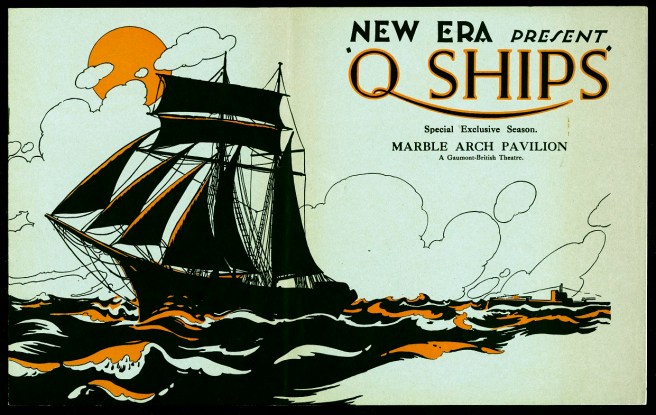
Text at top right reads: New Era Presents Q-Ships. Special Exclusive Season, Marble Arch Pavilion, A Gaumont-British theatre. To left a silhouetted ship in full sail against a sunset and outlined clouds on red waves, with small U-boat just visible emerging from the sea to right below the text.
Front cover of Q-Ships souvenir programme. This striking image conveys at one and the same time the impending destruction of a sailing ship from the U-boat (seen bottom right) and the sunset of the sailing vessel in the aftermath of the First World War. © Historic England Archive

She too was sunk ‘in action’ off the Bill of Portland in February 1928, and again it took several attempts, blamed on the removal of her figurehead as a souvenir. Much was made of this in the press, with superstitious sailors saying that to be successfully sunk she should have her figurehead with its ‘lucky squint’ reinstated! If nothing else, it was certainly a good story to drum up interest in the film. (11)

Amy has also been consistently charted at her position of loss since 1928 and has a unique place in the maritime heritage of England’s Channel coast. In being expended for re-enactment purposes, she can lay claim perhaps to being the final (indirect) victim of the First World War at sea in English waters (there were other direct post-war losses but we will cover that in a future edition of Wreck of the Week). She is also a rare, if not unique, example of the wreck of a Victorian sailing vessel documented in the early days of 20th century film. And finally, she has the sad distinction of being a counterpart to a genuine wartime loss, whose remains are yet to be discovered.

The Q-Ships film created – and documented in the very creation – a heritage of its own.


(1) Lloyd’s War Losses: The First World War: Casualties to Shipping through Enemy Causes 1914-1918, facsimile edition, 1990, London: Lloyd’s of London Press Ltd; uboat.net

(2) Q-boat Adventures, 1919, London: Herbert Jenkins Ltd.

(3) Western Morning News, Friday 25 November 1927, No.21,115, p5; Hampshire Telegraph, Friday 2 December 1927, No.3,114, p14

(4) Hampshire Telegraph, Friday 2 December 1927, No.3,114, p14

(5) The Stage, Thursday 28 June 1928, No.2,465, p24

(6) Western Morning News, Monday 2 January 1928, No.21,146, p5

(7) Belfast News Letter, Wednesday 4 January 1928, no issue number, p7

(8) UKHO 17584

(9) Entry for Amy on www.clydeships.co.uk

(10) New Era Presents: Q-Ships souvenir programme, 1928

(11) Dundee Courier, Monday 26 March 1928, No.23,340 p5


Diary of the War, July 1918

The ‘rag-tag and bobtail of the seas’

On 30 July 1918 a U-boat sighted a ship on a westbound course some 25 miles or so off the south Devon coast in the English Channel.

She had happened upon Stock Force, a modern steel-built collier of only 732 tons, launched in 1917, one of the little ‘rag-tag and bobtail of the seas’, under the command of Harold Auten. (1) Steaming westward without convoy, the Stock Force, though small, was better than nothing for a U-boat half-way through a hitherto unsuccessful war patrol.

At 5pm the U-boat launched a torpedo whose track was spotted by the crew of Stock Force, who tried their best to port the helm and put the engines full speed astern. Even so, they could not avoid the incoming torpedo, which struck their ship on the starboard side forward. The explosion caused a ‘tremendous shower’ of timber and a 40-foot hole in her side, and she began to settle down by the bows, with five men injured. (2) There was nothing for it but for the crew to put the long-rehearsed ‘abandon ship’ order into effect.

Not all the crew got away. There were some left behind . . . with five wounded taken below decks by the surgeon, working ‘up to his waist in water’, to have their hurts attended to.  (3)

The U-boat surfaced half a mile distant and watched for some 15 minutes as the crew pulled away, then drew closer to investigate on the port beam, perhaps considering why, as you might too, why a modern vessel, and a collier at that, was throwing up such a shower of timber.

Thus began one of the most well-known duels between a U-boat and a Q-ship. In a sense Stock Force was indeed coasting in home waters, but she was on patrol in the hope of attracting just such attention from a U-boat. The timber was ballast bolted into her hold to keep her afloat in the event of being torpedoed – ‘floatation planks’. (4)

The men who got away were a ‘panic party’ for show: the remainder of a crew larger than usual for a collier of her size were now busy dropping all pretence along with her false sides as they opened fire with the ship’s hidden guns, minus her forward gun and some of the ammunition – the gun had been knocked out of action and the ammunition blown up in the explosion. One man was pinned underneath the forward gun and remained there ‘cheerfully and without complaint’ (5) while in a very real situation of danger. Nevertheless, forty minutes after the torpedo had struck, the Stock Force was engaging her enemy.

Contemporary black and white photograph of merchant seamen, two men in foreground, with gun in background being manned by crew to right.
Manning the gun. Image courtesy of the Butland family, descendants of William Butland, Chief Petty Officer on board Stock Force.

They were all naval men wearing the clothes of merchant seamen, and such was the level of pretence there was even a ‘Board of Lies’ aboard the vessel, so that every man knew the story of each patrol by heart to account for the greater crew complement – the extra men were supposedly crew of one or more mined vessels (always mined, never torpedoed, to avoid the risk of the story not checking out).

The Stock Force continued to attack the U-boat, inflicting so much damage upon her periscope, conning tower, and finally also tearing a hole in the submarine’s hull. They ‘poured shell after shell until the submarine sank by the stern, leaving a quantity of debris on the water.’ (6) In turn the ferocity of the action contributed to the Stock Force‘s own demise and the water gained on them even as they tried to nurse her back towards land.

As Auten would later put it: ‘ . . . it was particularly hard to have got her almost within sight of land – the shore was only eight miles away – and then to lose her’ as ‘poor little Stock Force sank to her last home’. (7) She sank at 9.25pm with the crew taken off by two torpedo boats and a trawler. (8)

Another story of mutually assured destruction on the high seas? Not quite. There was more to the tale of the Stock Force than met the eye. Few, if any, details emerged of the action in the press, with greater prominence being given to other successes against U-boats, for example off the east coast by a British submarine and in the English Channel by a yacht (9) The key detail widely extracted in the press from a statement by David Lloyd George in Parliament was that U-boat losses now stood at 150. (10)

Details began to trickle out with crew honours gazetted, divorced from any context and prefaced only by the words that ‘The King has been graciously pleased to award the following honours . . . ‘ (11) Auten was awarded the Victoria Cross for his part commanding the action. Immediately after the war, details emerged of the Stock Force in action and it was there that the ‘kill’ of the submarine came to light. (12) The story was then widely taken up in the press, with double-page spreads and artists’ dramatic impressions of the U-boat upended and sinking below the waves, even as Auten and his crew met the public aboard Q-ship Suffolk Coast on tour. (13)

Pencil drawing of docklands, with barges in foreground and to right a submarine and ship are berthed alongside one another.
HM Q-Ship Suffolk Coast and U-155, Deutschland, St. Katherine’s Dock, London, 1918. Ministry of Information Commission, Scheme 2 © IWM (Art.IWM ART 1496)

The lost U-boat was originally attributed to U-98, which can, however, be placed south of Norway with the sinking of Alkor on 31 July and was surrendered on 16 January 1919. The attacking submarine was UB-80, which sank only to rise again, for once again she was out on patrol in September 1918 following repairs and surrendered to Italy on 26 November 1918, but it is unsurprising that at the time she was credibly believed to have been lost. Both were broken up in the UK and Italy respectively. (14)

So, after all, there is only one ship on the seabed off the south coast of Devon as a result of the action of 30 July 1918. Camouflaged in service, the Stock Force also remained camouflaged on the seabed following her demise and was attributed to two different sites, both also probably contemporary war losses, before being identified in 2011 in a location much more consistent with Auten’s description of the position of loss than the previous two candidates, at some 7 miles SW off the Bolt Tail, Devon. (15)

Or is there? We will continue the story of Stock Force across this week as we commemorate the centenary of one of the most well-known of all Q-ship incidents and its significant contribution to the maritime heritage of Devon.

[With many thanks to Steve Mortimer and John Butland for their very kind help in telling this story over the week.]

(1) Intertitle, Q-Ships, 1928, New Era Productions

(2) Auten, Lt Commander Harold, 1919, Q-boat Adventures London: Herbert Jenkins Ltd; Keble Chatterton, E, 1922 Q-Ships and their Story London: Sidgwick and Jackson Ltd

(3) London Gazette, 19 November 1918, No.31,021, p13,695

(4) Auten 1919; Keble Chatterton 1922

(5) London Gazette, 19 November 1918, No.31,021, p13,695

(6) ibid.

(7) Auten 1919

(8) London Gazette, 19 November 1918, No.31,021, p13,695

(9) for example, Hull Daily Mail, 21 August 1918, No.10,265, p2, Gloucestershire Echo, 9 August 1918, extra, p1

(10) for example, Hampshire Telegraph and Naval Chronicle, 9 August 1918, No.7,167, p4

(11) London Gazette, 13 September 1918, No.30,900, p10,847

(12) London Gazette, 19 November 1918, No.31,021, p13,695

(13) The Sphere, 14 December 1918, No.986, pp196-197

(14) U-98 https://uboat.net/wwi/boats/?boat=98 UB-80 https://uboat.net/wwi/boats/successes/ub80.html

(15) UKHO 18017; Historic England National Record of the Historic Environment records 832147, 832260, and 832265


Diary of the War: June 1918

A tale of two ships

History has a habit of repeating itself, not least at sea. Today’s First World War wreck has a namesake with a very similar history in the Second World War: both vessels were owned by the same firm originally and were likewise lost to enemy action on Admiralty service in English waters, both with significant loss of life.

On 13 June 1918 HMS Patia was sunk by in the Bristol Channel in a position said to be 25 miles west of Hartland Point, while on service as an armed merchant cruiser. She was built in 1913 for Elders and Fyffes (of banana fame), whose early 20th century ships took advantage of modern refrigeration technology to transport bananas across the Atlantic to ensure fruit reached market in peak edible condition.

A photograph of her sinking is in the Imperial War Museums Collection online.

Their second Patia, built in 1922, entered Admiralty service first as an ocean boarding vessel, then underwent conversion to a fighter catapult ship. She too was sunk on 27 April 1941 off Beadnell Point, Northumberland, by an aerial attack, but not before her crew had downed the attacking aircraft – continuing the theme of mutually-assured destruction covered in last month’s post.

It’s worth reiterating that the War Diary has showcased the war service of many of the world’s commercial shipping fleets during the First World War, and these companies would reprise that service during the Second.

Wartime deployment would depend to some extent on their original civilian roles. We have already seen how trawlers became minesweepers, Scandinavian colliers were requisitioned and redeployed in British collier service, and ocean liners became troopships and hospital ships – and also armed merchant cruisers, a form of vessel we have not hitherto covered in the War Diary.

Patia‘s speed as a specialist banana carrier made her suitable for carrying out this auxiliary naval role, which she successfully performed from November 1914 right up until 13 June 1918, armed with 6 x 6in howitzers and 2 x 3pdr anti-aircraft guns. She served principally in the North Atlantic between Scotland and Iceland, and from 1917 took up convoy escort duties. Her logs survive up till 30 April 1918, showing that in February she had escorted a convoy home from Dakar (Senegal) before docking at Avonmouth on the 25th for maintenance. Subsequent entries reveal “chipping and painting” over the next month, that is, getting rid of rust before applying a fresh coat of paint. (1)

No further logs survive, highlighting one of the key difficulties in researching the events of a century ago. As usual, the Admiralty press release was extremely brief, hiding the location of loss:

‘The Admiralty on Monday night issued the following: – H.M. armed mercantile cruiser Patia, Acting Captain W. G. Howard, R.N., was torpedoed and sunk by a German submarine on the 13th inst.

‘One officer and 15 men, including eight of the mercantile crew, are missing, presumed drowned. The next-of-kin have been informed.’ (2)

The details which made it into the press at the time focused on the human interest aspect, including the deaths of local men, which had been depressingly regular reading in regional newspapers since the outbreak of war. For example:

‘CASUALTIES AMONG MIDLAND MEN.

‘The following additional particulars of local men killed have been supplied:-

‘Signalman William Harold B. Roe, RNVR, HMS Patia, lost his life through the Patia being torpedoed on the 13th inst. The elder son of Mr William Roe . . . he was educated at King Edward’s Grammar School, holding scholarships. On leaving school he entered Lloyds Bank and rapidly progressed. On January 10, 1918, he was married to Miss Alice Williams . . . ‘ (3)

Likewise, the Western Daily Press reported:

‘A Portishead man, Mr Leslie Victor Atwell, lost his life in the ill-fated Patia. He was a naval reservist and joined up on the outbreak of war. He was 35 years of age, married, and previously an employee of the Docks Committee.’ (4)

More happily, another feature referred to the ‘Exciting Experiences of Famous Young Walsall Violinist’:

‘One of the able seamen who was saved from the Patia was Harold Mills, Walsall’s brilliant young violinist. He arrived in Walsall after a short stay in an English hospital, and in a chat with a representative of the Observer, spoke on all subjects except his being torpedoed.’

It emerged that he spent an hour in a boat which then picked him up and transferred him to an American destroyer. Mills gave good copy:

‘Most of his kit was lost, including his violin, but, as he philosophically expressed it, it was not his best.’ (5)

The stories of the two Patias are not wholly similar, however. The second Patia is almost certainly identified off the Northumberland coast (6), whereas the location of the 1918 Patia is not fully clear.

A site formerly attributed to Patia has since proved to be the Armenian, another First World War casualty of 1915, identified by her bell. (7) Patia is now believed to lie in a different location in the Bristol Channel, itself further west than the stated position of 25 miles west of Hartland Point, although such positions are not necessarily reliably expressed. That site’s charting history reaches back to 1928 but no further: this does not necessarily preclude its identification with Patia, since, after all, many First World War vessels have only been discovered in recent years. (8)

The submarine which attacked the first Patia in 1918 was herself sunk in August of that year off Start Point by HMS Opossum. The Heinkel responsible for sinking the second Patia in 1941, and shot down in its turn, has to date not been located.

(1) https://www.naval-history.net/OWShips-WW1-08-HMS_Patia.htm

(2) Hampshire Telegraph, Friday 21 June 1918, No.7,160, p5

(3) Birmingham Daily Post, Thursday 20 June 1918, No.18,738, p7

(4) Western Daily Press, Saturday 22 June 1918, No.18,728, p6

(5) Walsall Observer, and South Staffordshire Chronicle, Saturday 22 June 1918, No.2,591, p3

(6) UKHO 4390

(7) UKHO 16089

(8) UKHO 17227


Diary of the War: May 1918

Side by Side in the North Sea

The Admiralty issued a brief press release on 4 June 1918:

“One of H.M. destroyers was sunk on the 31st May, after being in collision. There were no casualties.” (1)

B&W photograph of ship in port broadside view, smoke billowing.
Destroyer HMS Fairy © IWM (Q 38854)

An unfortunate but trivial incident, since all hands had fortunately survived? Not quite.

The ‘HM Destroyer’ in this press release was HMS Fairy, 355 tons, under the command of Lt. Geoffrey Howard Barnish, RNR, sister ship to HMS Falcon, 375 tons, commanded by Lt. Charles Lightoller RNR, survivor of the Titanic (see previous post on Charles Lightoller). Falcon had been lost just weeks earlier after a collision with HM Trawler John Fitzgerald, 235 tons, during convoy esort duties on the North Sea coast.

In the early hours of 31 May Fairy was also on convoy escort duties in the North Sea, together with six armed trawlers and an armed whaler. However, history was not quite about to repeat itself.

Barnish considered that a destroyer escort should be “to seaward and a little abaft the beam of the rear ship of the convoy.” (2) In this way the escort could steam rapidly forward to the scene of any attack, rather than be forced to double back to deal with the attacker.

He was relieved to round Flamborough Head, for he considered a U-boat  attack on a convoy south of Flamborough Head unlikely, because of the shoals in the area. That is enough information for us today to realise that it was a southbound convoy and thence to guess at its likely composition, so we can see why Admiralty press releases gave so little away. Statistically, however, his confidence was misplaced, and a cursory glance at wreck site remains for 1914-18 reported near Flamborough Head demonstrates that approximately half were indeed attacked south of Flamborough. (3)

That same night UC-75, displacing 417 tons on the surface, and under the command of Walther Schmitz, was also on war patrol seeking a target north of the minefield she had just laid to the south off the Outer Dowsing Shoal. A southbound convoy, laden with valuable cargo for London, presented a suitably attractive opportunity for an attack.

The convoy found her first. Around 2am, SS Blaydonian struck UC-75 as she passed overhead. As a southbound collier, she was laden with coal and low in the water, so UC-75 received quite a hefty blow that sounded to Barnish as if his worst fears had been realised with a torpedo fired among the convoy and he left his station to investigate.

Over on UC-75 the damage to her conning tower prevented the hatch being properly shut, leading to water ingress and forcing her to surface. In the meantime the convoy steamed on – to inflict more damage in the dark. SS Tronda was a Norwegian flying the British flag under the Shipping Controller (she would survive the war and revert to Norwegian ownership), and as was typical for Norwegian vessels under these circumstances, she went where she was most needed, on a coal run. She too ran over UC-75. Then the SS Peter Pan, owned by Furness, Withy & Co., one of the chief shipping companies in the coal trade, and therefore also a laden collier, was the next to strike UC-75. We can imagine the submarine reeling under each blow like a punch-drunk boxer on the ropes.

On arrival at the scene it was not yet clear to Barnish whether the submarine was friend or foe. There was sufficient history of U-boat operations off the Yorkshire coast and the apparent sound of a torpedo attack to make an enemy identification all too plausible, but there was still some doubt. Despite the report, there was no evidence of an actual attack and there was also the  basic knowledge that British submarines were known to be operating on secret missions out of the northern ports.

In that new age of modern warfare, Barnish made his decision with the information he had available. He turned to an ancient tactic – he moved to ram his target, weaponising his vessel should the submarine prove to be German, but astern, a manoeuvre which would allow the crew to escape and avoid loss of life, should it prove to be British.

What happened next is not fully clear: Barnish and Schmitz’s versions were necessarily coloured by their respective viewpoints and the order of events has also been interpreted differently by subsequent commentators. Barnish then heard voices shouting ‘Kamerad! Kamerad!’, identifying the vessel as a U-boat, and proceeded to ‘order the coxswain to port the helm in order to hit her in a more vital spot’, but he felt that they were too close for that manoeuvre to be effective. (4) According to another (secondary) version, these voices were heard after the impact. (5)

Barnish recognised that the Fairy was probably damaged in this first pass but nevertheless renewed the attack, ordering the U-boat to be raked by gunfire as Fairy turned to ram the submarine once more, with the U-boat returning fire. Fairy‘s bows struck the U-boat aft of the gun, crumpling up on contact, so that they were under water within seconds and two of the German crew were able to climb from one vessel to the other, while others were picked up by Fairy. Not all, however, and Schmitz would go on to interpret the speed of the renewed attack and the accompanying gunfire as aimed at the crew in the water, as well as at their vessel. (6)

At this point in the war the seas off Flamborough Head (and elsewhere) were regularly perturbed with scenes of wartime strife. Similar allegations against U-boat crews would surface in early July with the discovery of a boat washed up at Flamborough, carrying dead bodies which bore signs of wounds inflicted by gunfire after getting into the boat. (They were identified as from the Madeleine, a French lugger damaged, but not, in fact, sunk, by UB-40 on 2 July 1918.) (7)

Reverting back to the events of 31 May, another life and death struggle was about to take place. Generally speaking, vessels lost in English waters either to accidental collision or deliberate ramming demonstrate that the colliding/ramming vessel usually escaped relatively unscathed, with the force transferring to the vessel in contact, but occasionally the force is so great that the former also sinks. (8) So it proved to be in this case: Fairy had taken on an enemy larger and more robustly built than herself and paid the price.

Barnish and his crew quickly realised that their ship was sinking too rapidly to make any attempt at beaching feasible, the nearest land being at least 10 nautical miles away, so the crew were sent off in the boats, along with the prisoners, who were thus shipwrecked for the second time in less than an hour. Barnish and two signal ratings remained behind to signal a message saying that they were about to abandon the vessel, then swam to a Carley float. All the British crew would survive, but only 14 out of 31 of UC-75‘s men would survive their double shipwreck to be picked up.

B&W photograph of men in uniform around an inflatable liferaft.
Men gather round their Carley float during a boat drill aboard HMS Widgeon, on convoy duty in the North Sea, during the Second World War. © IWM (A 18444) This scene would have changed little, if at all, from 1918, when Barnish and his two crew were forced to make use of their Carley float in the escape from HMS Fairy.

Barnish and his crew were decorated in 1918 and received prize bounty money in 1920 for this action. (9) Schmitz was made a prisoner of war and would die in the flu epidemic of 1919.

And still UC-75 and Fairy lie half a mile apart SE of Flamborough Head, sites of mutually assured destruction. Both have been identified by internal and structural evidence (identification on propellers in the case of UC-75 and the telegraph and pressure gauges in the case of HMS Fairy) and external damage. (10) Despite being struck by Blaydonian, UC-75‘s conning tower was reported in 2016 as still intact, while Fairy‘s bows bear the scars of her attack on UC-75. She lies seaward of UC-75, just as, a century ago, she had kept station seaward of her convoy.


(1) Widely reproduced in the UK press, for example, in the Newcastle Journal, 5 June 1918, p6.

(2) Barnish’s own words, reproduced in Dorling, T (“Taffrail”). 1931 Endless Story: being an account of the destroyers, flotilla-leaders, torpedo-boats and patrol boats in the Great War London: Hodder & Stoughton

(3) National Record of the Historic Environment (NRHE) database: 2018

(4) Dorling 1931; Edinburgh Gazette 20 September 1918, No.13,323, p3498

(5) Termote, T. 2017 War Beneath the Waves: U-boat Flotille Flandern 1915-1918 London: Unicorn Publishing Group

(6) ADM137/3898, German submarines UC-48-94: papers concerning details of vessels, interrogation of survivors, photographs and ship’s book of UC-92 (The National Archives, Kew)

(7) See, for example, the Scotsman, 6 July 1918, No.23,431, p7; uboat.net

(8) National Record of the Historic Environment (NRHE) database: 2018

(9) Dorling 1931: Edinburgh Gazette, 20 September 1918, No.13,323, p3498; 25 May 1920, No.13,598, p1305

(10) UK Hydrographic Office reports 8971 (UC-75) and 8974 (Fairy).

Diary of the War: April 1918

Luisa

Over the course of the War Diary on this blog, the featured wrecks have illustrated the twists and turns of the war away from the Western Front. Today’s wreck is no exception: the Spanish steamer Luisa, torpedoed by UB-74 off Pendeen lighthouse on 12 April 1918, while bound from Barcelona to Liverpool with a general cargo.

Built in 1897 as the Tyneside collier Minerva, she was sold on into Spanish ownership under the same name in 1899, and ten years later was sold on again to the Cia Naviera Sota y Aznar of Bilbao, who renamed her Aizkarai Mendi. Each ship in their fleet was evocatively named in Euskera (Basque) after a different mountain (mendi) in the Basque country. 

Aizkarai Mendi was sold on once more in 1915 to become Luisa for a family firm whose main business was timber. Spain was neutral during the First World War, a stance which opened up her shipping to commercial opportunities which companies such as Luisa‘s owners Hijos de José Tayà were quick to seize. Bilbao’s exports of iron ore were much in demand from both sides requiring raw materials to turn into war materials, and Luisa became the first in the family’s fleet. (1) The Tayà fleet would go on to expand rapidly over the course of the war with vessels which, like the Luisa, were bought up from other fleets.

As we have seen in previous articles, neutrality was no guarantee of safety at sea, and finding ready markets on both sides carried the risk that the belligerent powers would each seek to hamper the other’s trade, and U-boats began to target Spanish shipping. The news from Madrid broke in Britain a fortnight later, in the context of three Spanish ships ‘sunk in a period of four days’, including the Luisa ‘with a cargo of coal’. (2)

‘The indignation in maritime circles is enormous . . . A very energetic protest has been made to the Government by M. [sic] Señor Taya, the owner of the Luisa, who demands the immediate seizure of all German vessels now lying in Spanish ports.’ The U-boat attacks were attributed to reprisals for the ‘diplomatic check sustained by Germany in the matter of the commercial agreements concluded between Spain and the Entente nations’.  In further news from Madrid, clearly seen as connected, the next paragraph goes on to reveal that the ‘German submarine U.C. 48, which sought refuge in a Spanish port in a damaged condition, has been interned.’ (3)

More details on the wreck event emerged as the survivors arrived back at Barcelona in late May. In a telegram to the Spanish Prime Minister, Señor Tayà described the circumstances. Luisa was torpedoed ‘unarmed, neutral, and flying the Spanish flag’ in ‘full daylight at one o’clock in the afternoon’ while ‘following French and British steamers with a view to avoiding mines,’  the French vessel 3 miles ahead and the British a quarter of a mile ahead. ‘The submarine, however, kept at a respectful distance from the foreign steamers, as they were armed.’  (4)

After being torpedoed, the Luisa sank within a few minutes with three men killed in the engine-room, but the remainder of the crew were rescued by two British patrol vessels. ‘The owners of the lost vessel fully expect the Spanish Government to make a claim on Germany and in the meantime to seize a German steamer of equivalent value.’ (5)

As the U-boat campaign against Spanish shipping continued, the Aznar company would go on to lose Anboto Mendi off Runswick Bay, while en route from Bilbao for Middlesbrough with iron ore on 10 May 1918, and the Tayà company’s ship Villa de Soller would be sunk in the Mediterranean on 15 May 1918. Ten days later, the U-boat which had attacked her sister ship Luisa would be depth-charged by HM Yacht Lorna off the Bill of Portland.


(1) García Domingo, G. 2007 “El impacto de la Primera Guerra Mundial en la marina mercante española: un apunte sobre el caso catalán (1914-1922)”,  Transportes, Servicios y Communicaciones, No.13, 122-144; Lowry, C. 2009 At what cost? Spanish Neutrality in the First World War MA thesis, University of South Florida

(2) Cambridge Daily News, 25 April 1918, No.9,269, p4

(3) Ibid.

(4) The Scotsman, 7 May 1918, No.23,279, p3; Londonderry Sentinel, 25 May 1918, no issue number, p4, republishing in translation a contemporary article in El Sol.

(5) Ibid.

Diary of the War: March 1918

War Knight

The War Knight was entirely a product of the First World War. She was one of the British ‘War Standard’ ships, built to a standard pattern that enabled a faster turnover in shipbuilding to help counteract the continuing toll in British mercantile shipping losses. All had the War– prefix, and were named in classes, with some intriguing juxtapositions, such as War Crocus and War Tune. War Knight was one of a group of similarly-named vessels: War Baron and War Monarch among them. All were lost around the English coastline in 1917-18.

Her story is also characteristic of this phase of the war as ships now steamed in convoy with escorts that shuttled between appointed rendezvous locations, where the next escorts would take over. There were other countermeasures in place to ensure the safety of each convoy, such as zig-zagging at predetermined intervals of varying and therefore less predictable lengths, to help obscure their true course.

Most extraordinary of all, ships were painted in dazzle camouflage which broke up hull outlines, making it difficult for a U-boat to get an accurate fix on the vessel and determine its size, outline, speed, and course. Firing a torpedo was a scientific act which had to take account of the distance travelled by the target in between firing the torpedo and its contact with the intended victim.

Art took on science in this battle to keep ships safe from attack, and the ‘Cubist ships’, as they were known to contemporaries, became a common sight on the world’s oceans. It seems counter-intuitive to conceal large moving objects in abstract eye-catching patterns and bright colours, but the patterns were carefully worked out to disrupt the ship’s outline as far as possible. Nor were the two sides of the vessel the same: each side would carry a different pattern, and the paint scheme would be carried through any visible area of a ship, such as cabins or recessed elements of superstructure.

I will let the paintings below tell the story, all seen from sea, all with the viewpoint of another ship at sea in the same convoy, and all painted by a lieutenant in the Royal Naval Reserve, who certainly married his knowledge of the sea, observation of contemporary shipping, and his artistic talent to considerable effect.  In painting 1 below, we see our first dazzled ship, an oiler, like the War Knight, at reasonably close quarters, from astern of another ship in convoy whose wake leads our eye to the dazzled ship, but even so, her bow is distorted. We have to allow for artistic licence, of course, but the ship has elements of the same palette as the cliffs behind, and the pattern at her bows echoes the vertical undulations of the cliffs. We are seeing distortion of distance as well as the ability to blend into the background.

Painting from the sea looking towards cliffs and the body of a vessel painted in dazzle camouflage.
1. A dazzled oiler, with escort, Geoffrey Stephen Allfree, 1918 © IWM (Art.IWM ART 567)

There is ‘clear blue water’ between the viewer and the ship astern as the convoy is keeping station, under the watchful eye of a British airship. Convoys could be very large, and destroyers and other escorts, such as the one seen nearer the cliffs on the left, had to act as ship-shepherds. The lead merchantman would be designated the Commodore, with every other ship in the convoy taking its station from the Commodore.

A convoy of dazzle camouflaged ships in the lower third of the painting, against a blue sea and a blue sky with pink and orange tinges to the clouds and on the horizon.
2. A Convoy in the Channel, Geoffrey Stephen Allfree, 1918 © IWM (Art.IWM ART 560)

In painting 2 above the pink tinges in the sky suggest dusk and that this might be an eastbound convoy, as it was when the War Knight‘s convoy entered the western Channel from the Atlantic on 23 March 1918, with the Mirlo as Commodore. There were several other oilers in the convoy, War Knight being on the port flank and the American oiler O B Jennings on the starboard, and a number of vessels were dazzled, including the Jennings. The convoy was put on edge by hearing ships being sunk off the Lizard in separate incidents, and we start to realise, even at this distance, the two ships nearest us look uncomfortably close to one another, as if they are huddling close for comfort.

Rough dark blue sea in lower third of painting, ships barely visible against a pink tinge of sunset on the horizon, dark clouds above.
3. Seascape with convoy and evening sky effect, Geoffrey Stephen Allfree, 1918 © IWM (Art.IWM ART 569)

Against the evening sky in 3 above, the ships seem to blend into the rough sea, particularly those nearest to us, with only their funnels and the steam they belch the main clue as to their presence – the perennial problem for all steamers in war, since the black clouds of coal-driven steam would simply give them away.

And therein, in the dark off the Isle of Wight, lay the problem. The convoy steered further to the south than originally planned, with the presence of a new minefield off the Needles revealed that day by the loss of HMS New Dawn. Just before midnight, a distress call then emanated from the south-east from a torpedoed tanker (which managed to limp in to Southampton). A supposed torpedo flash followed half an hour later, then within the next half an hour a distress call in French was heard to the south (which cannot, to this day, be reconciled with the loss of any French vessel).

Caught not between the devil and the deep blue sea, but between a minefield to the north and a hunting U-boat to the south in the darkness of the night, the decision was taken to alter course once again. Wireless could not be used in case communications were heard by the enemy, so recourse was had to a loudhailer amongst a convoy starting to scatter, barely able to see each other in the dark and with the situation exacerbated by dazzle camouflage. This confusion was further aggravated when one of the convoy, whose captain was perhaps being hypervigilant, challenged the escort’s authority and caused further delay in getting the message out to all the ships.

Thus O B Jennings and Aungban, on the starboard flank, started to turn north-west on the old course, as the Kia Ora and War Knight on the port flank turned south-east on the new course. As oiler smashed into oiler, the rest of the convoy were dazzled by a huge explosion and a fireball that seemed to coalesce into a single ship, according to one observer. Only a few men escaped alive from War Knight, and those with severe burns, some of whom succumbed to their wounds in hospital.

Ultimately War Knight and O B Jennings were a ‘menace to other ships’ and certainly the huge flames and burning sea would have alerted any U-boats in the vicinity to the rest of the convoy. O B Jennings was sunk by the escorts (although raised, returned to service and sunk in the Atlantic later in the war) and War Knight was taken in tow with the aim of beaching her. She then struck a mine from the very same field the convoy had been attempting to avoid, so there was nothing for it but to scuttle her too, to dowse the flames.

All the safety measures by this stage of the war – the convoy system, the zig-zagging, the dazzle camouflage, the radio silence – were all cited in the official loss report as contributory factors to this tragic collision in convoy, which became a regular feature of this phase of the war, but for the War Knight to endure so many vicissitudes was unusual. This wreck is well-known, and much has been written about the phenomenon of dazzle camouflage, but there seems to be little literature on the impact of dazzle among ships in the same convoy. Measures that served to screen ships from the eyes of enemies could also obscure them from their friends. Finally, here is the model showing the dazzle scheme for the collier Camswan, also lost in a collision in convoy off the Isle of Wight on her maiden voyage in 1917:


3D ship model painted in colour with abstract black patterns, photographed against a grey background.
First World War model of the dazzle scheme for the SS Camswan, c.1917. © IWM (MOD 2259)

Sources:

ADM 137/3450, The National Archives

Cant, S. 2013. England’s Shipwreck Heritage: from logboats to U-boats. Swindon: Historic England

New York Times, 18 April 1918, p7

O B Jennings

For more on the War Knight, see the Maritime Archaeology Trust’s Forgotten Wrecks of the First World War.

For more on dazzle camouflage, see the following resources: https://www.smithsonianmag.com/history/when-british-wanted-camouflage-their-warships-they-made-them-dazzle-180958657/ and http://www.bbc.co.uk/guides/zty8tfr


Diary of the War: February 1918

HMS Brown Mouse

If ever there was a name that sounds most unlikely for a warship, this is it. The Brown Mouse was no Dreadnought, Implacable or Dauntless . . .

Yet she went to war and what better cover could there be than such an innocuous-sounding name? All of 42 tons, she was built as a Brixham trawler, and launched in February 1908, official no.125110, a detail which might seem trivial or boring, but I’ve included it for a reason. (1)

In her original register entry Brown Mouse was described as a trawler, and assigned a fishing number of BM 276, but from the outset it seems that she was owned by the same man who later operated her as a yacht, Evelyn Pearson. (2) At least one other example of a yacht built on Brixham trawler lines still survives on the National Register of Historic Vessels. This vessel is the Golden Vanity, which was built in the same year at the same yard, Sanders & Co. of Galmpton, for the marine artist Arthur Briscoe, and this vessel was assigned the very next official number in the sequence. (3)

She appears to have fished locally at least in 1909, since during that year she was crewed by four or five men, with William Kingdom of Brixham as skipper. (4)

She was then fitted with an auxiliary steam engine by Simpson, Strickland & Co. of Dartmouth in 1910, whereupon she was re-registered, again at Brixham, due to the ‘material alterations’. She was no longer described as a trawler in the new registry, and it may be at this point that Evelyn Pearson and Brown Mouse became “regular” visitors to Brixham. (5) 

Then the war came and Evelyn Pearson joined up in September 1914, becoming a captain in the 12th Battalion, King’s (Liverpool) Regiment. He would have been about 39, but he had previous soldiering experience in the Lancashire Fusiliers in the 1890s. (6)

In the meantime, the development of the Q-Ships as, effectively, fisheries protection vessels, had begun during 1915, as fishing smacks were targeted off the east coast, as described in our July 1915 post. Similar attacks took place thereafter on a fairly regular basis on the North Sea and Channel coasts, with enemy activity intensifying at intervals.

Protection against mass sinkings of the fishing smacks came from among their own: one vessel from each fleet would be commissioned as a ‘Special Service’ vessel to guard their fellows engaged in fishing. Their diminutive size inevitably led to their designation as ‘Q-smacks’, but they were no less ‘Special Service’ vessels for that. Some even engaged U-boats directly, as Inverlyon had done in defending the Lowestoft smacks, covered by one of our past blog posts for August 1915.

Sadly Captain Pearson was killed in action in Flanders on 8 January 1916, at the age of 41. (7) The next phase of his yacht’s history is slightly unclear. Her registry at Brixham was closed on 27 November 1916 ‘in consequence of material alterations’, with her prior ownership stated as Captain Pearson, Thomas Kirkland Rylands, and the Hon. Earl Stanhope, and on the same day her ownership is recorded as transferred to H F Eastick of Great Yarmouth. (8) Eastick had already lost other vessels during the war, such as the Copious in 1914. Brown Mouse would not have been the first or last Brixham trawler to have transferred to the Lowestoft or Great Yarmouth fleets. 

It seems, however, that she would remain within her familiar waters in and around Brixham, rather than in service with Eastick, for one month later she was a ‘Special Service’ vessel. Perhaps Earl Stanhope, who was involved in the War Cabinet, had drawn official attention to her as a suitable vessel for the purpose.

Despite Inverlyon‘s success, it wasn’t always possible for the Q-smacks to defend their charges. On 8 June 1917, another sailing Q-smack, the Prevalent, was unable to assist when four Brixham smacks were sunk in the fishing grounds off south Devon, in full view of Start Point. One of those vessels was the Onward, built in 1907, and assigned an official number of 125101. Other vessels also assigned numbers from the same batch of official numbers allocated to Brixham, all built locally at around the same time as Brown Mouse and Golden Vanity, had also fallen victim to German submarine attacks: Markum on 17 April 1917, Boy Denis on 26 April, and Rupee on 4 October 1917.

One contemporary writer suggested that the Prevalent incident prompted the retrofitting of an auxiliary motor engine aboard Brown Mouse. (9) With her existing engine it is more likely that she was identified as a suitable candidate capable of speeding to the site of any trouble with enemy submarines, and replaced the Prevalent on the Brixham station.

However her participation as a Q-smack locally came about, the circumstances of her loss suggest that Brown Mouse was out on patrol with the Brixham trawlers on 28 February 1918. Unlike the other vessels with whom she was registered, however, she was not a war loss and so is not mentioned in many of the standard sources. Details of what happened next were given by the skipper of another local trawler, the Leonora Minnie, who had a narrow escape when the Brown Mouse caught fire and seemed headed for his vessel, the worst nightmare for any skipper of a wooden vessel, but, fortunately, she cleared the Leonora Minnie’s bows. Brown Mouse was subsequently ‘lost by fire off Berry Head’, with the local RNLI being called out to assist, a service which cost them £24. Fortunately, it seems that no lives were lost on this occasion. (10)

Trawler, yacht, and Q-Ship: small, as her name implied, Brown Mouse was sufficiently versatile to operate in all three roles, and to do so locally in every case. Her story highlights a mini-landscape of war off Brixham, in which fishing vessels came under attack, leisure cruising ceased, and small ships took on a modern enemy.

With many thanks to John and Sandie of Brixham in Pictures for their kind assistance with this article.

Black and white photograph of the interior of a boat, with a fisherman landing baskets of fish.
A fisherman landing his catch from a Brixham trawler in the 1950s. The photographer, John Gay, was interested in recording traditional working lifestyles that were heading towards obsolescence. AA087818. Copyright Historic England


(1) Her tonnage is variously cited, dependent on source: see, for example, British Vessels Lost at Sea, 1914-18, Section I, p26 (HMSO, 1919) stating 42 tons, following the vessel’s register books, whereas other source state 43 tons, such as the Brixham Heritage Sailing Trawlers Archive

(2) Devon Heritage Centre, Register of Sea-Fishing Boats, 1902-1979 DSR/BRI/2/1; Registry of Shipping and Seamen, Cardiff, MNL Appropriation Books, Official Nos. 125101-125150, accessed via the Crew List Index Project

(3) Description of her build as on sailing trawler lines, from The Marine Engineer and Naval Architect, Vol. XXXIII, August 1910, p24; National Register of Historic Vessels, Golden Vanity, as another such vessel

(4) Devon Archives and Local Studies, transcripts of crew lists, 20 May to 30 November 1909, List A3, and 1 July to 31 December 1909, List D, both referenced to 1976/BROWN MOUSE/125110, and both accessed via the Crew List Index Project

(5) Devon Heritage Centre, Register of Shipping 1894-1917 DSR/BRI/1/4; The Marine Engineer and Naval Architect, Vol. XXXIII, August 1910, p24; Western Times, 27 January 1916, No.20,771, p3

(6) Gloucestershire Echo, 18 January 1916, [no issue number] p2; London Gazette, 11 August 1893, No.26,431, p4577; London Gazette, 8 June 1897, No.26,860, p3201

(7) Commonwealth War Graves Commission record for Captain E H M Pearson; Western Times, 27 January 1916, No.20,771, p3

(8) Devon Heritage Centre, Register of Shipping 1894-1917 DSR/BRI/1/4; Brixham Sailing Trawlers Heritage Archive

(9) Keble Chatterton, E. 1922 Q-Ships and their Story. London: Sidgwick and Jackson

(10) Brixham Heritage Sailing Trawlers Archive; Western Times, 4 February 1919, No.21,170, p5


Diary of the War: January 1918

HMHS Rewa

This week we look at a wreck in the Bristol Channel which was first published in most British newspapers on 10 January 1918, six days after the ship was lost on 4 January.

Rewa was built as a liner in 1906 for the British India Steam Navigation Co., along with her 1905 sister, Rohilla, both vessels named after provinces of India. Their careers paralleled one another: both were converted from passenger service to troop transports, taking part together in the Coronation Fleet Review, 1911, and on exercises in 1913 off the Humber. (1) From transport service it was but a short step on the outbreak of war to conversion to hospital ships. Both would be lost in that service and Rohilla was featured in the War Diary of October 1914.

From 1915 onwards Rewa would become one of the familiar sights of the Gallipoli campaign, transporting men out from Suvla Bay to the depot at Mudros (Greek Moudros) to hospital at Alexandria or Malta, or back home. (2) On her final voyage she was bound from Mudros to Avonmouth via Gibraltar, where she had been inspected by a neutral Spanish observer to ensure her bona fides as a hospital ship. (3) There are some conflicts in the numbers on board, but the usual figures given are 207 crew, 80 medical personnel, and 279 wounded men (making a total of 566), although contemporary newspapers gave the rounded figures of 550 and 560. (4)

On his first patrol of the New Year was Kapitänleutnant Wilhelm Werner of the Kaiserliche Marine (Imperial German Navy) in U-55 off the coast of Cornwall. (5) For almost a year now, Germany had waged unrestricted submarine warfare, torpedoing ships without warning, but, by the terms of the Hague Convention, hospital ships were exempt from attack. They were distinctively painted with a white hull and the internationally recognised symbol of the Red Cross, and were to be lit in the dark for night recognition. The Rewa was accordingly proceeding up the Bristol Channel, ‘brilliantly lighted’ as demanded by the convention. (6) The Captain stated: ‘We had our Red Cross flag up and our lights had been lit at sunset – viz., steaming lights, navigation lights, and Convention lights, and they had remained and were alight at the time of the explosion. All the lights were electric. The ship was hit abreast of the funnel on the port side, as near amidships as possible.’ (7)

Thus when Werner fired the torpedo which caused the explosion off Hartland Point in the Bristol Channel, he must have known that he was contravening the Hague Convention. The captain had seen suspicious lights just before the torpedo struck, and ported his helm, but had not verified the identity of the vessel before the torpedo actually struck. (8)

The explosion is said to have extinguished the lights (many newspapers reported that a fortuitous find of a candle afforded some light, although, less dramatically, emergency candle lamps as a backup system were, in fact, lit) (9) and the ship began to settle. Fortunately for the evacuation, the vessel remained on an even keel before she finally sank, the sea remained calm, and there was time to send a distress call. Within 20 minutes everyone was on board the ship’s boats, even the ‘cot cases’ who were unable to fend for themselves. Given the dark and the imperative for haste, it was impossible for everyone to gather up sufficient clothing to keep warm while exposed to a cold night on the sea.

‘One of the nurses gave all her heavy garments to cover the men who were very ill, and remarking this an officer transferred to her his overcoat’, according to one account that was widely repeated across the press. (10) The number of nurses aboard was put at three, which seems a very small number amongst such a large medical staff with so many patients to look after. (11)

Even as they bobbed about on the sea, the little flotilla of lifeboats kept together on the captain’s orders and burned flares to attract attention – another factor in the survival of so many. (12)

Miraculously, only three men were initially reported missing, believed killed in the explosion in the engine-room, but, in fact, four lascars of the Indian Merchant Service were killed and are commemorated on the Bombay 1914-1918 Memorial, Mumbai: Usman Ghulam Qadir, trimmer, Ali and Said Ahmad Umar, both firemen, and Sultan Shah Azad, paniwallah (water-carrier). (13)

‘Another steamer and three trawlers were speedily on the scene’, although ‘speedy’ might have been a relative term since they were in the water for three hours before being picked up. (14)

The rescue vessels belonged to the Swansea Patrol and survivors were accordingly landed there. (15) The Western Daily Press described the ‘piteous’ sight as survivors came ashore,which moved onlookers to tears: ‘a procession of maimed and limping men, some on the backs of others and all without boots, wended its way under willing hands of helpers to the Coal Exchange . . . all business being suspended, while others were taken to leading hotels . . .’ (16) Some of the survivors were suffering from shock and wounds sustained in the explosion: one of the rescued lascars was reliving the fire in his mind, and another man went about all day without complaint until collapsing in the evening, when he was found to have several broken ribs. (17)

Eighteen survivors were taken to the Dan-y-Coed Red Cross Hospital (18) while others were despatched onwards to Southmead Hospital in Bristol. (19) It seems that Dan-y-Coed was a specialist in prosthetics made by a member of staff, so perhaps that was where some of the ‘maimed’ men ended up. A Dr Harrison was himself a hospital case with dysentery. Another medic, one Dr Lambert, had served since 1915 aboard Rewa at Gallipoli and had found romance and marriage in 1917 with one of her nurses, Alice Lockhart. He was with Rewa to the bitter end, receiving compensation for the medical instruments he had been forced to abandon on the sinking ship, but it is not yet known if his wife was also aboard at the time. (20)

The official German position cast doubt on the possibility of a submarine attack and suggested that a mine had been responsible for sinking the vessel, but the news triggered worldwide condemnation. As it was the Rewa would be cited as a war crime for which Wilhelm Werner was held responsible, although he would ultimately escape prosecution for this and other attacks on shipping.

The lights may have gone out on the Rewa as the torpedo struck, but, a century on, we are able to shine a light on some of those affected, whose stories are not always told in the accounts of shipping losses during the First World War: ordinary men and women, British and Indian, patients and crew, walking wounded and those severely ill and maimed.

Poster with text 'What a Red Rag is to a Bull - the Red Cross is to the Hun', with image of a U-boat and a torpedo track towards an illuminated red cross on a ship.
British propaganda poster of 1918. The striking of the Rewa amidships led to accusations that U-55 had fixed on her painted red cross as a target. © IWM (Art.IWM PST 13547)


(1) Online sources frequently state this as the Coronation Review of 1910, but 1910 was the year of George V’s accession, not his coronation. The review took place in June 1911; see, for example, The Times, 26 June 1911, p10. For the Humber exercises, see, for example, The Sphere, 2 August 1913, Vol.LIV, No.706, p11.

(2) Casale, F. 2008. “Dr John Lambert on HS Rewa at Gallipoli”, Proceedings of the History of Anaesthesia Society,  Vol.39, 2008, pp20-24

(3) i.e. that she was not being used for any military purpose. Spanish confirmation of their compliance, and of British compliance with the conditions of the Convention, was received from the observer who disembarked at Gibraltar. The Scotsman, 16 January 1918, No.23,284, p5

(4) New York Times, 10 January 1918, p1; The Times, 11 January 1918, No.41,684, p5; Western Daily Press, 10 January 1918, No.18,589, p6

(5) For the dates of U-55‘s patrol on this and other occasions, see https://uboat.net/wwi/boats/successes/u55.html

(6) Daily Telegraph, 10 January 1918, No.19,577, p5

(7) Birmingham Daily Post, 10 January 1918, No.18,602, p2

(8) ibid.

(9) Newcastle Journal, 14 January 1918, No.22,657, p5

(10) Western Daily Press, 10 January 1918, No.18,589, p6

(11) Daily Telegraph, 10 January 1918, No.19,577, p5

(12) Birmingham Daily Post, 10 January 1918, No.18,602, p2

(13) Commonwealth War Graves Commission

(14)  Western Daily Press, 10 January 1918, No.18,589, p6; Birmingham Daily Post, 10 January 1918, No.18,602, p2

(15) Crawford, J. 2014. GGAT 130: First World War Scoping Study: Glamorgan and Gwent: a report for Cadw pp99-100

(16) Western Daily Press, 10 January 1918, No.18,589, p6; Revd R G James, British and Foreign Sailors’ Society https://www.sailors-society.org/about-us/press-room/rewa/

(17) Daily Telegraph, 10 January 1918, No.19,577, p5

(18) Powell, C. nd. Caring within the Community: Mumbles Red Cross Hospitals

(19) Western Daily Press, 10 January 1918, No.18,589, p6

(20) Huddersfield Daily Examiner, 10 January 1918, No.15,682, p4; Casale, F. 2008. “Dr John Lambert on HS Rewa at Gallipoli”, Proceedings of the History of Anaesthesia Society,  Vol.39, 2008, pp20-24

Diary of the War: November 1917

SS Belém

I am pleased to welcome as my guest blogger for this month my colleague Stuart Churchley, Marine Planning Archaeological Officer at Historic England. Although this month’s wreck was not lost to war causes, she nevertheless illustrates a little-known aspect of the First World War in the English-speaking world, that of Portugal’s involvement in the war. Stuart writes:

The name of a wrecked vessel can often hold clues not only to its origin, but also the historical context in which it served: today’s wreck, lost 100 years ago on 20th November 1917, is just such a wreck with the potential for a far larger story.

At around the same time as the British Army famously used their tanks on the western front at Cambrai on 20th November 1917, a little-known merchant vessel, the SS Belém, was wrecked at Menachurch Point, just north of Northcott Mouth, Bude.

When I first started researching the SS Belém, my first thought was that this vessel must have been inadvertently lost: an isolated wrecking case on the very periphery of the war action, participating in no known convoy for the area, miscalculating a notorious stretch of coastline like so many others had previously, whilst avoiding the threats of unrestricted U-boat attacks and mines alike.

Locally it is well known and has captured the imagination of visitors and artists, becoming a recognisable feature of the landscape. The wreck itself was photographed at the time of its loss oriented facing south, running parallel to the coastline overlooking to the east.

Black and white photograph of stranded ship, seen in profile broadside on to the beach, with rocks and stones visible in the lower half of the image. The ship is dry with the tide at the top of the image just lapping at the bottom of the vessel.
Contemporary photograph of the Belém ashore, 1917, seen from the overlooking cliffs.

A brilliant eyewitness account of the ship’s stranding from the perspective of Arthur Madge, can be found within an online pdf produced by a local historian, Audrey Aylmer, which also includes photographs of the site in 1997, 80 years after the Belém came ashore. (1) As an eight year old boy in 1917, Arthur had been awoken at his boarding school by the sound of the distress signals in fog from the stranded Belém (so she had certainly not been lost to war causes).

Today, when tides and wind work in tandem, a mixture of metal features can be revealed on the beach. It’s easy to see that the coastline of shale and sandstone known as the ‘Bude Formation’ and heavy westerly winds has caused the ship to become severely disarticulated, mangled and a little bit hazardous underfoot. The intertidal sand has formed a protective layer over what remains of the wreck, comprising a long subtly curved hull structure, a boiler cracked open like a an eggshell, large elements with rivet patterns and flanges, and the propeller itself sitting serenely within a bowl of scoured sand. The site is very clearly seen from above by drone in some excellent 2015 images published by Martin Busby online. (2)


Three groups of dark metal elements of a wreck sitting in pools of water on a sandy beach, against a backdrop of grey mist.
Boiler and propeller shaft of wreck, Menachurch Point in mist, 2007. CC-BY-SA/2.0 – © David Hawgood – geograph.org.uk/p/411088

Tracing back why a vessel owned by the Portuguese government came to be here is not easy. However, looking at the wider historical background can be a fruitful and interesting undertaking.

Portugal was pretty much neutral for the first half of the war, but was faced with a challenging period due to the limiting – and almost total loss – of trade with its pre-war European neighbours to the Atlantic north and within the Mediterranean. As relations gradually soured, Imperial Germany declared war on Portugal on 9th March 1916, as a result of a multitude of factors, most notably the capture and confiscation on 23rd February 1916 of the 72 German ships interned in Portuguese ports on or since the outbreak of war. (3)

These seized vessels comprised roughly 10% of all German vessels holding out in neutral ports at this time, and equated to a tonnage double the Portuguese merchant navy before the war. (4) Such a scenario therefore would have proved tempting to both the Portuguese and British authorities, during an ever-growing shipping crisis, with the potential for some form of agreement along the lines of those made with other nations as the ripples of the war spread ever outwards. (5)

What is all the more interesting is that the British had made just such a secret agreement with the Portuguese high command in Belém Palace, Lisbon, on 5th February 1916, leading up to the capture of the 23rd. In doing so the captured vessels would be divided between Britain and Portugal, with 80% of these ships sent to British war effort, and 20% being retained by the Portuguese. (6) (In previous posts we have looked at the fate of interned German vessels in British service; German shipping company property in England, and the secret Tonnage Agreements with Scandinavian countries.)

This decision to seize the German ships in Lisbon would also have far-reaching consequences for Portugal, with the German Navy laying mines in and around the mouth of the Tagus, and the subsequent arrangements for the Portuguese army to be transported to Brest, whence they would advance to the Flanders fields to support the British army. (7)

Could it then be that the SS Belém was one of the 14 vessels transferred to Portugal out of the original 72 internees?

To know this conclusively would take much greater research than has been undertaken here, but from what we know about the Belém, it would seem likely that she was one of that group. Previously named Rhodos, the ship was built in Flensburg in 1890 by Flensburger Schiffsbau Gesellschaft. The Rhodos was possibly very familiar with Portuguese ports, given her original owner, the Deutsche Levante Linie A.G.

However, records document that she came into the ownership of the Transportes Maritimos Do Estado (Portuguese State Steamship Line), in 1916, consistent with the events leading up to the famous prize capture, while other vessels similarly seized by Portugal are known to have ended up in the same ownership, suggesting that the company was formed to account for these ships. (8)

This certainly tallies with the source from Audrey Aylmer which details that the Rhodos, which she suggests was seized in Lisbon in 1916, and later loaned to Italy to bring coal from England, while her return cargo would generally be sulphur from Sicily to England for munitions. In other words, she would work a reasonably familiar route.

Furthermore Audrey Aylmer’s narrativegoes on to say that there was no sulphur ready on the Belém’s final voyage so the vessel came back to Benjaffa, Oran, North Africa, to load 2500 tons of iron ore for Cardiff.

After she was wrecked, holes were cut in her sides to throw out the cargo, and the swell caused large holes in the ballast tanks. The Belém is believed to have been later sold to the shipbreakers, with what remained of the cargo salvaged. (9) This would suggest that the remains represent possibly a combination of natural and human factors, but are no less fascinating for that.

The Belém is a rare archaeological witness in English waters to this pivotal event in Portugal’s involvement in the First World War. Strangely, there is another not far away, another ship also belonging to the Transportes Maritimos do Estados, the Brava (ex-German Togo) torpedoed off Trevose Head in 1918, while inbound to Cardiff with pit props.

What became of some of the other 71 vessels is unclear: many are thought to have been destroyed by German submarines in route to British ports, certainly the fate of Tungue (ex German Zieten), which was torpedoed by UB-51, another Transportes Maritimos do Estado vessel, which was chartered by Britain on her final voyage.  (10) Given the Belém‘s destination of Cardiff with iron ore, chartering to Britain might well explain why she was said to have had two Royal Navy gunners aboard, who were rescued along with the other crew. (11)

However, it has been pointed out that one of the minor successes of this decision to bring about formal entry into the conflict was the agreed return of the surviving captured German ships from Britain and France, which would form the basis of Portugal’s post-war merchant fleet in the 1920s. (12) The Belém is an excellent illustration of how profoundly the First World War changed shipping around the globe, and with what long-term effects.

Aerial view of a brown seashore with items of wreckage showing as darker areas standing proud of the sand, particularly towards the lower right of the image.
Aerial photograph of the Belém site in 2013, by kind permission of the Coastal Offshore and Archaeological Research Services (COARS), University of Southampton. The site is dynamic: previous views in 2006 and 2010 have shown less wreckage.

Thank you very much to Stuart for writing this fascinating post!


(1) Aylmer, A. date unknown (after 2011); The Demise of the SS Belém

(2) Busby, M. 2015 http://budeandbeyond.co.uk/ss-Belém-by-drone/

(3) de Oliveira Marques, A. H. 1986, História de Portugal. Lisboa: Palas Editora, p.235.

(4) Brandão, M. C., 2016. German Submarine war in Portuguese Waters: Esposende – a Smuggling Network. University of Oporto, Portugal

(5) Marder, A. J., 2014, From the Dreadnought to Scapa Flow: Volume IV 1917, Year of Crisis. Barnsley: Seaforth Publishing.

(6) Brandão, M. C., 2016. German Submarine war in Portuguese Waters: Esposende – a Smuggling Network. University of Oporto, Portugal.

(7) Salgado, A. 2016. “British Naval Aid to Portugal During the First World War”, The Mariner’s Mirror, 102:2, 191-202.

(8) National Record of the Historic Environment, Mon No: 1585637, https://www.pastscape.org.uk/hob.aspx?hob_id=1585637; http://www.theshipslist.com/ships/lines/portstate.shtml

(9) Aylmer, A. date unknown, (after 2011), The Demise of the SS Belém

(10) https://uboat.net/wwi/ships_hit/6158.html; http://www.theshipslist.com/ships/lines/portstate.shtml

(11) Aylmer, A. date unknown (after 2011), The Demise of the SS Belém

(12) Brandão, M. C., 2016. German Submarine war in Portuguese Waters: Esposende – a Smuggling Network. University of Oporto, Portugal.


No.55: Sambut

Two sections of Mulberry Harbour used for the D-Day landings of 1944 and relocated to Portland Harbour in 1946. Listed Grade I
Old and new: Two sections of Mulberry Harbour used for the D-Day landings of 1944 and relocated to Portland Harbour in 1946, as seen from Portland Castle. Listed Grade II. (Image courtesy of Andrew Wyngard)

D-Day

[This blog entry was originally written to commemorate the 70th anniversary of D-Day, 6 June 2014, and has been updated for the 75th anniversary, 6 June 2019.]

Today, on 6 June, I would like to turn my attention to a wreck which took place shortly after noon on 6 June 1944.

Although the south coast was the prime departure location for D-Day, it’s important to remember that other ports also contributed to the huge invasion effort with ships, men and materials crossing the Channel from other ports. Air cover and support operations for Normandy also took place from airfields that were not necessarily the closest to the invasion sites, such as RAF Rivenhall/USAAF Station AAF-168.

The Thames was another focal point of activity in the run-up to the Normandy landings and beyond. For example, in the run-up to D-Day aircraft struck at the Pas-de-Calais, drawing enemy attention away from the actual invasion site, as part of Operation Fortitude, a co-ordinated deception operation. The Thames also played its part on D-Day itself.

On D-Day -3, 3 June 1944, troops had embarked on SS Sambut in London, including members of the 92nd Light Anti-Aircraft Regiment of the Royal Artillery. (1) It was common during wartime for embarkation to take place several days beforehand and there were cases later in 1944 when troops ‘swung at anchor at Glasgow in the murk for five days before we finally set sail.’ (2) On 6 June 1944 convoy ETM-1 left Southend under the command of Captain Willis, bound for Normandy, composed principally of escorts and American Liberty ships loaned to Britain under the Lend-Lease programme, Sambut sailing with her sisters Samark, Samarovsk, Sambut, Samdel, Saminver, Sammont, Samneva, Samos, Sampep, Samphill, Samvern, and Samzona, (3) carrying troops, vehicles, and ammunition. Cargo was stowed inside other cargo to maximise space: lorries were filled with motorbikes in some cases, gelignite in others.

Unfortunately, shells fired at random from German gun batteries on the Calais side struck the Sambut off Dover at 1215. Lorries and petrol cans on deck caught fire, followed by a gelignite explosion in the hold. The troops tried to jettison some of the munitions but it was quickly realised that it was a futile effort. Within 15 minutes the order was given to abandon ship, and by 1245 the ship had been completely abandoned, although not without the loss of 136 crew and military personnel out of 625 (562 military/63 crew) on board. (4)

She was the first Liberty ship to be lost in Operation Overlord, half way through D-Day itself: other Liberty ships would follow as the Normandy campaign wore on over the ensuing weeks and months, such as the well-known Richard Montgomery, also off Southend, in August 1944.

The Sambut shares several features in common with other 20th century wartime wrecks. Primarily, of course, her combustible cargoes contributed to her loss, but blazing wrecks in navigational channels were also a danger to other shipping, and this hazard was compounded under wartime conditions by their potential to direct enemy attention towards operations.

Her master had been ordered to lower the ship’s barrage balloon to make the vessel less conspicuous against the white cliffs of Dover, but it was already too late: either the ship had already been spotted or the barrage from the shore had managed to score a lucky hit.

As with the War Knight off the Isle of Wight in 1918, so with the Sambut in the Straits of Dover in 1944: the burning ship was scuttled by her own side, as the Royal Navy fired a torpedo to finally sink her. (5)

One other feature of 20th century wrecks, as we have often recorded in this blog (for example, the Ballarat, 1917) is that they tend to be well-documented by ‘real-time’ evidence in a way that was not possible before the advent of photography, and of course it then became critical to document operations as they unfolded, for both record and propaganda purposes. This moving film in the IWM Collections records a church service aboard Samarovsk followed by a view of the Sambut on fire, with explosions visible at intervals.

At one and the same time the vessel is characteristic of the archaeological remains of 20th century conflict around the English coastline, and a unique reminder of a specific day which turned the tide of the war.  Today she lies intact and upright on the seabed, a tangible reminder of 6 June 1944.

(1) William Wills, “92 LAA Regt. Loss of the Sambut on D-Day“, BBC People’s War archive, 10 July 2005

(2) Oral history reminiscence, Corporal Cant RAF, Convoy KMF 36, November 6, 1944

(3) Convoy ETM-1, Arnold Hague Convoy Database

(4) Tom McCarthy, True Loyals: A History of 7th Battalion, The Loyal Regiment (North Lancashire/92nd (Loyals) Light Anti-Aircraft Regiment, Royal Artillery, 1940-1946, 2nd ed., Countyvise Editions Ltd., Birkenhead, 2012, republished online

(5) ibid.

(6) UKHO 13665