
The Story of a Swedish barque wrecked off Berwick-upon-Tweed in 1916

We welcome back Maritime Research Specialist Tanja Watson, who writes:
Built in Germany, registered in Hawaii, community-owned for a period in Sweden, and eventually wrecked off the Northumberland coast in November 1916, the barque Jolani had a 40-year career that spanned multiple owners, registries, and oceans. This article traces the vessel’s history from her construction in 1876 to her loss in 1916, exploring how one ship became associated with global trade networks, maritime enterprise, and local memory.
Ship origins and a Hawaiian Connection
Constructed in 1876 at the Johann Ahlers shipyard in Elsfleth, Germany, Jolani was built for tropical service and was notable for her unusually refined construction and fittings. Constructed from pitch-pine with fittings of teak, beechwood, and ebony, she possessed unusually elegant proportions, with the form and grace more commonly associated with a clipper than a working cargo vessel. Measuring approximately 52 metres in length, 9.5 metres in breadth, and 5.5 metres in depth, she was 798 net register tons, 1,400 gross.
The vessel was commissioned for Bremen shipowner H. Hackfeld, whose commercial interests were closely connected to Hawaii. For economic reasons, much of Hackfeld’s fleet operated under Hawaiian registry, and Jolani was accordingly registered in Honolulu, despite being German-owned. The ship’s fittings reflected these Pacific associations. The elegant salon gave her an almost yacht-like character, while a large, signed portrait of King Kalākaua displayed aboard encouraged a long-standing belief that the ship had once belonged to Hawaiian royalty.

By James J. Williams – Hawaii State Archives. Call Number: PPWD-15-4.018, Public Domain, https://commons.wikimedia.org/w/index.php?curid=10830218
That story persisted for decades but appears to have been incorrect. Research undertaken in the 1950s demonstrated that royal ownership was unlikely. Instead, the Hawaiian imagery seems to have functioned as both tribute and commercial branding. Even the vessel’s name reflected these connections: Iolani is linguistically closer to the Hawaiian spelling, as the letter J does not exist in Hawaiian. The name has been interpreted as meaning “God of Heaven,” although alternative translations exist.
Arrival in Sweden and the Viken Years
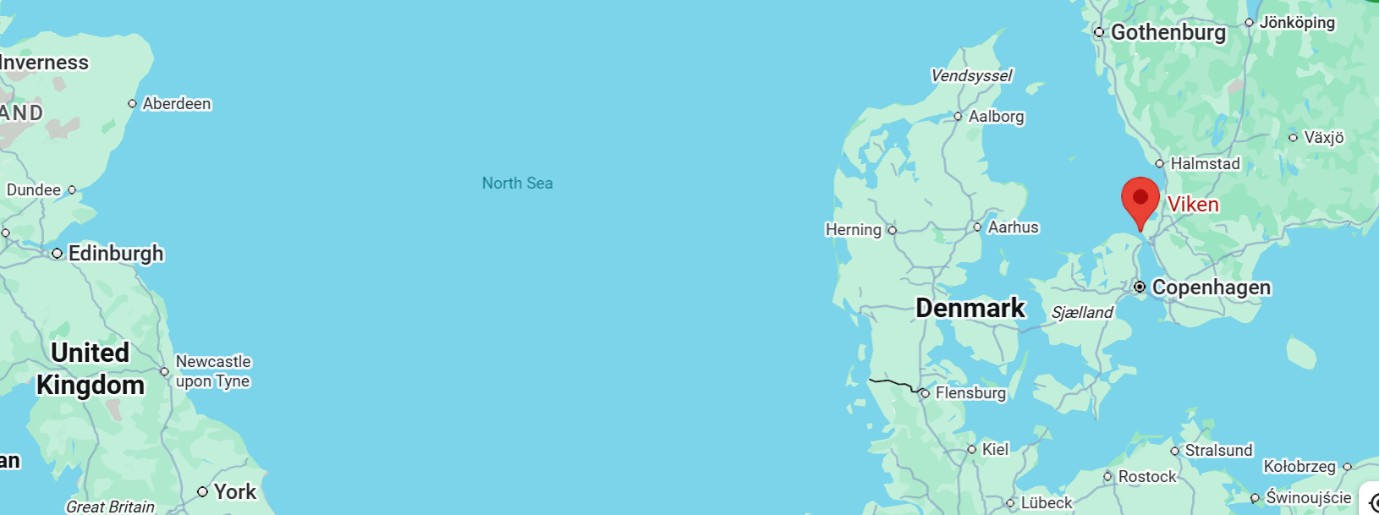
Jolani entered Swedish ownership in 1884: local tradition says that Captain P. A. Andreasson Lilja suddenly decided on a whim to purchase the vessel at auction in Hamburg for 75,000 kronor. Financing such a vessel, however, required far broader support, and ownership quickly developed into a community-backed venture involving 25 guarantors from the seafaring community of Viken on Sweden’s south-west coast.
The purchase reflected wider developments in Swedish maritime history. During the 1880s, locally organised shipping partnerships flourished during the height of the bondeseglation (“farmer-sailing”) era, when communities pooled capital, labour, and risk to participate in expanding global trade. Within this context, Jolani became one of the best-known vessels associated with Viken, serving as the town’s flagship between 1884 and 1897.
The vessel’s significance extended beyond ownership structures. Captain Andreasson Lilja commanded the ship until 1896 and appears to have developed a particularly close attachment to her, naming a son who was born shortly after the purchase “Jolani”. That son would later pursue a maritime career himself.
Trading Across Oceans
Under Swedish ownership, Jolani entered trading networks extending far beyond Scandinavia. Voyages regularly passed Germany, Holland, and England before continuing towards Mauritius, the Far East and India, South Africa, and South America, with occasional voyages reaching North America.
Although the vessel rarely returned to Sweden, her links with Viken remained visible. Whenever Jolani passed near the town, the large Hawaiian flag retained aboard was reportedly hoisted from the home of principal owner Tufve Pettersson. Measuring almost six metres in length, the flag became a memorable sight above the village’s low buildings—a reminder that this locally owned vessel spent much of her working life on distant oceans.

New Owners and the Final Voyage
After leaving Viken ownership in 1897 under Captain Nils Pettersson, Jolani continued under Swedish ownership while passing through several ports of registration. She transferred first to Malmö, later to Åhus in 1907, and finally to Stockholm in 1916.
Her final voyage began in Gothenburg during November 1916, still under Captain Lars Göransson. Bound for Newcastle-upon-Tyne with pit props and railway sleepers, the ageing vessel encountered severe weather in the North Sea. The storm destroyed her sails, smashed the lifeboats, and left the barque increasingly unmanageable before she stranded near Goswick Bay on the Northumberland coast on or around 19 November 1916 with 14 crew aboard. (Becoming unmanageable in severe weather was a not uncommon fate for vessels with railway sleepers as part of the cargo – if they broke loose, due to their size and weight, they were a significant liability.)
Rescue at Goswick Bay
The Holy Island lifeboat crew were alerted to the disaster and hauled their lifeboat, Edward and Eliza, some 4½ miles across the sands towards Goswick using six horses. Conditions remained extremely difficult, with rescuers wading waist-deep through the swollen channel known as the Gut before launching into the foaming surf. (For more on horse-powered RNLI launches, see this RNLI article.)
Repeated attempts to reach the wreck failed as darkness, heavy seas, and powerful surf drove the lifeboat back towards shore. Nevertheless, the rescuers persisted through the night. Eventually, ropes and lifebelts enabled contact with the wreck, and all fourteen crew members were brought safely ashore during the early hours of the morning. Contemporary descriptions vividly portray the disintegration of the vessel, with masts collapsing and gradually breaking up as rough seas crashed over the hull.
An account published in a Swedish newspaper in 1956 equally vividly described the conditions aboard (translated from Swedish):
The river rose, so that no one could get ashore. It was a difficult time for the 14 people on board. Huge rough seas constantly crashed over the ship. The fore and main masts snapped and went overboard. The planks were literally torn away from the hull, and the stern was torn off just before the cabin. The mizzen rig remained standing, however, and those on board clung to it, while the ship was gradually ground to coffee grounds in the cauldron of rough seas. It was not until nightfall that the coast guard, with the help of rocket launchers, was able to get out its lines and rescue everyone on board. (Kristiansbladet, Thursday 5 January 1956, p11)
Members of the lifeboat crew were later recognised by the Royal National Lifeboat Institution for their actions during the rescue and the Jolani is a good example of a wreck lost during wartime that was not lost to war causes.
Artefacts and Legacy
Today, much of Jolani’s history survives through the collections of Viken’s Maritime Museum. Preserved artefacts include four original logbooks, photographs, literature, a silver leaf artwork from Cape Town depicting the vessel, and an armchair from the captain’s cabin donated by descendants of the Lilja family, as well as paintings by Allan Fröjd, T. G. Purvis, and Christer Hägg.

Interest in Jolani continues today through ongoing research and public engagement. This blog is published to coincide with a presentation at the Viken Maritime Museum on 26 July 2026 by marine artist and former captain in the Royal Swedish Navy, Christer Hägg exploring the history of the vessel alongside two newly completed paintings inspired by Jolani and her long maritime career, and celebrates the international connections that make research into our wrecks possible.
With many thanks to Vikens Sjöfartsmuseum and Christer Hägg for their very kind help and an interesting collaboration and exchange of ideas: for our part, we were able to provide more details on the vessel’s fate and contextualise her type by reference to other vessels of the period wrecked in our waters. And, of course, once again many thanks to Tanja for writing this blog!
References
Illustrated Berwick Journal, “Details of Wrecked Vessels”, Thursday 23 November 1916, p. 5
Kristianstadsbladet, “Julseglats med kungaskeppet Jolani”, by Orvar Nilsson, Thursday 5 January 1956, p. 11
Lloyd’s List, Friday 24 November 1916, p. 7
Liverpool Journal of Commerce, https://www.wrecksite.eu/wreck.aspx?206803, accessed 2 June 2026
South Wales Daily News, Friday 24 November 1916, p.6 Top of Form
The Times, “Casualty reports”, 24 November 1916, p. 14
Vikens Sjöfartsmuseum, https://vikensbyaforening.se/fartygshistorik/, accessed 2 June 2026 [in Swedish]
Email correspondence with Vikens Sjöfartsmuseum and Christer Hägg, June 2026.