VE Day

Flying Fortress B17G 44-8640

To commemorate the 80th anniversary of the end of the Second World War in Europe on 8 May 1945 we are republishing this blog looking at the very last craft of any kind to be lost off the coast of England.

The last few months of the war saw a significant decline in shipping and aircraft losses over the sea attributable to war causes. The last six weeks of the war saw 10 shipping casualties to war causes in English waters. Over the same period there were 6 aircraft lost to non-war causes (mechanical failure or accident, for example).

The seventh and last aircraft, and last loss of the war in English waters, was the exception, and a war loss, despite its peaceable mission – just one day before the celebration of Victory in Europe. And it is to events in Europe we must turn first of all to understand the mission of the last aircraft of the war to find a grave with most of its crew in England’s territorial sea.

Background:

As the end of the war approached, there was real desperation in the occupied Netherlands after the arduous Hongerwinter [“Hunger Winter”) of 1944-5, of whom one of the best-known survivors was the actress Audrey Hepburn, whose mother was Dutch and who grew up in the Netherlands.

The Hongerwinter arose from a terrible combination of circumstances, any one of which on its own would have been bad enough Although the Allies pushed ahead after breaking out from Normandy, the objective of Arnhem in the Netherlands in September 1944 during Operation Market Garden proved a ‘bridge too far’. Attempted strikes by Dutch railway personnel led to retaliation by the occupiers, preventing food supplies from getting through, and when this blockade was lifted, there were overwhelming obstacles to overseas relief efforts. Although the Allies had managed to capture Antwerp in September 1944, it was several weeks before the port could be used and, even if it had been in use earlier, the the occupied western provinces of the Netherlands with the greatest population density,  and least agricultural land, including Amsterdam and Rotterdam, remained cut off. The canals and rivers froze early that winter and fuel for lorries was scarce. Limited relief supplies from neutral Sweden and Switzerland had helped a little but the situation remained dire. (1) 

Sepia pen and ink wash of seated woman in hat with a boy and a girl in the background.
‘They have taken all, and our food’, Netherlands. Eric William Taylor, 1944, purchased by the War Artists’ Advisory Committee. Taylor would go on to record the liberation of Bergen-Belsen in April 1945.  © IWM Art.IWM ART LD 4989

The relief effort: 

Even as the Allies closed in on Berlin and the end of the war in Europe, they were able to refocus from a purely offensive approach towards a relief effort and the rebuilding of a new Europe. The Lancasters of the RAF and the B-17 Flying Fortresses of the USAAF based in England, which had so recently been deployed on bombing missions were perfectly suited to dropping food parcels to the Netherlands, and thus Operations Manna (RAF) and Chowhound (USAAF) were born.

Historic B&W photo of six men loading the sacks, their uniforms streaked with escaped flour.
Operation Manna: Ground crew of No.514 Squadron at RAF Waterbeach, Cambridgeshire, loading cement bags filled with foodstuffs into the bomb bay of a Lancaster bomber, 29 April 1945, destined for those parts of Holland still under German occupation. © IWM CL 2490

It was a massive logistical effort which drew upon the resources of the Allied airfields of East Anglia at very short notice from mid-April 1945, with the situation becoming urgent against German resistance and the risk of further deliberate flooding both of agricultural fields and transport infrastructure a real possibility. There were no spare parachutes available, so safe conduct for low-level food drops was arranged, to begin in late April 1945.

Black & white photo of Dutch citizen waving at three aircraft flying low over a town.
Dutch citizens wave as food is dropped from Lancaster bombers over the Netherlands in April 1945. Fotocollectie Rijksvoorlichtingsdienst Eigen © Nationaal Archief, CC0 120-0739

The mission: 

Flying Fortress B17G 44-8640 of the 334th Bomber Squadron, 95th Bomb Group, set out from USAAF Horham in Suffolk on 7 May 1945, the day after the surrender of German forces in the Netherlands and the day before Victory in Europe day. Along with its precious cargo of food there were 13 on board, including observers from the station’s Photographic Section, all anticipating a routine mission.

Nose and two engines of silver aircraft inside a hangar with white roof.
A B17G Flying Fortress under restoration at the Mighty Eighth Air Force Museum, Georgia, USA. Jud McCranie, CC BY-SA 4.0

Following a successful drop 44-8640 turned for home. There were still pockets of resistance from the occupation forces, which is believed to have had a bearing on subsequent events. No. 2 engine was reported as ‘running rough’, with smoke and oil, thought to originate from rogue flak fired by the occupation forces at the aircraft in the IJmuiden area. (2) 

According to a crashed aircraft recovery specialist based at RAF Ford, Sussex, in 1944, crew would nurse their crippled aircraft, whether shot up, suffering mechanical failure, or simply running out of fuel, back from overseas missions to the English coastline, but would then often be forced to crash-land at or near the nearest available base, unable to make it back to their home bases. (3) 

As the situation worsened, the crew of 44-8640 realised that reaching the coast was going to be impossible and, fearing an explosion, they baled out over the sea off Suffolk, in the vicinity of Benacre Ness or Southwold, with one survivor recalling that the engine dropped away in a ‘ball of flame’ as he got away. The aircraft then fell into the sea.

Two men were picked up alive by a Catalina flying boat after some time in the water, and it is their testimony that enables us to know what happened to 44-8640, but the remainder of the crew were killed, including the observers.

Commemoration: 

Those of the crew whose bodies were recovered were interred at the American Cemetery and Memorial, Coton, Cambridge, but others were never found and are presumed entombed with the aircraft on the seabed.

Five aircraft seen in a blue sky with angel h
Detail of a mosaic on the ceiling of the chapel at the American Cemetery and Memorial, Coton, depicting aircraft being escorted by angels. James O Davies DP180621 © Historic England Archive

This, the final loss of any craft in English waters to war causes, was also one of the cruel tragedies of the war: to be shot at over the Netherlands and to keep the aircraft airborne so many miles only to lose the battle so close to the English coast, and all on a humanitarian mission. Somewhere off the coast lie its remains, which are yet to be discovered but which are automatically protected under the Protection of Military Remains Act 1986.

Victory in Europe was, perhaps, a collective sigh of relief, but it was not the end of the war, which would only come in August 1945 with VJ Day. It was a victory achieved at a huge human cost which has left legible traces in the historic environment – the destruction of historic fabric from London to Coventry and beyond, the legible traces in standing buildings from the suburban semi to national museums, the construction of military installations that have since become ‘historic’ in themselves, the legacy of commemoration – and the remains of ships and aircraft on the seabed, lost to war causes over the years from 1939 to 1945.

References: 

(1) For more detail on this subject, see Sutch, A. 2016 “Manna from Heaven”, RAF Museum blog, online

(2) Onderwater, H. 1985 Operation Manna/Chowhound: the Allied food droppings April?may 1945 Netherlands: Unieboek

(3) Oral history testimony, Ronald Cant (RAF Corporal, 1942-1946) as told to his daughter in reminiscing over D-Day, 2019.
VE Day

Flying Fortress B17G 44-8640

To commemorate the 80th anniversary of the end of the Second World War in Europe on 8 May 1945 we are republishing this blog looking at the very last craft (of any kind) to be lost off the coast of England.

The last few months of the war saw a significant decline in shipping and aircraft losses over the sea attributable to war causes. The last six weeks of the war saw 10 shipping casualties to war causes in English waters. Over the same period there were 6 aircraft lost to non-war causes (mechanical failure or accident, for example).

The seventh and last aircraft, and last loss of the war in English waters, was the exception, and a war loss, despite its peaceable mission – just one day before the celebration of Victory in Europe. And it is to events in Europe we must turn first of all to understand the mission of the last aircraft of the war to find a grave with most of its crew in England’s territorial sea.

Background:

As the end of the war approached, there was real desperation in the occupied Netherlands after the arduous Hongerwinter [“Hunger Winter”) of 1944-5, of whom one of the best-known survivors was the actress Audrey Hepburn, whose mother was Dutch and who grew up in the Netherlands.

The Hongerwinter arose from a terrible combination of circumstances, any one of which on its own would have been bad enough Although the Allies pushed ahead after breaking out from Normandy, the objective of Arnhem in the Netherlands in September 1944 during Operation Market Garden proved a ‘bridge too far’. Attempted strikes by Dutch railway personnel led to retaliation by the occupiers, preventing food supplies from getting through, and when this blockade was lifted, there were overwhelming obstacles to overseas relief efforts. Although the Allies had managed to capture Antwerp in September 1944, it was several weeks before the port could be used and, even if it had been in use earlier, the the occupied western provinces of the Netherlands with the greatest population density,  and least agricultural land, including Amsterdam and Rotterdam, remained cut off. The canals and rivers froze early that winter and fuel for lorries was scarce. Limited relief supplies from neutral Sweden and Switzerland had helped a little but the situation remained dire. (1) 

Sepia pen and ink wash of seated woman in hat with a boy and a girl in the background.
‘They have taken all, and our food’, Netherlands. Eric William Taylor, 1944, purchased by the War Artists’ Advisory Committee. Taylor would go on to record the liberation of Bergen-Belsen in April 1945.  © IWM Art.IWM ART LD 4989

The relief effort: 

Even as the Allies closed in on Berlin and the end of the war in Europe, they were able to refocus from a purely offensive approach towards a relief effort and the rebuilding of a new Europe. The Lancasters of the RAF and the B-17 Flying Fortresses of the USAAF based in England, which had so recently been deployed on bombing missions were perfectly suited to dropping food parcels to the Netherlands, and thus Operations Manna (RAF) and Chowhound (USAAF) were born.

Historic B&W photo of six men loading the sacks, their uniforms streaked with escaped flour.
Operation Manna: Ground crew of No.514 Squadron at RAF Waterbeach, Cambridgeshire, loading cement bags filled with foodstuffs into the bomb bay of a Lancaster bomber, 29 April 1945, destined for those parts of Holland still under German occupation. © IWM CL 2490

It was a massive logistical effort which drew upon the resources of the Allied airfields of East Anglia at very short notice from mid-April 1945, with the situation becoming urgent against German resistance and the risk of further deliberate flooding both of agricultural fields and transport infrastructure a real possibility. There were no spare parachutes available, so safe conduct for low-level food drops was arranged, to begin in late April 1945.

Black & white photo of Dutch citizen waving at three aircraft flying low over a town.
Dutch citizens wave as food is dropped from Lancaster bombers over the Netherlands in April 1945. Fotocollectie Rijksvoorlichtingsdienst Eigen © Nationaal Archief, CC0 120-0739

The mission: 

Flying Fortress B17G 44-8640 of the 334th Bomber Squadron, 95th Bomb Group, set out from USAAF Horham in Suffolk on 7 May 1945, the day after the surrender of German forces in the Netherlands and the day before Victory in Europe day. Along with its precious cargo of food there were 13 on board, including observers from the station’s Photographic Section, all anticipating a routine mission.

Nose and two engines of silver aircraft inside a hangar with white roof.
A B17G Flying Fortress under restoration at the Mighty Eighth Air Force Museum, Georgia, USA. Jud McCranie, CC BY-SA 4.0

Following a successful drop 44-8640 turned for home. There were still pockets of resistance from the occupation forces, which is believed to have had a bearing on subsequent events. No. 2 engine was reported as ‘running rough’, with smoke and oil, thought to originate from rogue flak fired by the occupation forces at the aircraft in the IJmuiden area. (2) 

According to a crashed aircraft recovery specialist based at RAF Ford, Sussex, in 1944, crew would nurse their crippled aircraft, whether shot up, suffering mechanical failure, or simply running out of fuel, back from overseas missions to the English coastline, but would then often be forced to crash-land at or near the nearest available base, unable to make it back to their home bases. (3) 

As the situation worsened, the crew of 44-8640 realised that reaching the coast was going to be impossible and, fearing an explosion, they baled out over the sea off Suffolk, in the vicinity of Benacre Ness or Southwold, with one survivor recalling that the engine dropped away in a ‘ball of flame’ as he got away. The aircraft then fell into the sea.

Two men were picked up alive by a Catalina flying boat after some time in the water, and it is their testimony that enables us to know what happened to 44-8640, but the remainder of the crew were killed, including the observers.

Commemoration: 

Those of the crew whose bodies were recovered were interred at the American Cemetery and Memorial, Coton, Cambridge, but others were never found and are presumed entombed with the aircraft on the seabed.

Five aircraft seen in a blue sky with angel h
Detail of a mosaic on the ceiling of the chapel at the American Cemetery and Memorial, Coton, depicting aircraft being escorted by angels. James O Davies DP180621 © Historic England Archive

This, the final loss of any craft in English waters to war causes, was also one of the cruel tragedies of the war: to be shot at over the Netherlands and to keep the aircraft airborne so many miles only to lose the battle so close to the English coast, and all on a humanitarian mission. Somewhere off the coast lie its remains, which are yet to be discovered but which are automatically protected under the Protection of Military Remains Act 1986.

Victory in Europe was, perhaps, a collective sigh of relief, but it was not the end of the war, which would only come in August 1945 with VJ Day. It was a victory achieved at a huge human cost which has left legible traces in the historic environment – the destruction of historic fabric from London to Coventry and beyond, the legible traces in standing buildings from the suburban semi to national museums, the construction of military installations that have since become ‘historic’ in themselves, the legacy of commemoration – and the remains of ships and aircraft on the seabed, lost to war causes over the years from 1939 to 1945.

References: 

(1) For more detail on this subject, see Sutch, A. 2016 “Manna from Heaven”, RAF Museum blog, online

(2) Onderwater, H. 1985 Operation Manna/Chowhound: the Allied food droppings April?may 1945 Netherlands: Unieboek

(3) Oral history testimony, Ronald Cant (RAF Corporal, 1942-1946) as told to his daughter in reminiscing over D-Day, 2019.

No.79 James Eagan Layne

In this week’s post, we commemorate the loss of the US Liberty Ship James Eagan Layne 70 years ago on 21 March 1945, torpedoed while bound from New Orleans, last from Barry in Wales, for Ghent with what was then termed ‘Government stores’. Translated, that meant military vehicles and other war materials destined for the liberation of Europe as the war was drawing to a close. Historic recoveries from this vessel have included numerous shell cases. (1)

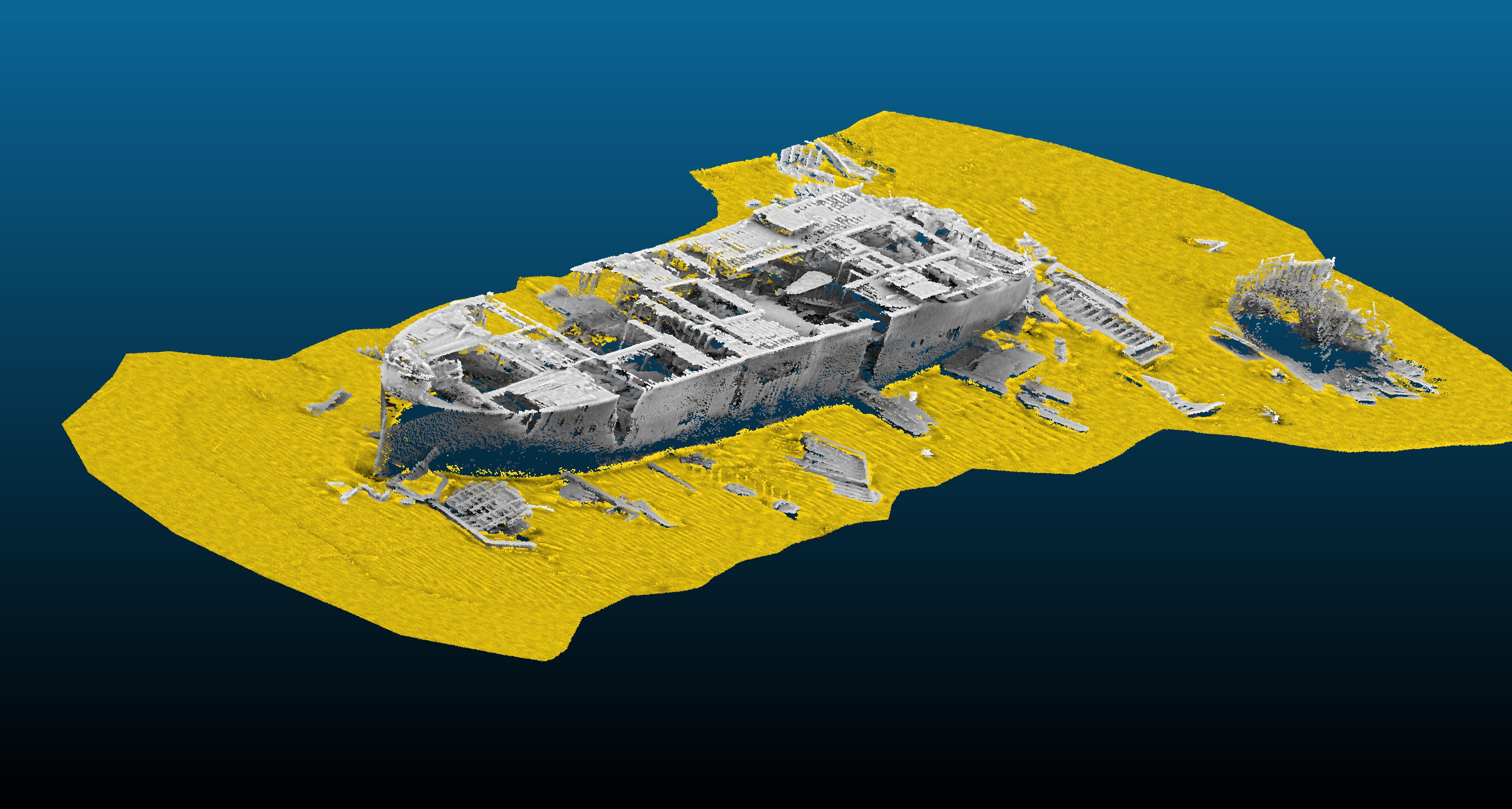
The forward section of the James Eagan Layne wreck, using modern bathymetric imagery allowing a view into the ship
Forward section of the James Eagan Layne, by courtesy of MSDS Marine and Swathe Services. There is much scattered debris, evidence of extensive post-war salvage.

The James Eagan Layne was one of several Liberty ships and other vessels bound for Belgium in the spring of 1945, following the successful conclusion of the Battle of the Bulge in January 1945. The Allies had repulsed the German advance, or ‘bulge’ in their lines, with heavy loss of life, particularly among the US troops who bore the brunt of the fighting. Allied access to the Belgian ports was now secured, barring minefields and U-boats, resuming the communication links severed by the fall of Belgium in 1940.

The pattern of wrecks on the seabed mirrors the fate of those communication links. Ten ships, bound either to or from Belgian ports, were sunk in English waters following the declaration of war in September 1939. It was a similar figure in early 1940 prior to the fall of Belgium in May, with 11 ships sunk by mine or torpedo on the same route.

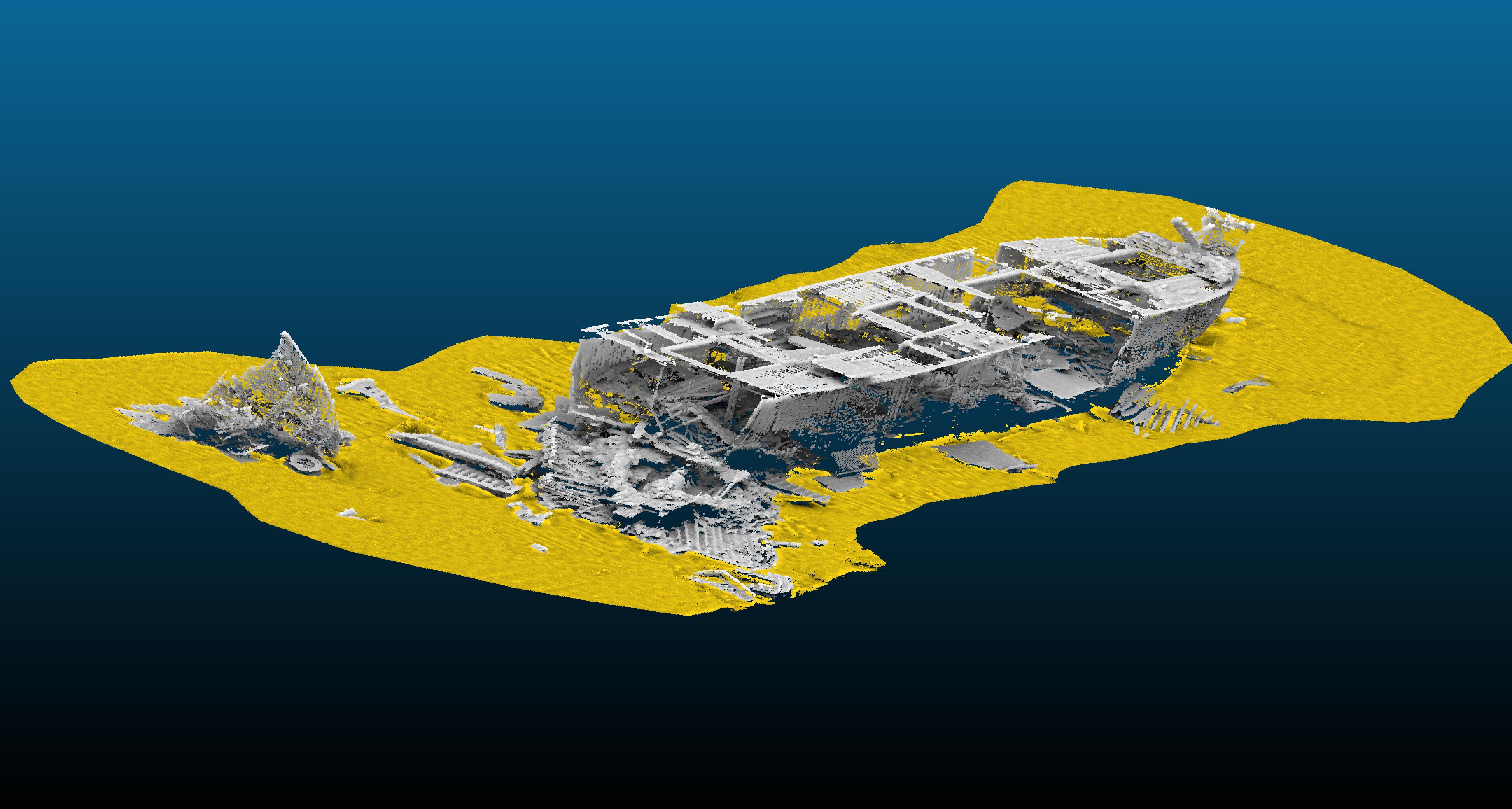
The aft section of the James Eagan Layne wreck, using modern bathymetric imagery allowing a view into the ship, and showing scattered debris
Aft section of the James Eagan Layne, by courtesy of MSDS Marine and Swathe Services. This image allows an insight into the box-like construction characteristic of the Liberty Ship.

Transport links with occupied Belgium were then severed and are reflected in the lack of corresponding wrecks from late 1940 to early 1945: then, as Allied ships were once more able to reach Antwerp and other ports, there was also a recurrence of wreck events. Between January and May 1945, 10 ships are known to have been sunk in English waters en route to or from Belgium: they included other Liberty Ships, the Henry B Plant and the James Harrod. The John R Park was also torpedoed the same day as the James Eagan Layne, albeit on a different route, bound from England for the United States.

For more on the James Eagan Layne, please have a look at the dedicated SHIPS (Shipwrecks and History in Plymouth Sound) and Promare Liberty 70 site.

(1) Receiver of Wreck droits.

With many thanks to MSDS Marine and Swathe Services for permission to reproduce these beautiful images.