No.87 Layers of History

Inspired by my recent holiday in Croatia, I thought I’d turn this week to looking at wrecks in English waters from that part of the world. I’ve touched before on how changing national boundaries and ideas of nationhood affect the way we classify wrecks – the nationality recorded at the time of loss is often very different from the nationality now, and this is as true for Croatia as for the subjects of my previous articles on EstoniaFinland and Hungary.

'Sailing ship in a storm', Ivankovic, 1887, ex voto painting in the cloisters at Kuna Peljeska, Croatia. Note the small saint on a cloud towards top left, rendering divine assistance, typical of such scenes, while the ship wallows in the sea, having lost most of her sails. The  associated church contains many silver ex voto plaques, many with shipwreck scenes.
Sailing ship in a storm, Ivankovic, 1887, ex voto painting in the cloisters at Kuna Peljeska, Croatia. Note at top left the small saint on a cloud rendering divine assistance, typical of such scenes, while the ship wallows in a heavy sea, having lost most of her sails. The associated church also contains many silver ex voto plaques, several depicting shipwreck scenes. Image courtesy of Andrew Wyngard.

Croatia has a long and proud seafaring tradition with many rocky islands rising steeply out of the sea, affording little shelter to anyone unfortunate enough to be shipwrecked there. Indeed, Richard the Lionheart caused an ex voto church to be built at Lokrum in 1192. The islands are well marked with picturesque lighthouses and it is worth exploring this fantastic gallery here. Though there may be a number of earlier vessels in our records whose Croatian origins are masked by the lack of detail in contemporary sources, they first come to our attention in English waters during the 19th century, when Croatia was part of the Austro-Hungarian empire.

One such vessel was Barone Vranyczany, lost in 1881 off Suffolk, named after a local noble family who had Magyarised their surname from the Croatian Vranjican. Her home port had the Italian name of  Fiume (now Rijeka): the name of her master, Pietro Cumicich, reflects a dual Italian-Croat linguistic heritage. With the help of the Austrian consul at Lowestoft, acting as interpreter, a fellow master from Fiume identified Cumicich’s body through his wedding ring inscribed with his wife’s initials and the date 10-12-77.

Croatia’s Italian heritage is very strong, reflecting its Venetian past and its proximity to the Italian coast. (The island of Korcula is traditionally said to have been the birthplace of Marco Polo, although this is disputed.) The Croatian littoral passed out of Venetian control to become the Republic of Ragusa, centred on Ragusa itself, now Dubrovnik: the two names, Latin and Croat, existed side by side until 1918 when Dubrovnik alone was officially adopted.

This link is clearly seen in the ship Deveti Dubrovački of Ragusa. She was one of a fleet belonging to the Dubrovnik Maritime Company, whose ships had a very simple house naming scheme. She was ‘The Ninth of Dubrovnik’: all the fleet were likewise named in order from ‘The First of Dubrovnik’ onwards. (1) She met her end in 1887 through a collision with a British steamer off Beachy Head, another wreck that illustrated the bond between husband and wife. The captain tied a rope around his wife, from which she was hauled in her nightdress aboard the steamer, despite her ‘imploring him not to mind her’: alas, she had the misfortune to see her husband go down with his ship. (The fact that the steamer did not also sink in this collision was attributed to the cushioning effect of the wool tightly packed in her hold.) (2)

Several ships have Italian names, such as the Fratelli Fabris, whose remains (1892) are said to lie close to Tater-Du on the coast of Cornwall, and which is known locally as the ‘Gin Bottle Wreck’. Indeed, a 1927 wreck was recorded in contemporary sources as of Italian nationality: the Isabo was built as Iris in Lussinpiccolo (now Mali Losinj, Croatia), then Austro-Hungary, a part of Croatia which became Italian in 1918.

At the same time the Kingdom of Yugoslavia was created, to which the Slava, a war loss of 1940 off Porlock Bay, belonged. Only nine ships out of the country’s fleet survived the war. (3) After the Second World War Yugoslavia became a Socialist Federal Republic, of which Croatia was a constituent part. Our final wreck today is the Sabac, which belonged to that country’s nationalised fleet, and which was lost in 1961 in a collision off the South Goodwin light vessel.

Since 1991 Croatia has been an independent state, but one whose long maritime history endures, intertwined with that of many other nations, past and present. Its heritage is part of our own heritage too, from Lokrum to the wrecks around our coastline today.

(1) Anica Kisić, “Dubrovačko Pomorsko Društvo”, Atlant Bulletin, No.13, July 2004, pp22-4. URL: https://www.yumpu.com/hr/document/view/36424950/srpanj-2004-atlantska-plovidba-dd/23

(2) Edinburgh Evening News, 30 December 1887, No.4,530, p2

(3) http://www.atlant.hr/eng/atlantska_plovidba_povijest.php
No.79 James Eagan Layne

In this week’s post, we commemorate the loss of the US Liberty Ship James Eagan Layne 70 years ago on 21 March 1945, torpedoed while bound from New Orleans, last from Barry in Wales, for Ghent with what was then termed ‘Government stores’. Translated, that meant military vehicles and other war materials destined for the liberation of Europe as the war was drawing to a close. Historic recoveries from this vessel have included numerous shell cases. (1)

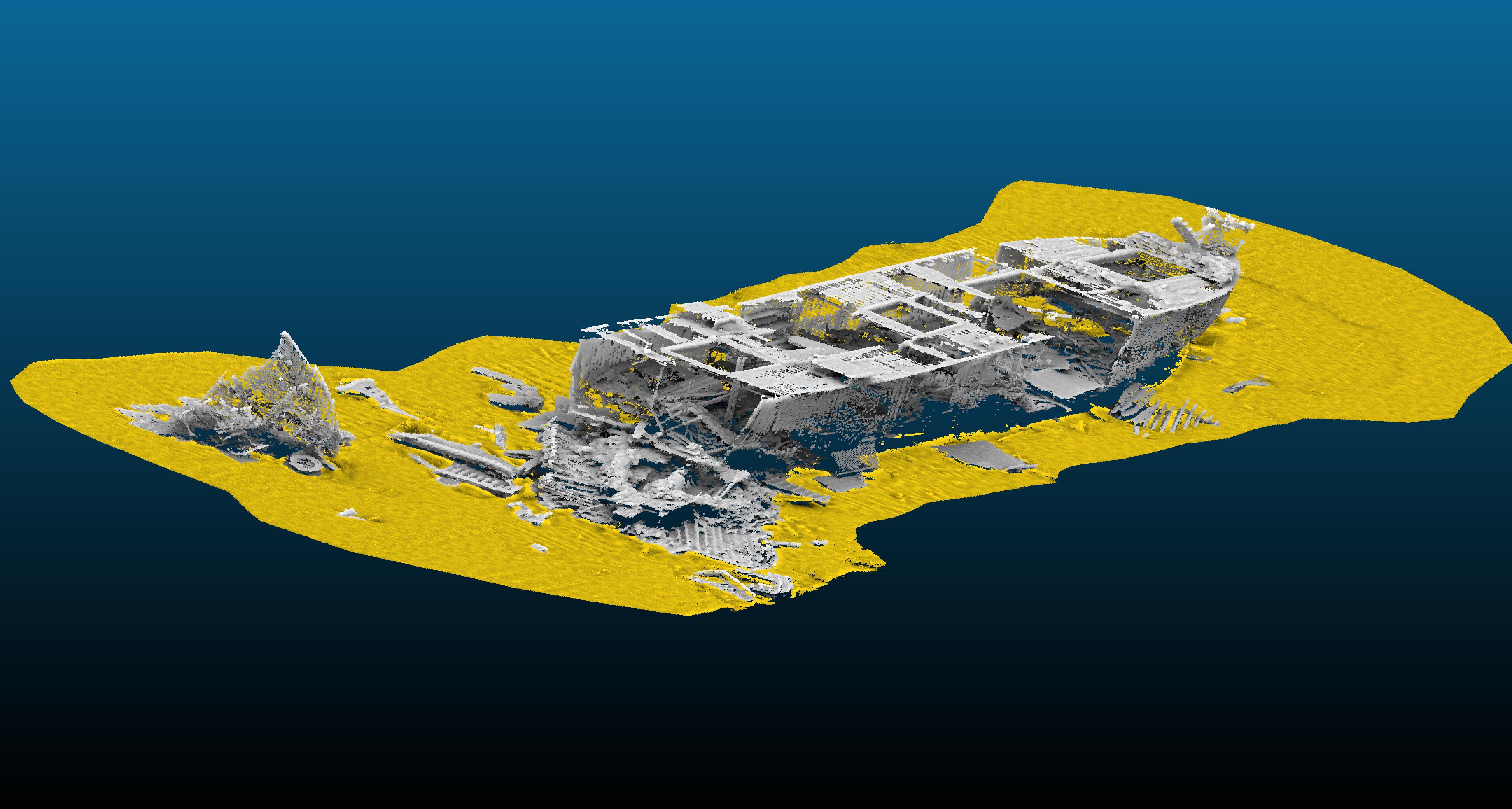
The forward section of the James Eagan Layne wreck, using modern bathymetric imagery allowing a view into the ship
Forward section of the James Eagan Layne, by courtesy of MSDS Marine and Swathe Services. There is much scattered debris, evidence of extensive post-war salvage.

The James Eagan Layne was one of several Liberty ships and other vessels bound for Belgium in the spring of 1945, following the successful conclusion of the Battle of the Bulge in January 1945. The Allies had repulsed the German advance, or ‘bulge’ in their lines, with heavy loss of life, particularly among the US troops who bore the brunt of the fighting. Allied access to the Belgian ports was now secured, barring minefields and U-boats, resuming the communication links severed by the fall of Belgium in 1940.

The pattern of wrecks on the seabed mirrors the fate of those communication links. Ten ships, bound either to or from Belgian ports, were sunk in English waters following the declaration of war in September 1939. It was a similar figure in early 1940 prior to the fall of Belgium in May, with 11 ships sunk by mine or torpedo on the same route.

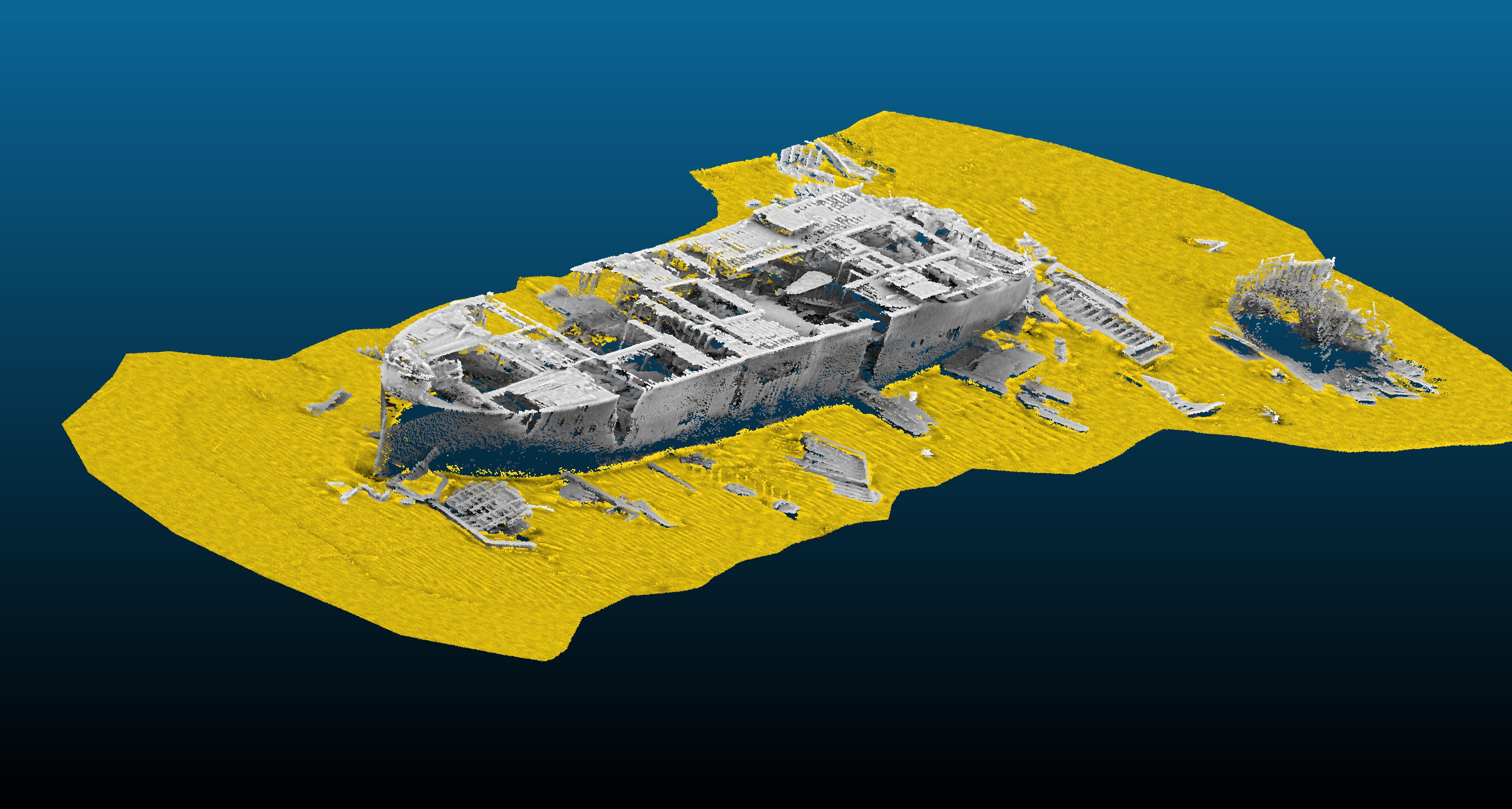
The aft section of the James Eagan Layne wreck, using modern bathymetric imagery allowing a view into the ship, and showing scattered debris
Aft section of the James Eagan Layne, by courtesy of MSDS Marine and Swathe Services. This image allows an insight into the box-like construction characteristic of the Liberty Ship.

Transport links with occupied Belgium were then severed and are reflected in the lack of corresponding wrecks from late 1940 to early 1945: then, as Allied ships were once more able to reach Antwerp and other ports, there was also a recurrence of wreck events. Between January and May 1945, 10 ships are known to have been sunk in English waters en route to or from Belgium: they included other Liberty Ships, the Henry B Plant and the James Harrod. The John R Park was also torpedoed the same day as the James Eagan Layne, albeit on a different route, bound from England for the United States.

For more on the James Eagan Layne, please have a look at the dedicated SHIPS (Shipwrecks and History in Plymouth Sound) and Promare Liberty 70 site.

(1) Receiver of Wreck droits.

With many thanks to MSDS Marine and Swathe Services for permission to reproduce these beautiful images.

No.67 A Concatenation of Events

Last week I wrote about multiple wreck events in which two ships happened to come ashore at the same place at different times, so to continue this ‘multiple wrecking’ mini-series within the blog, I’d like to focus on crews who have been doubly shipwrecked in a short space of time.

In May 1940 Hervé Cras, a ship’s doctor aboard the French destroyer Jaguar, survived the S-boat attack which sank her at Dunkirk. He finally made it out of Dunkirk aboard the Emile Deschamps and later recalled how the Jaguar‘s survivors stood up to salute their ship as they steamed out of Dunkirk, but were barked at to sit down again, because the vessel was dangerously overloaded. The Emile Deschamps picked her way carefully to Kent, but was mined close to safety off the North Foreland, the very last vessel of the Dunkirk evacuation to be lost in English waters. Once more Cras survived to tell the tale – literally: he became a leading naval historian, including a book on Dunkirk itself. (1)

On 3 January 1891 the Caroline Robert de Massy foundered off Dungeness while bound from the Black Sea port of Batumi for Antwerp with oil, following a collision with the Raithwaite Hall. The crew were saved, as were the seven crew of the vessel Ferdinand van der Taelen of Antwerp, returning home on the de Massy instead of their own ship, sunk in the Mediterranean on 23 November 1891, homeward-bound from Nikolaiev with grain. (2) All on board were taken up by the Raithwaite Hall and landed at Dover, the Ferdinand‘s crew presumably awaiting the next passing ship for Antwerp. It must have taken them at least three ships to get home, possibly four, if they were picked up by another ship in the original incident before being transferred to the de Massy, as the next available vessel bound for Antwerp.

Similarly, one of the survivors of the Earl of Dalkeith packet off Boulmer in November 1807 turned out to have also been rescued from the wrecking of the Leith packet off the Humber just a few months earlier.

On a related note seamen usually (not always . . . !) exerted themselves to save the crews of other vessels in distress, since they were painfully aware that another time they would themselves be in need of help. So it proved for the crew of the Anne Henrietta: on Christmas Eve 1768 they saved the crew of the William and John: their courage was rewarded within a few weeks, when they were themselves picked up by a passing fishing smack after their ship went down off Norfolk.

This post prepares the ground for October’s edition of the War Diary, looking at a notable wreck of late October 1914.

******************************************************************

(1) under the pen name of Jacques Mordal, Dunkerque, 1968, Paris: Editions France Empire

(2) erroneously reported in the original source as Friedrich van der Taelen


No.54 The Dudgeon

In their Quincentenary week we take another look at the work of Trinity House, this time examining lightvessels as warning lights, wreck markers, and wrecks in themselves.

This week in 1736 the Dudgeon lightvessel first went on station, the second lightship after the Nore in the Thames Estuary in 1732. Demand from the east coast coal trade between Newcastle-upon-Tyne and London led to the marking of the Dudgeon, a dangerous shoal off the Norfolk coast.

Such early lightvessels proved their worth both as hazard markers and as reference points for locating wrecks. In 1785 the Mayflower of Scarborough ‘foundered nigh the Dodgen light’ and in 1824 the captain of a passing ship reported that he: ‘in passing the Dudgeon Float . . . bearing about NNW 8 miles, saw a sunken brig, with her royal masts shewing, painted white, and two vanes flying.’ He ‘supposed her to be from the northward, but not a collier.’

Lightvessels in their turn could become wrecks. Moored at their stations, they were prone to becoming casualties of the very same hazards against which they warned other shipping. There were other patterns of loss: the Dudgeon station was among the most unfortunate, with three incidents within 50 years. None were to the shoal itself, despite early concerns about the Dudgeon lightvessel parting her cables three times in two years (1), but to two other major causes of lightvessel loss.

As moored vessels, lightships were equally unable to take steps to avert collision, so the Dudgeon was ‘run down’ in 1898 and again in 1902: 38% of lightvessel wrecks recorded in English waters were lost to collision. Their inability to take evasive action also meant that, when war came, aerial bombardment was also a significant cause of loss, accounting in just two years for 26% of our recorded lightvessel wrecks. The East Dudgeon lightvessel was sunk by air attack in 1940, along with six others in 1940-1. The crew escaped, but were overwhelmed by the elements, with only one survivor.

Strangely enough, given how early lightvessels were wooden ships exhibiting lanterns, we have no recorded lightships wrecked by fire, or are there others of which we are not yet aware?

(1) Light upon the Waters: A History of Trinity House 1514-2014 p87-8

No.48: The Cieszyn

Dziękuję ci Kapitanie!

Following a trip to Poland last week, I thought I’d talk about Polish shipwrecks in English waters.

We have at least 69 wrecks of Polish origin, but a number may have been masked by historic former nationalities such as “Prussian”. Without a home port being named, it is difficult to identify just to which modern state incorporated within the former extent of Prussia a vessel belongs. Our earliest reference is in 1389 to the Cristofre of Danzig, while a reference to “Dansk in Prucia” from 1391 is clear enough, at the period when Gdansk was one of the major cities of the Hanseatic League, a trade association which dominated the Baltic and North Sea and became a power in its own right. Richard II and his queen, Anne of Bohemia, surrendered their rights in the wreck and restored the wrecked goods to the merchants involved.

Inevitably language isn’t always much of a clue, since most Prussian names were recorded in German rather than Polish, although occasionally other languages crop up. There is even a Lord Wellington belonging to Gdansk, wrecked off Lincolnshire in 1824, when memories of the Anglo-Prussian alliance against Napoleon were still fresh. The ports of Gdansk and Szszecin continued to be referred to as Prussian Danzig and Stettin until well into the 20th century.

During World War II a number of Polish ships were lost in English waters including today’s featured wreck, the Cieszyn, which was bombed and sunk by two Dorniers off Lowland Point, near Falmouth, 73 years ago yesterday on 20th March 1941.

It was said that the boat carrying the escaping crew also came under attack, as did the lifeboatmen who put out from Coverack to rescue them in the Three Sisters lifeboat. When the Coverack cox’n, Archie Rowe, was featured on This Is Your Life in the days before it became dominated by celebrities, the team tracked down Captain Mikosza of the Cieszyn to express his gratitude.

Her bell was recovered in 1997, leading to the identification of the wreck, which had previously been thought to be a different wreck site, now believed to be the 1942 wreck of the British armed trawler Lord Snowden, lost in collision in the same general area. In turn the last resting place of the Lord Snowden has been reattributed from elsewhere, when the 1940 wreck of another WWII armed trawler, the Comet, was positively identified by her bell, having previously been believed to be Lord Snowden.

The Cieszyn also lives on in literature. As the fictional Bielsk, the Polish novelist Arkady Fiedler, who spent the war years in London, paid tribute to the Cieszyn and other wartime Polish ships in his book Dziękuję ci Kapitanie (Thank you, Captain!) For a picture of her, please see: http://pl.wikipedia.org/wiki/Plik:SS_Cieszyn_POL.jpg

The Polish wrecks in English waters are thus tangible reminders of the shifting alliances in Europe in times of war and peace.

See also a recent post on the Raphael of Gdansk here.

26. Totes Meer

There can only be one wreck of the week this week, as everyone is talking about the Do17 Flying Pencil recovered from the Goodwin Sands on Monday. Rather than commenting directly on the wreck, I would just like to set it into some sort of historical and cultural context.

We know from our records that the Do17 was one of 12 aeroplanes which were shot down or crashed on the shore on the same day, as the Battle of Britain raged: three in the Humber area, the remainder over Kent and Sussex.

As far as I am aware all the aircraft lost on that day came down into the sea: none crashed on land. Three German aircraft, a He111, a Me109 and our Do17, were lost as against 9 British: two Defiants from the same squadron which attacked the Do17, two Hurricanes, two Spitfires and three Hampdens.

Overall Historic England’s records show that some 433 German aircraft were lost during WWII, of which approximately 364 are known to have been shot down in or near the sea. Undoubtedly there is some under-reporting of both terrestrial and maritime losses of aircraft, an issue not confined to the German side. It is therefore impossible to say definitively from the data available that more German aircraft were shot down over the sea than they were over English territory, but this looks largely to be the case.

It seems apt then, to look at Paul Nash’s painting, Totes Meer. It was actually inspired by a dump at Cowley in Oxfordshire of crashed German aircraft seen in a terrestrial context, but reworked by Nash into a ‘dead sea’ of twisted wreckage, waves upon waves of German aircraft crashing upon an English shore.

It is virtually contemporary with our Do17, being painted in 1940-1 as part of Nash’s work as an official war artist. Hindsight colours our view of the painting, since we know the outcome: it is easy to forget that, at the time it was made, the war hung in the balance. Did contemporary viewers see each crashed German aircraft as one less to rain bombs on Britain, or do they represent a force as unending and as unyielding as the sea? Or are both views tangled up in the wreckage?

A very visible wheel, not unlike the still inflated wheel seen on the Do17, lends the mangled heap the appearance of the eye of a beached whale or school of whales, reinforced by exposed wing struts suggesting baleen plates. A beached whale is an animal out of context: so, too, are these aeroplanes, lying in the sea instead of flying through the air.

19. Pêcheur d’Islande (An Icelandic Fisherman)

To commemorate the centenary of the wreck of the Tadorne and the loss of the Bastiaise in 1940, both in north-eastern waters, the French frigate Primauguet recently called at Newcastle.

The Tadorne (which means “shelduck”) was a French trawler en route to the Icelandic fishing grounds which became embroiled in a storm off the Northumberland coast on March 29th, 1913 and eventually struck Howick Rocks to become a total loss. The local lifeboat succeeded in rescuing 25 out of the 30 crew.

The scene was one of steaming mugs of tea doled out amid scenes of mutual incomprehension between French fishermen and Northumbrian farmers. Eventually a French servant at nearby Howick Hall was sent for to act as an interpreter, through whom the master was able to convey his profuse thanks.

The five drowned men are commemorated at St. Michael’s, Longhoughton, a corner of an English field that is forever France:

According to the memorial, the Tadorne was lost below the Boat House at Howick, which can be identified on historic Ordnance Survey mapping, but is no longer extant. One of the names on the memorial is Pierre Archenoux of Cancale: though he is long dead, his story lives on through his trunk. It was washed up, and sent back with a personal note of condolence to his widow by Lady Grey at Howick Hall, thereafter passing down his family. It inspired a French children’s novel with beautiful silhouette illustrations telling the story of the wreck and pictures of life aboard a typical French trawler of that period.

There are bits and pieces of wreckage attributed to the Tadorne around Howick Haven, absolutely in the correct position below the Boat House, where a gap in the rocks forms something of a natural beaching area; presumably the reason for the siting of the Boat House itself, whence boats could be easily launched. I have just recorded this wreckage in a separate site record linked to the casualty record: though in all likelihood, this machinery and framing do indeed belong to the Tadorne, there’s a century’s worth of time elapsed between the event and the wreckage, so if anyone knows this wreck and can fill in the gaps, confirm the identification, and enable us to merge the two records, please let me know.

As an aside, Breton trawlers like the Tadorne, of Nantes, dominated the Icelandic cod fishery in the late 19th/early 20th centuries. A contemporary edition of the Encyclopaedia Britannica (1911, vol.XXIV, p293) refers to the existence of a French-Icelandic pidgin; the even more specialised Breton-Icelandic pidgin has also been recorded, a minority language if ever there was one. The story of French trawling off Iceland is also told in the novel Pêcheur d’Islande by Pierre Loti, 1891 (one of my set books in those far-off days when you were expected to be able to write critical essays in French at A-level . . . )

12. The Swiss Navy

Happy New Year to you all.

In an example of the “history begins yesterday” approach the recording of post-1945 wrecks began in 2010, when something like 500 modern wrecks were input onto the National Record of the Historic Environment (now under the aegis of Historic England, but at the time when this post was originally written, part of English Heritage).

That old joke about the Swiss Navy isn’t quite as far fetched as you might think: in the 20th century there was, and indeed into the 21st there remains, a Swiss mercantile marine not confined to the shores of Lake Geneva!

Today’s wreck is the Nyon, a Swiss ship which foundered off Beachy Head with a cargo of Mercedes cars following a collision with the Jalazad in 1962. Not only was she Swiss-registered, she is unusual for another reason.

In fact, she is a double wreck, in fact, because part of her had been left behind when she was hauled off the Byrips off St. Abb’s Head, Scotland, in 1958, and so is in the records of the Canmore database (Royal Commission on the Historical Monuments of Scotland) as a wreck. She was repaired and re-entered service until her final loss in the 1962 incident. This form of double wrecking in different locations at different times, though rare, does occasionally happen and we signpost as appropriate to other records, as in this instance.

This interesting picture story recounts this initial incident.

Similarly landlocked at first sight are the ships which used to belong to Austria-Hungary, but the Austro-Hungarian Empire was formerly much greater than the borders of the eponymous constituent countries today, and had an outlet to the sea at Trieste in modern Italy and at ports on the Croatian coast.

We know of at least 60 ships which either belonged to Austria-Hungary at the time of loss or had borne an Austro-Hungarian nationality at an earlier period. One of the latter was the Elmcrest, torpedoed in 1940, having formerly borne the Hungarian name of Auguszta Főhercegnő (Archduchess Augusta). In other words, within our records is a body of evidence for ships registered in countries that have never had (Switzerland), or formerly had (Austro-Hungary), an outlet to the sea.