Diary of the Second World War – August 1945

Graphic commemorating the 80th anniversary of VJ Day, featuring a bold 'V' with '80' above and 'VJ DAY' below.

The Terukuni Maru

In our final Diary of the Second World War, 80 years after VJ Day on 15 August 1945, we take a brief look at what it took in terms of shipping losses to enemy causes in the immediate post-war world before we circle back to the early months of the war and a rare loss of a Japanese vessel in English waters, and an even rarer one under the circumstances of war.

Sweeping the Peace

The immediate post-war world was dedicated to achieving the peace and in this the world’s navies and merchant fleets played as large a part as they had done during the days of war – but in shipping lanes that were considerably safer than they had been for the past six years: no approaching aircraft with a payload of bombs, no warships on the prowl on the surface of the sea, no submarines waiting to loose a torpedo and hole a vessel below the waterline.

Even as the new world order started to take shape and ships brought home troops, POWs and refugees, home, carried occupation forces, and took dispossessed persons and GI brides to new lives on other continents, there remained one more issue that was harder to deal with than simply ceasing fire.

After both World Wars there were occasional losses to stray mines following the cessation of hostilities (see our post on losses after the First World War, which were recorded right up to 1925). Between VE Day on 8 May 1945 to VJ Day 15 August 1945, there was only one war-related loss in English waters: HMS Kurd, mined off the Lizard with the loss of 16 crew while on those self-same necessary clearance activities in July 1945.

As late as 1950 the Ramsgate trawler Volante exploded after striking a mine in the Thames Estuary, although fortunately, in that case, all hands escaped.

These were the very last direct maritime victims of the Second World War within English territorial waters. Mines continued to wash up on beaches on a regular basis until the 1950s and 1960s and less frequently since then, although they still occur and require dealing with.

A Japanese liner in 1939

From the immediate post-war period, we now circle back to think about VJ Day and events earlier in the Second World War. Of course, the events in question – the atomic bombs unleashed on Hiroshima and Nagasaki, and the surrender of Japan – took place on the other side of the world and so we cannot commemorate the end of the war directly with events in our waters in the year of 1945.

The war, however, came to Japan’s door in the waters of the Thames Estuary in November 1939 with the loss of the Terukuni Maru – described in the contemporary press as a ‘crack liner’ – i.e. a first-class liner (a slightly old-fashioned usage now, but which survives in expressions such as ‘crack shot’). Her prestige was demonstrated in several ways, such as the fact that she was a motor-driven vessel, rather than a steamer.

1930s  lithograph postcard of the Terukuni Maru in port bow view at sea, with the legend of her owners NYK Line to top right, underneath her name and tonnage in both English and Japanese
1930s postcard of the motor vessel Terukuni Maru (Public domain: Wikimedia Commons)

Terukuni Maru and Nagasaki

The Terukuni Maru was completed in 1930 for the Nippon Yusen Kaisha (NYK) Line as a link between Japan and Europe. She was built by Mitsubishi at Nagasaki, reflecting the increasing pre-war Japanese industrial confidence which saw ships built domestically, rather than via orders placed with foreign shipyards. [1] This shipyard would be devastated by the atom bomb dropped on Nagasaki on August 9, 1945. An annotated aerial view of Nagasaki in the US National Archives from 1945 identifies the shipyard (marked 2 on plan), while the shipyard is seen devastated in this aerial view of 1946 with sunken shipping also visible.

The final voyage of Terukuni Maru

The Terukuni Maru left Yokohama for London on 24 September 1939 – but not without war risk insurance: it was a journey that may have seemed safe in the Far East but would become increasingly risky as it neared a Europe in conflict.

As they neared the English coast in November 1939, that journey would become riskier still. There had been plentiful recent minelaying all along the east coast of England: by U-boats on the Suffolk coast and off the mouths of the Thames and Humber by destroyer groups, each claiming several ships. US naval intelligence warned that ‘thirty-nine mines had been sighted adrift off the English coast’. [2] British intelligence suggested that on the nights of 20 and 21 November German mine-laying aircraft had been active. [3] Among the ships attributed to the Thames destroyer group’s activities was the Dutch liner Simon Bolivar, bound from Amsterdam to South America, on 18 November.

There were already swept War Channels off the coast of the UK for Allied shipping and neutrals alike – mines being no respecter of neutrality – for at the outset of war Japan was neutral. Pearl Harbor on 7 December 1941 was yet to come.

Both the British naval authorities and the captain of the Terukuni Maru were well aware of the dangers ahead.

Captain B Matsukura gave an interview to The Times. in which he said that, having arrived in the Channel on the morning of 19 November, his vessel was boarded by naval officers for clearance and guidance towards the swept War Channels. [4] They finally weighed anchor for London with their 28 remaining passengers on the morning of 21 November with the assistance of a British pilot, while five crew were posted to scan for mines. However, as lunch was being served, ‘there was a terrific explosion . . . the ship shot up, several plates were broken, and three of the passengers were injured.’ [5] To Reuters he said that ‘When we struck the mine the ship shivered and jumped into the air.’ [6] The master gave his opinion that: ‘I would say it was a deep mine. If it had been an ordinary floating mine at least one of my look-outs would have seen it. My own belief is that it was a magnetic mine.’ [7]

All on board saved – including an unusual passenger

The ship’s engines were disabled and the pilot suggested beaching the ship, but it proved impossible to do so, and she began to list. However, the time it took for her to finally sink, 40 minutes later, and the relatively few passengers (most having disembarked earlier in the voyage) meant that it was possible to save all on board in eight lifeboats: 28 passengers, a passenger’s dog, 177 crew, and the pilot. The ship then finally heeled over to starboard and sank. [8]

There was another passenger – a stowaway of sorts. A falcon had flown on board, exhausted and hungry in the eastern Mediterranean, and was ‘taken care of by the bath-steward, but otherwise regarded as a bird of ill-omen.’ It was placed on board the Beaverford, one of the ships which had come to the rescue, and taken to London Zoo. The Beaverford was in Convoy HXF (Halifax-UK Fast), having made the journey ‘northabout’ via Scotland and bound for Dover, which suggests the convoy was on scene and others may well have been able to assist, including their escorts HMS Acasta and HMS Ardent. [9] The falcon’s survival made a good story and a feelgood picture for the press, even if its feathers had been somewhat ruffled by its extraordinary journey.

Images flashed around the world

But someone else also took good pictures of the wreck as it was taking place – the ship’s photographer, K Asami. The Daily Mirror told its readers: ‘You owe the amazing pictures in today’s Daily Mirror to a boy of eighteen . . . His photographs will be well paid for. It won’t be only camera work that will have earned him the money, but initiative and enterprise.’ [10]

That picture of the wreck itself is now in the Mirrorpix archives – search on Terukuni Maru – and and tells the full story at a glance – the ship heeling over to starboard, her bows already below water, the passengers escaping, and the swarms of other vessels giving assistance at the scene. The viewpoint is high, and taken from some distance, so he was able to take his photograph safe on board another vessel, giving him a stable platform to create a coherent image that told a powerful story.

Clearly he was able to take his most precious – and portable – possession with him, and became an accidental war journalist. Photography – and the democratisation of photography – made it possible to record shipwrecks as they actually happened, a trend which started to significantly come into its own during the First World War, can be said to have come of age during the Second World War, and is a precursor to today’s crowdsourced mobile phone footage that contributes so much to modern television news bulletins.

Orderly evacuations such as those on board the Terukuni Maru, or aboard the WWI loss Ballarat (subject of an earlier post) made it easier to do so, or those on board rescuing vessels could also take pictures (covered in our post on HMHS Anglia, also WWI). The teenage Asami’s astonishing photograph was syndicated around the world by radiophoto – a means of remote transmission of photography which emerged in the 1920s and 30s (also called Wirephoto by the Associated Press). For example, it was reproduced in the New York Times, where it was described as ‘passed by British censor’. [11]

Those who were there could thus bring a perspective that professional journalists just could not cover, but the conventional press could, of course, avidly film and interview survivors: check out this Gaumont newsreel of 23 November 1939.

Censorship and the War Channels

The reason Asami’s picture passed by the censor was that there was no identifiable detail as to the vessel’s location and no press report gave details other than ‘North Sea’ or ‘England’s east coast’, in conformity with British wartime censorship, even internationally. For example, in the Daily Mirror, we are told: ‘Crowds saw the crack Japanese liner Terukuni Maru sink off the East Coast yesterday after striking a Nazi mine.’ [12]

Hidden in plain sight

Yet there is an interesting story that is hidden in plain sight and wartime censorship has nothing to do with it. The position of the wreck has received no commentary as far as I am aware, until now.

The wreck’s position and identity have always been known with a consistent charting history since the date of loss, wartime reports on her position and marking, and dispersal activity in 1950 – an unbroken chain of reporting. [13]

The official Lloyd’s casualty report was finally made on 19 February 1940, and stated ‘reported to have sunk in forty minutes after striking a mine off Harwich on the 21st November, 1940’ although further correspondence ensued with the owners, who were reluctant to give up the possibility of salvage. However, by May 1940, they had ‘no objection to the record ‘Sunk – War Loss 11.39′ being made against this ship’s name in the Society’s Register Book.’ [14]

The wreck is charted and located around 3.5 miles or so NNE of the Sunk Head Tower light, and 2 miles ENE of the Inner Sunk light, nearly 12 miles east of Frinton-on-Sea, Essex. [15] The pilot’s suggestion of beaching the ship confirms its proximity to local sandbanks. [16] The Daily Mirror had said ‘crowds’ witnessed the wreck, which appears to be corroborated by the reminiscences of an eyewitness standing as a boy with his friend on the cliffs at Frinton-on-Sea, Essex, on 21 November 1939: he saw a liner he believed to be the Terukuni Maru sailing near the Sunk lightvessel go up in ‘an enormous plume of water’ and ‘turn on her side’. [17] This position also seems consistent with two boats from the Terukuni Maru, still complete with their oars and a quantity of ships’ biscuits still inside, fetching up at Den Hoorn and De Koog on the Dutch coast a couple of weeks later. [18]

What exactly was the Terukuni Maru doing there? She was heading north from the Downs off the eastern coast of Kent for London, so how come she was as far north as off the Sunk light vessel? The location of the wreck is nearly 30 miles north of Margate, where she could ’round the corner’ west into the Thames.

Map showing the location of the Terukuni Maru near the east coast of England, Frinton to the west, the approaches to the Thames to the south-west, and Margate almost due south.
Maps Data: Google Earth; Image: Landsat, Copernicus; Data: SIO, NOAA, US Navy, NGA, GEBCO

The Terukuni Maru had a British pilot on board, familiar with the many sandbanks of the Thames, and who will have been up-to-date with the war channels, adding a new layer of requirements for careful navigation – and the vessel was proceeding in accordance with instructions given when boarded by naval officers. She might well have drifted a little after being mined, since her engines were disabled, but she cannot have drifted very far, if at all, in the 40 minutes it took her to sink. Yet she was seen off Frinton-on-Sea near the Sunk light vessel by witnesses, with many vessels coming to her rescue; she was recorded by Lloyd’s as mined off Harwich; and has a consistent history of charting and identification by the UK Hydrographic Office since the time of loss.

So why was she there? Examination of data for wrecks which were mined in English waters during the first four months of the war shows that there is a small cluster off this area corresponding to those few days of activity noted above. It seems natural that the Simon Bolivar, coming across from Amsterdam on 18 November, would have joined the war channel close to Harwich (after all, Harwich and the Hook of Holland have been connected by a regular service for centuries) but it is harder to work out exactly why the Terukuni Maru was so far north of her expected peacetime course, when the weather was not a factor and her crew had expert pilotage and Admiralty advice.

The clue, perhaps, is in the words ‘the expected course’. The vessel will have been directed towards the swept War Channels, and it could be that the wreck remains of the Terukuni Maru form a tangible record of something short-term and ephemeral – a set of instructions, a change of course, a temporary alteration to the war channels, and direction towards known channels believed swept and safe – as the area near the recent wreck Simon Bolivar would have seen significant sweeping activity to make the area safe. Or was she directed away from London to Harwich?

There is an intriguing comment in a secondary source, synthesised from contemporary Australian and Singaporean newspapers, [19] which describes the position of loss as 8 miles north of Margate, 20 miles east of Shoeburyness. That position is some 24 miles south of the known and charted position of the wreck, but it would certainly be a location more compatible with a vessel turning east into the Thames from the Downs. Yet she cannot have drifted 24 miles to her final location of loss when she was seen off Harwich having exploded.

There is clearly more to discover.

Conclusion

The Terukuni Maru demonstrates the sense of menace present in the world’s shipping lanes from the outset of the Second World War and which would finally be brought to a close worldwide on VJ Day. The losses of Simon Bolivar and Terukuni Maru in close temporal and geographical proximity brought home in headlines around the world the danger posed to neutrals by unsignalled minefields in the early years of – and throughout – the war. As a neutral at this stage of the war, Japan was outraged, and this was a rare maritime loss for Japan prior to her entry into the war at Pearl Harbor in December 1941. So this wreck marks a moment in time for Japanese vessels during the Second World War.

Despite press censorship, we see also a positive shift in the documentation of shipwrecks by the growing medium of photography and the development of war journalism. The wreck’s dispersal in 1950 echoes the parallel efforts made in post-war minesweeping and the constant reminders of war debris in various forms. From September 3, 1939 to August 15, 1945, the Terukuni Maru was but one of many victims of the war in English territorial waters: the remains of some 349 vessels, some positively identified, some with potential attributions, and some unknown, are recorded in Historic England’s dataset, with many more known only from documentary evidence. [20]

It seems there is more to discover, so we may well return to the Terukuni Maru in due course.

The one Japanese loss of the Second World War in English waters, the Terukuni Maru has been an appropriate wreck to mark the final edition of the Diary of the Second World War on this blog. We will continue to cover other shipwreck stories within English waters: all Second World War entries, and those for the Diary of the First World War will remain archived and accessible.

Footnotes

[1] Lloyd’s Register Foundation Archive and Library, completion report for the Terukuni Maru, 28th June 1930, LRF-PUN-W283-0129-R. There is some confusion in some secondary sources over whether she was built at Kobe or Nagasaki, possibly because some elements of her construction were overseen by the Kobe surveyor, necessitating some correspondence with the Nagasaki surveyor, all of which is also in the Lloyd’s Register Foundation archives.

[2] Rohwer, J and Hümmelchen, G 2007-2025 Chronik des Seekrieges 1939-1945 November 1939 (Württembergische Landesbibliothek: published online) (in German); New York Times, 23 November 1939, No. 29,888, p2 (subscription service).

[3] Terukuni Maru Nippon Yusen Kaisha (NYK) Line 1930-1939 https://www.derbysulzers.com/shipterukunimaru.html, based on contemporary newspapers. This source covers the Terukuni Maru as a motor vessel fitted with Sulzer engines. Attribution to a parachute mine is supported by eyewitness accounts from Frinton-on-Sea, Essex, reminiscences in 2007 of a witness who had, with a friend, seen parachute mines being dropped as a boy of 14 on 20 November 1939.

[4] The Times, 22 November 1939, No.48,569, p8

[5] ibid.

[6] Malaya Tribune, 22 November 1939, p1

[7] Straits Times (Singapore), 6 December 1939, p10

[8] The Times, 22 November 1939, No.48,569, p8

[9] The Times, 25 November 1939, No.48,572; convoyweb Convoy HXF 8. The falcon was a peregrine falcon which arrived at the Zoo on 23 November 1939, listed as ‘caught at sea’ and presented by the Chief Officer of the SS Beaverford, Surrey Commercial Docks. It died on 29 July 1940. With very warm thanks to the Librarian at the Zoological Society of London for this information.

[10] Daily Mirror, 22 November 1939, No.11,220, pp 1, 10-11, 20

[11] New York Times, 23 November 1939, No. 29,888, p7 (subscription service)

[12] Daily Mirror, 22 November 1939, p20

[13] United Kingdom Hydrographic Office (UKHO) report 14537, 28 November 1939 onwards

[14] Lloyd’s Register Foundation Archive & Library, Report of Total Loss, Casualty, &c. for Terukuni Maru, 29 February 1940 LRF-PUN-W283-0109-W

[15] Correlation of the wreck’s charted position with key seamarks and landmarks using geospatial information tools

[16] The Times, 22 November 1939, No.48,569, p8

[17] Eyewitness writing in 2007 on his experiences as a teenager witnessing the wreck on the Warsailors Forum

[18] e.g. in De Limburger, Vol. 70, No.284, 5 December 1939, p6 (in Dutch)

[19] https://www.derbysulzers.com/shipterukunimaru.html

[20] Examination of the National Marine Heritage Record (NMHR), Historic England, August 2025

Diary of the War – August 1944

Modern colour photograph using time-lapse photography of a concrete hard standing with side features as a mock-up of the open ramp of a landing craft. It is set in grassy dunes with grass growing in the crevices between the concrete slabs.  

The concrete 'landing craft' is shown at twilight with the time-lapse photography showing the movement of stars in the sky, to illustrate the time that has elapsed since it was built and had a function.
Replica landing craft in concrete in the dunes at Braunton Burrows, North Devon, seen at twilight, 2019. These features were used as training facilities for embarkation and disembarkation practice in preparation for the Normandy landings, and are listed as a group of eight at Grade II.
DP248202 © Historic England Archive

The Ongoing Support of the Normandy Invasion

D-Day was one day in history. It finally marked the day that the war turned, in Churchill’s famous phrase, from the ‘end of the beginning’ to the ‘beginning of the end.’ [1] As an equally famous saying has it, ‘Rome wasn’t built in a day’, and it would take some months before the Allies were able to encircle the Germans at the Falaise Pocket [12 to 21 August 1944] south of Caen and the Normandy landing beaches, to clear the way to Paris, liberated shortly after [19 August to 25 August 1944]. It would take until the end of the war to fully drive the occupiers out of France.

The ongoing invasion effort required ongoing logistical support. Resistance came not only from land forces but also from seaborne forces, so for this entry we take a look at a number of ships wrecked while supporting operations in France, the common theme of the wrecks this month.

It is a tale of landing craft, Liberty ships, and ‘Government stores’.

The first of this group were lost on 8 August when convoy EBC 66 [Bristol Channel to France] was attacked while bound from Barry for Seine Bay. EBC 66 was a multinational convoy comprising British, American, Norwegian and Dutch ships, and escorted by three Flower-class corvettes from different forces: HMS Petunia; ex-HMS Lotus loaned to the Free French as Commandant d’Estienne d’Orves, named after a French naval officer executed by the Nazis in 1941, and HMCS Regina of the Royal Canadian Navy.

Simple modern colour digital photograph of the land silhouetted in black to foreground (rocks) and right (cliffs) of image, with the white lighthouse and its light appearing to right background. The blue sea comes in from the left background to right foreground, and dark clouds are visible in the dark blue sky.
View looking north across Stinking Cove towards Trevose Head lighthouse at midnight, 2023.
DP 437442 © Historic England Archive

Off Trevose Head, north Cornwall, U-667 struck among the convoy. First to be attacked was the American Liberty Ship Ezra Weston, laden with ‘Government’ and general cargo, specified as 20mm guns, acid and military vehicles, from Avonmouth for Falmouth and the invasion beaches, which was torpedoed below the waterline at around 7.30 in the evening. This attack was initially attributed to a mine. Her captain attempted to beach her but she was in a sinking condition and beginning to break up. She broke in two at 9.45pm and had to be abandoned, fortunately without loss of life. LCT 644 took off the majority of the crew, 4 officers later leaving the vessel in a lifeboat. [2]

HMCS Regina stayed nearby to ‘become a sitting duck for the next torpedo’, as survivors put it. [3] She was struck at 10.48pm, and though 30 men were lost in the engine and boiler room, the survivors owed their lives two factors: to the Ezra Weston, as most were on deck watching over the stricken merchant in their care, and to the crewman on watch who had had the foresight to order her depth charges to be made safe. The survivors were picked up by LCT 644 and the Admiralty Trawler Jacques Morgand (formerly a Dieppe trawler and seized at Falmouth in July 1940). [4]

The two ships lie virtually side by side off the coast of Cornwall, within a few hundred metres of each other, and Regina showing evidence of an implosion on the seabed after her rapid sinking in less than half a minute, with a debris trail of unexploded depth charges. The Ezra Weston is split in two.

Historic colour photo of ship in starboard bow view, painted white, green and blue in dazzle camouflage, with spray at the bows as she cuts through the water under a blue sky with multiple white clouds on a fair day at sea. The paint is battered in places illustrating her hard work at sea in wartime.
Photo: Corvette HMCS Regina pennant number K234
© Government of Canada. Reproduced with the permission of Library and Archives Canada (2024).
Source: Library and Archives Canada/Department of National Defence fonds/e010777224

On the same day Fort Yale, a vessel on Lend-Lease to the UK from the US, was mined and damaged onthe other side of the Channel at Arromanches while on convoy ETM 56 (Southend to Seine Bay, motor transport to France) having been on ‘Special Services’ shuttling between the Thames and the Seine since the early days of the Normandy invasion. She was released from service on 12 August with engine damage, but apparently still afloat. On 15 August any further service was deferred pending repairs, but she was able to proceed back to Southend from the Seine under tow of two tugs, one British and one American, on 19 August. [5]

On 23 August she was torpedoed in mid-Channel SE of the Isle of Wight, with the majority of the crew being picked up and landed at Portsmouth.

On 14 August a near carbon-copy of the attack on Ezra Weston and HMCS Regina in roughly the same area, off Hartland Point this time, dispatched the American LST 921 and British LCI(L) 99, respectively a Landing Ship Tank and a Landing Craft Infantry (Large). They too were on an EBC convoy, EBC 72, and that number shows the frequency of convoys bound for Normandy: daily increments since EBC 66 on 8 August. [6] Their attacker was also U-667, which would herself not last much longer: her last known radio contact was on 25 August, but she failed to arrive at the rendezvous point the following day, having been lost in a British minefield off La Rochelle. [7]

Historic black & white photo of LCI(L) seen in starboard view on the water against a backdrop of hills. Seagulls circle the ship while a barrage balloon flies overhead.
LCI(L) 98 (OPS 41), seen while underway in home waters. Copyright: © IWM. Original Source: http://www.iwm.org.uk/collections/item/object/205200182

We return now to another Southend to Seine Bay convoy, this time ETC 72, a coastal convoy. On 19 August they were in mid-Channel when U-413 torpedoed Saint Enogat SE of St. Catherine’s Point, Isle of Wight. Most of the personnel survived to be picked up and landed at Juno Beach. In a strange way, her place of loss reflects her service career. Built as part of War Standard tonnage in 1918 as War Clarion, she was sold post-war to one of the French railway companies: her new name Saint Enogat reflected the Breton area served by her new owner, the Chemins de fer de l’État, but she passed in 1920 to the Société Maritime Nationale. [8]

Historic colour poster in mid-century style showing a black and white ferry crossing Dieppe harbour dotted with fishing craft seen against a backdrop of cliffs with a church on top. There are strong colours of blue (sea and sky) and orange (cliffs, reflections on the sea) to evoke warm sunny days. The text below advertises the ferry service in French.
Poster by René Péan for the Chemins de fer de l’État linking Paris & London via Newhaven & Dieppe
© The Board of Trustees of The Science Museum, London / National Railway Museum York

https://collection.sciencemuseumgroup.org.uk/objects/co229706/chemins-de-fer-de-letat-et-de-brighton CC-BY-SA-4.0

After the fall of France in 1940, Saint Enogat was seized at Plymouth and was transferred to the Ministry of War Transport (MOWT). She would return to France on the ‘Store Transport Service’ following the Normandy invasion, regularly shuttling between Southend and the invasion beaches, until her loss. Her sinking was initially attributed to a mine, but a later note adds: ‘Considered vessel more probably torpedoed by s/m.’ [9]

Our final and most famous wreck of the vessels bound for Normandy during August 1944 is undoubtedly the Liberty Ship Richard Montgomery, wrecked the following day on 20 August and regularly making headlines since.

Unlike the others, however, she was not lost to war causes. She crossed the Atlantic as part of convoy HX 301 from New York for Liverpool, arriving in Oban on 8 August, thence joining convoy ‘northabout’ round Scotland, after which she fed into a southbound convoy bound for the Thames. She then anchored in the Thames Estuary on Sheerness Middle Sand to await yet another convoy for her final destination of Cherbourg to support the invasion with her cargo of munitions.

There she broke her back and started to settle into the sand, with only half her cargo salvageable. She is designated under Section 2 of the Protection of Wrecks Act 1973 as a dangerous wreck, administered by the Maritime and Coastguard Agency through the Receiver of Wreck. [11] She lies within a well-demarcated exclusion zone and it has often been said that no other ship can now run onto Sheerness Middle Sand because of her, a most unusual case of one maritime hazard replacing the previous hazard at that location. [12]

Her story, from her background to her modern-day management, can be read in full in a dedicated article on GOV.UK

Wreck of the SS Richard Montgomery, off Sheerness, showing her upperworks and looking towards the resort of Southend-on-Sea across the Thames.
The superstructure of Richard Montgomery on Sheerness Middle Sand, Thames Estuary, seen here attracting numerous cormorants in 2014.
© Christine Matthews CC-BY-SA 2.0
https://www.geograph.org.uk/photo/4194776

Famous in her own right, the Richard Montgomery is nevertheless part of a wider story, a bigger picture, and a maritime landscape of war that fed into the continuing battle to liberate France after D-Day.

Footnotes

[1] Winston Churchill, Prime Minister’s Address to the Lord Mayor’s Banquet, Mansion House, 10 November 1942

[2] Ezra Weston, Historic England, National Marine Heritage Record (NMHR) record 766919

[3] Quoted from Deep Wreck Mysteries: Fatal Decision, broadcast ITV West, 25 January 2007, 7.30pm

[4] HMCS Regina, Historic England, NMHR record 1102944; Jacques Morgand, photograph and details online

[5] Fort Yale, Historic England, NMHR record 766513; Shipping Movement Record card, BT 389/13/246, The National Archives, Kew; Report of Total Loss, Casualty &c. No.75,092 Fort Yale, Lloyd’s Register Foundation Archive & Library, LRF-PUN-W244-0106-W,

[6] LST 921 Historic England, NMHR record 1534459; LCI(L) 99, NMHR record 1534460; convoyweb

[7] U-667, uboat.net

[8] Saint Enogat Historic England, NMHR record 1246470; uboat.net

[9] Shipping Movement record card, St Enogat [sic] BT 389/28/120, The National Archives, Kew

[10] Richard Montgomery Historic England, NMHR record, 904735; convoyweb

[11] Statutory Instrument 1973 No.1690 Protection of Wrecks (Designation No.2) Order 1973

[12] Cant, S 2013 England’s Shipwreck Heritage: from logboats to U-boats (Swindon: English Heritage)

Diary of the War – May 1944

MMS 227 – Hr. Ms. Marken

The focus this month is on motor minesweeper MMS 227 and to recognise the contribution of the Free Dutch forces.. After the fall of the Netherlands, Dutch vessels contributed to the Dunkirk evacuation and to the British trooping and convoy effort, including the liner Johan de Witt, which became a troopship and convoyed many British troops around the world, including my own late father in 1944. [1] Dutch ships also served in other theatres of war such as the Italian campaign of 1943 and at D-Day. [2]

A number of small motor minesweepers were built during the war by small contractors in sheltered coastal waters around the country. As always, production was dispersed for security and to take advantage of the specialist skills of the smaller boat-builders.

These builders, like Curtis of Par, Cornwall, who built MMS 227/Marken, specialised in the manufacture of wooden ships. Wood was ideal for motor minesweepers for several reasons: to take pressure off raw materials for steel ship production and because, unlike steel, it would not set off magnetic mines.

It remained a dangerous job: over the course of both World Wars this blog has highlighted how frequently minesweepers fell victim to the very danger they were working to save others from, and small wooden craft were extremely fragile in such an explosion.

Nevertheless over 400 of these vessels were built in two classes, one slightly larger than the other, either 105ft or 127ft long. [3] In an official Admiralty photograph campaign showcasing the work of the motor minesweepers and their crews from all walks of civilian life, they were labelled as ‘The Little Ship with a Big Job.’ [4]

Several of the smaller class of minesweepers were then cascaded to Free Dutch forces operating in the 139th Minesweeping Flotilla out of Great Yarmouth and Harwich. They were all renamed after locations in the Netherlands, rather than merely numbered, as they had been in the Royal Navy.

Thus it was that MMS 227 became Hr. Ms. Marken, after the island on the IJsselmeer. (Hr. Ms. or Harer Majesteits is the prefix of ships of the Koninklijke Marine or Royal Netherlands Navy, which is conventionally translated into English as HNLMS or His/Her Netherlands Majesty’s ship.) Several would survive the war and be incorporated into the peacetime Dutch Navy to continue the postwar work of mine clearance in the North Sea.

On 18 April 1944 Queen Wilhelmina visited Dutch minesweepers at Harwich, an event that would not be reported in the press until 9 May, and even then in only the briefest of terms: ‘Queen Wilhelmina of the Netherlands recently visited men of the Dutch fighting forces and Dutch minesweepers whose crews were originally trawler fishermen.’ [4]

Historic black & white photograph of a dockside scene. Queen Wilhelmina, in a coat and hat and accompanied by 3 men in navy uniform, clutches a large bouquet of flowers in her arm. She walks along the quay with shipping beside her on the right, and dockside infrastructure, such as cranes, to the left and in the background.
Queen Wilhelmina inspects Dutch minesweepers at Harwich in the company of Dutch and British officers. To the right the name Putten can be seen, another of the motor minesweepers lent to Dutch forces. (A 22874) Copyright: © IWM. Original Source: http://www.iwm.org.uk/collections/item/object/205155024

On 20 May 1944 Marken was clearing the War Channels when she struck an acoustic mine near the Sunk Lightvessel in the Thames Estuary, and was blown in half with the loss of 16 out of her 17 crew, including her captain Gerardus Albertus Smits of the VRH (Vrijwillige Reserve Hulpschepen, approximately equivalent to the Royal Naval Voluntary Reserve). [6]

The wreck was clearly visible as broken in two until around 1981, but by 1990 had shown signs of further deterioration and beginning to be covered by sand and buried by the following year. [7] MMS 113, of similar type, lies on the western foreshore of Portsmouth Harbour, another relic of the era of the ‘little ship with the big job’.

Footnotes

[1] Oral history reminiscence, Corporal R F Cant RAF, recorded in unpublished family notes

[2] Karremann, J, 2019 “D-Day en de Koninklijke Marine”, marineschepen.nl [in Dutch]

[3] Nautical Archaeology Society, nd “Minesweeper MMS 113” nauticalarchaeologysociety.org

[4] See, for example, IWM (A 15539) et seq. in the collections of the Imperial War Museum

[5] Press release widely published in e.g. Evening Dispatch, 9 May 1944, p4, Gloucestershire Echo, 9 May 1944, p3, etc.

[6] Visser J nd “105 feet class – minesweepers” Royal Netherlands Navy Warships of World War II; Hr. Ms. Marken Wikipedia

[7] United Kingdom Hydrographic Office record No.14566; Historic England National Marine Heritage Record no. 908141

Diary of the War – June 1944

D-Day 80

Modern colour photograph of the ends of two concrete Mulberry Harbour structures at sea, exposing their respective staircases, with a ship visible in the gap between them.
Two Phoenix caisson components for a Mulberry Harbour can still be seen at Portland, Dorset, where they were towed post-war. Listed Grade II
© Des Blenkinsopp 2019 CC-BY-SA 2.0 https://www.geograph.org.uk/photo/6173674

Eighty years on from the launch of Operation Neptune on 6 June 1944, the largest seaborne invasion in history, we take a look at those craft which, for one reason or another, did not make it to the landing beaches of Normandy, but which do form part of a tangible heritage of D-Day around the southern coasts of England.

An invasion of this scale required considerable preparations, in assembling the fleet, in meeting the conditions they were likely to find geographically and militarily, and in meeting the needs of the invasion forces once the assault on Normandy began in earnest.

A key problem for the invasion forces was the issue of landing supplies in a hostile environment until French ports could be recaptured from the occupying forces. To overcome this problem, the ‘Mulberry Harbours’ were prefabricated concrete units to be towed across the Channel and assembled at Omaha and Gold, two of the five designated landing beaches. ‘Phoenix’ caissons were built to be sunk in great secrecy off the southern coasts of England to be refloated and towed across once the invasion was under way to build the Mulberry Harbours, supported by subsidiary units such as ‘Whale’ pontoons.

Not all of the Phoenix caissons could be refloated to serve their purpose, and a number of these survive at the spot they were sunk 80 years ago. They are charted in southern English waters from the Bristol Channel in the west via the English Channel facing the Normandy coast to the Thames Estuary in the east. The remains of these Phoenix units form a counterpart to the remains of the ‘as built’ Mulberry Harbours on the opposite side of the Channel. (The Portland caissons shown at the top of the blog are slightly different, in that they came back as part of a return group post-war.)

Modern colour photograph: aerial view of two sunken caissons just visible to centre right, emerging from a large expanse of murky grey-green water. A small beacon lies atop one, marking them out as a navigational hazard.
Aerial view of sunken Mulberry Harbour caissons in the Thames Estuary, off Southend-on-Sea, Essex.
© Simon Tomson 2022 CC-BY-SA 2.0 https://www.geograph.org.uk/photo/7244874
Modern colour photograph of 8 sections of Mulberry Harbour in a bright blue sea, in various states of decay and angles from each other, no longer a coherent harbour assemblage.
Remains of the Mulberry Harbour at Arromanches-les-Bains, Normandy.
By Хрюша – Own work, CC BY-SA 3.0 https://commons.wikimedia.org/w/index.php?curid=4770875

The invasion began during the night of 5-6 June. LCT(A) 2428 was a Mk V Landing Craft Tank (Armoured), which, as the description implies, was intended to carry tanks which could roll off directly onto the beach to provide covering firepower. This function would itself attract fierce return fire, so to that end the vessel was fitted with protective armour plating, hence the (Armoured) suffix.

Contemporary monochrome pen and ink drawing seen from the bridge of a landing craft under way, with the ramp being unloaded and tanks being readied for departure as the craft nears land in the distance.
A Landing Craft Tank at sea, 1944 (Art.IWM ART LD 4180) Edward Ernest James, 1944
Copyright: © IWM. Original Source: http://www.iwm.org.uk/collections/item/object/14233

LCT(A) 2428 was laden with Centaur CS IV tanks and Caterpillar D7 armoured bulldozers as she began to make her way over to Normandy. In the early evening of 5 June she broke down and anchored near the Nab Tower, to the east of the Isle of Wight. The vessel began to capsize following damage ‘sustained by weather to double bottoms on starboard side aft’ according to a military report, and shed her lading, although fortunately without loss of life. However, she remained afloat after capsizing, posing a navigational hazard, and the only remedy was to sink her by gunfire.

LCT(A) 2428 therefore lies some distance from her cargo of tanks and bulldozers, which now lie as an assemblage off Selsey Bill, Sussex – two wreck sites from one event. The remains of the tanks and bulldozers form a Scheduled Monument: read more about the scheduled site and discover more about the Landing Craft 2428 project.

Contemporary black & white photograph of a landing craft tank, ramp down, to left, temporary harbour infrastructure to right, and in the right distance, a steamer waiting offshore.
LCT Mk V 2291 (FL 7138), similar to LCT(A) 2428 but without the armour plating, discharging a bulldozer into a Landing Ship Dock. Copyright: © IWM. Original Source: http://www.iwm.org.uk/collections/item/object/205120579

An operation at the scale of Neptune required air cover and air support. The wooden Horsa glider, a personnel carrier which could be towed to deploy troops by air, came into its own in seaborne invasions on D-Day and in other theatres of war. Like the Landing Craft Tanks, some of the gliders moved off for their own specific operations on the night of 5 June 1944, while others took to the air during D-Day itself.

Among them was Horsa Mk I LH550, bound for Landing Zone N at Ranville, Normandy, which slipped tow for reasons unknown, and ditched into the sea off Worthing, West Sussex, apparently without loss of life. Unlike the Mulberry remains or LCT(A) 2428 and her cargo, the last resting place of Horsa LH550 is unknown.

Contemporary watercolour sketch of grey aircraft, cockpit facing to the left of image, the fuselage broken at right, with its tail propped up against the wing. The wing has black and white invasion stripes.
A Horsa glider lying in a field with the rear end and tail fin resting against the left wing, giving some idea of how the Horsa wrecked off Worthing might have appeared, although in fact the rear compartment was intended to be broken off on landing:
preparatory sketch for ‘Crashed Gliders: the landing zone at Ranville, 1944’
(Art.IWM ART LD 6322) Albert Richards Copyright: © IWM. Original Source: http://www.iwm.org.uk/collections/item/object/22870

Convoy ETM-1, comprising American Liberty ships, sent to Britain under the Lend-Lease programme, and their escorts, left the Thames Estuary on the morning of D-Day en route to Normandy. The convoy moved south towards the Straits of Dover when one of their number, the Sambut, was struck by fire from German positions at Cap Gris Nez. War matériel by its very nature is usually hazardous, and cargo vessels laden with such dangerous cargoes extremely vulnerable. Sambut‘s cargo of petrol cans and vehicles caught fire, which led to an explosion of the gelignite she also carried, and it was impossible to save the ship, her crucial supplies, or, unfortunately, a quarter of the personnel on board. (Read our D-Day 70 blog for more detail on the loss of Sambut.) The loss of Sambut was captured on film in real time by another ship in the same convoy, and the reminiscences of a survivor of the 92nd Light Anti-Aircraft Regiment of the Royal Artillery who was on board, recorded 50 years after the event, are also in the collections of the Imperial War Museum (Reel 2, 05:50 onwards). It is a well-documented wreck and is known and charted.

In the breadth and diversity of the craft that were lost on 6 June 1944 within English waters – aircraft, land vehicles, cargo ships and floating harbour structures – we glimpse a little of the scale of the invasion. We recognise, too, the archaeological remains of a single day in history on this side of the Channel, linked to their counterparts lost the same day on the Normandy beaches, memorials in concrete, wood, and steel.

The Gotha in the Thames Estuary

Gotha IV 656/16

Today’s record which commemorates a loss on 12 August 1917 came to the Historic England’s national marine database in a roundabout way, when a piece of personal research took a maritime turn and I ended up discovering the story of an aircraft lost in the sea all those years ago.

Background: Dipping briefly into the personal to provide some background, inspired by the national commemorations of the First World War (including Historic England’s commemorative research and this blog’s own Diary of the First World War) I undertook a research project on my family in the Great War, and not a moment too soon, because my principal oral history source and the last living link to the Great War generation has since passed away.

All the other centenary commemorative activities undertaken by many organisations, individuals and historians, have created a rich resource and a considerable legacy of their own, in a freely available online format. They are hugely helpful to anyone researching the events and locations of the Great War today – among them the Red Cross, the Imperial War Museum, and First World War aviation and air accident history experts, particularly the work of Ian Castle of Zeppelin Raids, Gothas and Giants: Britain’s First Blitz, 1914-18.

The story and the challenge: My great-aunt from Southend-on-Sea told the story that as a young woman she had seen British aircraft in combat with Gothas over the Thames Estuary during the First World War, with a dogfight as part of the event. (1) I wanted to see if I could identify the particular event concerned from just those few words gleaned at second-hand.

British aircraft in foreground with Allied roundels on upper wings pursued by a German aircraft with the Iron Cross visible on its left upper wing, the right on fire. Other aircraft are visible in the background amid white clouds and black smoke.
An Aerial Fight, Louis Weirter, 1918. This Imperial War Museum commission shows a dogfight between British and German biplanes. © IWM Art. IWM ART 654. Original source: http://www.iwm.org.uk/collections/item/object/37417

So what happened during that dogfight? There were several aerial incidents during the First World War over the Thames Estuary, but most could be eliminated on the following grounds:

(a) they were too early, since the Gotha saw service only from 1916 onwards;
(b) they involved aircraft other than Gothas, such as Zeppelins;
(c) they took place at night, when she is less likely to have seen or watched the aircraft;
(d) they were bombing raids either unopposed or opposed only by ground artillery; or
(e) they were events in which German aircraft were pursued by British craft without engagement.

The most likely incident, therefore, is one that took place in the early evening of a summer Sunday on 12 August 1917, when the resort of Southend-on-Sea was still full of day-trippers. I suspect it is likely that perhaps my great-aunt, at the age of 18, was out on a Sunday stroll on the promenade looking out over the sea, perhaps even out with her fiancé, who was later killed in action, and whose name, full of grief, she took to the grave with her.

As usual, accounts of incidents during the war vary tremendously, because of differing individual perspectives, the ‘fog of war’, ensuing propaganda claims and counter-claims by each side, and confusion with other similar incidents in the same action all being factors in sometimes making it difficult to obtain a clear and objective account of events.

It all happened very fast, too, which meant it must have passed in a blur for the combatants, and for historians a century later a very difficult task to decipher.

At 5.20 pm British aircraft scrambled from their bases on either side of the Thames Estuary to intercept German aircraft off the Thames. At 5.30 pm Gotha bombers arrived off Southend from their base at Gontrode, Belgium, with the Thames an easy flight path to follow right to the heart of the capital, where they intended to discharge their bombs.

One Gotha broke away from the eastbound trajectory along the Thames to attack Margate around 5.40 pm but was subjected to anti-aircraft fire from the ground and was then chased by RNAS pilots virtually all the way back to Zeebrugge. (2)

The other aircraft carried on at first towards London, with a couple of bombs being dropped on Rochford airfield (where Southend Airport now is) around 5.50 pm, and reaching as far east as Canvey Island, before turning back against the increasing headwind from the south-west and heading on a roughly ENE course, dropping bombs on a path between Leigh-on-Sea, Southend, Bournes Green and Little Wakering, pursued by 61 Squadron of Rochford.

This phase of the action was over land, but close enough to the coast to be visible to day-trippers and cause them to abandon their socks and shoes on the beach. (3) The death toll from bombs in Southend itself was something like 25-30 persons. (4) 61 Squadron then pursued the Gothas out to sea, and at this point pilots from RNAS Eastchurch on the Isle of Sheppey, on the opposite side of the Thames, also rose up to engage eight Gothas as they turned back east.

In the meantime Flight Lt Harold Spencer Kerby, who had joined the pursuit of the lone Gotha off Margate, on the north-eastern coast of Kent, peeled away north-westwards in his Sopwith Pup following the sight of ‘anti-aircraft fire bursting in the direction of Southend’ to join four other ‘British machines’ against the eight Gothas, so this was approximately 6pm or so. (5)

Historic B&W photo of man in biplane, front propeller to left, on a hard-standing, trees and shrubs on the horizon visible just below the lower wing.

Sopwith Pup single-seat fighter biplane. Copyright: © IWM. 67558 Original Source: http://www.iwm.org.uk/collections/item/object/205129173

According to eyewitness Kurt Delang of Kasta 15: ‘One single-seater fighter followed us on our course along the east coast of England. This Englishman attacked our Gotha[s] constantly from above and very soon caused heavy damage to our aircraft.’ (6) In other words, Kerby was straightaway on the attack. The Gothas at this point were certainly tracking the coastline from the landward, but Little Wakering was their last landside point and after that they moved out to sea from the Essex coast.

I suspect that this point of the incident is what my great-aunt witnessed from Southend-on-Sea, as she would have been able to see Kerby in his Sopwith Pup making for the anti-aircraft guns at Shoeburyness which came into play as the Gothas moved out to sea, and going on the attack as he crossed their paths. (Kerby described their course as north-easterly, but the trajectory of the bomb drops across the area suggest an ENE course.) (7)

Kerby made a fruitless diving attack about ’30 miles to seaward’ then climbed and singled out ‘one Gotha 4,000 [ft] below the formation, but still flying with it. I attacked from the front and drove him down into the sea, where I observed him turn over. One of the occupants I saw hanging on the tail of the Gotha.’ (8)

The aircraft in the sea was Gotha IV 656/16 of Kasta 16, Kagohl III. (9) Unteroffizier Kurt Delang of Kasta 15 described the same incident in such a way as to suggest it refers to the same incident, albeit with a different outcome: ‘We were already down to 500 metres above the water when the Englishman again attacked. Then he flew beneath us for a long time . . . and pulled up straight in order to gain altitude and strike again from above.’ Delang’s account then diverges considerably from Kerby’s: ‘When the British single-seater had attained only a modest speed, he was right in the sights of our machine guns. Flames burst out . . . he plunged into the North Sea.’ (10)

Accounts then become somewhat more muddled with various claims from all parties as to the place of loss. Other German sources (11) stated that the crew of Delang’s aircraft, had ‘shot down a British single-seater near Southend,’ with two other British losses also claimed on this raid, of a triplane near Margate and a two-seater near Southend.

However, there are no records of Kerby or any other British pilots being shot down that day in home waters, and the only aircraft losses on that day on both sides were on the Western Front, including Delang’s Gotha, which crash-landed just short of its home base at Gontrode. What they reported seems to have been the loss of one of their own. (12)

Historic black & white photograph of light-coloured biplane with Iron Cross markings on fuselage and tail, with three men standing beside the tail.
Gotha G IV RG + 406/16 of Kagohl III in December 1916. Public domain, Wikimedia Commons https://commons.wikimedia.org/wiki/File:Gotha_G_IV_2.jpg

How could this happen? It was difficult to mistake the two aircraft, with the much larger three-man Gotha bomber having a distinctive pattern of vertical struts arranged in a 2-2-3 pattern between each pair of wings, compared to the Sopwith Pup with its single set of two struts on either side, and each side had recognition markings. As the painting at the top of the article shows, however, smoke and cloud could obscure the view and rapid decisions taken in an emergency could lead to the ‘fog of war’ descending. They fired, but did they miss Kerby and strike one of their own instead as the aircraft danced their fatal dance in the sky?

The confirmation of air combat results is both very specific and very vague. It certainly name-checks the principal theatres of action at Southend and Margate and seems to suggest a wide spread of British aircraft, a one-seater, a two-seater and a triplane, but does not name the models downed, and in any case the main British production triplane, the Sopwith Triplane, saw service overseas, not in home defence. This may therefore be an example of a claim demonstrating some results from what was otherwise an abortive mission which did not achieve its target.

So where did this take place? Delang reported Kerby’s first dive as ‘along the east coast of England’, suggesting that land was in sight at that point, i.e. the Essex coastline, although Kerby suggests it was further out to sea. British sources attribute the loss of Gotha IV 656/16 to ‘some way off Southend’, but this is consistent with Delang on the ‘British’ loss ‘near Southend’. Other German sources suggest that 656/16 was lost off Dover, but not in combat.

The incident certainly took place some distance offshore because Kerby circled the capsized Gotha before ‘returning to England’, and threw a lifebelt to the crew member who had got out onto the tail, which certainly suggests he had a good look at the aircraft and was able to identify it, as shown by the illustration immediately below.

Men in military uniform examining the damaged tail of a downed aircraft, with IV and an Iron Cross legible on the side.
Portuguese and British troops inspecting the tail of a German Gotha G.IV heavy bomber, brought down in the Portuguese sector, France. Copyright: © IWM Q 64432) Original Source: http://www.iwm.org.uk/collections/item/object/205311688

Kerby then attempted to direct some destroyers bound for Dunkirk to assist the stricken aircraft, but his signals were ignored, although these nameless destroyers provide a further clue.

Those destroyers help point us in the direction of where the aircraft came down. The aircraft pursuit took a roughly ENE course along the Essex coast, as revealed by the bomb drops, and the respective pilots’ accounts, then out to sea. Other than the abortive engagement off Margate, no action took place over the Kent coast, so Dover appears too far south for Kerby’s destruction of the Gotha, and Delang’s account that an aircraft had been shot down into the North Sea also suggests a locale further north than Kent. The German source that claimed 656/16 was lost ‘off Dover’ would naturally have had less knowledge of the English coast than the British pilots, so we can suggest that the destroyers Kerby saw are unlikely to be those of the Dover patrol.

Instead, the destroyers he attempted to signal are more likely to have been those of the Harwich patrol, where the 10th Destroyer Flotilla was part of the Harwich force. These destroyers were thus steaming on a south-easterly course and would have been using the swept War Channels safe, as far as possible, from mines, and keeping well clear of the notorious sandbanks at the entrance to the Thames Estuary.

Additionally, for the German aircraft, an easterly course from Essex was unsustainable for their return flight to Gontrode in Belgium with fuel supplies running low, especially after taking evasive action, so at some point the Gothas would also have had to start to bear on a south-easterly course, for which the Dover area would also have been too far south. It thus seems more likely that 656/16 was downed before the formation began to turn their course for home.

We can see that the British aircraft were quite capable of pursuing the Gothas virtually all the way back to Belgium, and, as we have seen, others in this incident were certainly followed 40 to 50 miles out to sea. This suggests that Kerby’s estimate of action some 30 miles offshore is probably correct, with the final downing of his quarry perhaps a little further east and intersecting with the destroyers he witnessed from Harwich making for Dunkirk.

The most likely area fitting the criteria of an easterly to north-easterly course some 30 to 40 miles out to sea from the populated areas of the Essex Thameside coast, and intersecting with the Harwich-Dunkirk route taken by the destroyers, is an area just off the south-western tip of the present-day London Array Wind Farm. Although 30 miles sounds a long way offshore from Essex, this area in fact lies within the UK limit of territorial waters (12 miles) given its greater proximity to the Kent coastline.

Outcome: I was not at all hopeful that I would even be able to identify the incident my great-aunt witnessed. Years of professional historical research have taught me that sometimes the unexpected happens and a trail that seems at first to be unpromising proves to be a fascinating piece of research (and vice versa). Even so, I was astonished that by retracing the flight paths of Flight Lieutenant Harold Spencer Kerby and Unteroffizier Kurt Delang, I ended up with a record of an aircraft lost to the sea, and one which was new to the Historic England national marine database.

Footnotes:

(1) As told by the author’s great-aunt (1898-1994) to her father (1922-2020), and preserved in an unpublished family history document, Serena Cant 2018

(2) The Globe, 13 August 1917, No.38,093, p1; http://www.iancastlezeppelin.co.uk/12-aug-1917/4593992454

(3) The Globe, 13 August 1917, No.38,093, p1; http://www.iancastlezeppelin.co.uk/12-aug-1917/4593992454

(4) The Globe, 13 August 1917, No.38,093, p1; http://www.iancastlezeppelin.co.uk/12-aug-1917/4593992454

(5) The Globe, 13 August 1917, No.38,093, p1

(6) Kasta = German, short for Kampfstaffel (Squadron);  http://www.airhistory.org.uk/rfc/Kagohl3-diary.html

(7) http://www.airhistory.org.uk/rfc/Kagohl3-diary.html

(8) The Globe, 13 August 1917, No.38,093, p1, Harold Spencer Kerby’s own words, derived from official sources and repr. in Franks, N. 2012 Sopwith Pup Aces of World War I (London: Bloomsbury Publishing); http://www.airhistory.org.uk/rfc/Kagohl3-diary.html

(9) Kampfstaffel (Squadron) 16 of Kampfgeschwader der Obersten Heeresleitung (German Army High Command Bomber Squadron) 3, also known as the England-Geschwader/Englandgeflieger, or English Squadron: http://www.airhistory.org.uk/rfc/Kagohl3-diary.html

(10) http://www.airhistory.org.uk/rfc/Kagohl3-diary.html

(11) Also quoted in http://www.airhistory.org.uk/rfc/Kagohl3-diary.html

(12) https://aviation-safety.net/ http://www.iancastlezeppelin.co.uk/12-aug-1917/4593992454

Festival of Archaeology 2017

Conservation of Artefacts from the wreck of the London

I am pleased to welcome this month’s guest blogger Eric Nordgren of Historic England, who tells us more about conservation of artefacts excavated from a maritime context.

Eric at work in the lab
Eric at work in the lab. © Historic England


I have been working with Historic England as a conservation project assistant since November 2016. My main role is to carry out remedial and investigative conservation on artefacts lifted from the London protected wreck. The London was a Royal Navy warship that sank in the Thames Estuary following an explosion in 1665. A program of work to better understand this protected shipwreck has been under way since 2014, resulting in surface recovery of exposed objects and in two seasons of underwater excavation and recovery of hundreds of artefacts made of wood, leather, rope, ceramic, glass, iron, copper and lead. The London: Excavation of material at risk project is a collaboration between Historic England, the protected wreck licensee, Cotswold Archaeology, and Southend Museum Services, where the artefacts and site archive will be deposited.

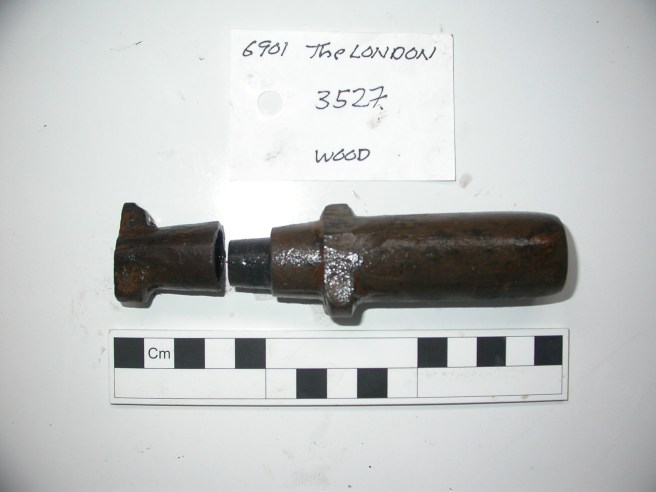
The process of conserving marine archaeological material can often involve quite a bit of time and repetition: consider that 150 Apostle musket cartridge bottles have been recovered from the London, from complete examples with cap, to some that consist of just a few broken fragments. Each one has to be photographed, assessed, repackaged in soft nylon netting, wet cleaned to remove mud from the sea bottom, desalinated, treated with polyethylene glycol and freeze dried. I’ve just finished the wet cleaning stage which took 4 workdays!

At top of image, label naming the artefact with text '6901: The London 3527: wood'. Centre of image, wooden bottle, with stopper to left, body of bottle to right, underneath this is a scale marked off in centimetres.
‘Apostle’ musket cartridge bottles. © Historic England

Jumble of black bottles, all with individually numbered white labels.
Some of the 150 bottles after wet cleaning. © Historic England

It’s not just the Apostle cartridges, all the artefacts from the London have to go through similar stages.  The water in all 158 boxes of artefacts has to be changed every month in order to remove salt from the marine environment in a process called desalination. Both organic (wood, leather) and inorganic (ceramics, glass, metal) materials can be damaged if allowed to dry out while they still contain soluble salts such as sodium chloride. Artefacts are soaked in baths of distilled water which allows salts to diffuse out, allowing them to be safely dried. Desalination isn’t difficult, but it does take some time and requires knowledge of the drying behaviour of a wide variety of materials.

Though some stages of marine conservation are repetitive, there are lots of interesting moments as well. One of the most exciting things about archaeological conservation is finding out more about the artefacts during the process and especially discovering clues about who made them and the technology they used. This process is called ‘investigative conservation’ and uses a variety of tools and techniques such as microscopy, X-radiography and digital imaging.

Here is one example discovered during digital x-radiography of a pewter spoon:

Bowl of a spoon, darkened with age and contact with water, against a plain grey background.
Pewter spoon from the wreck of the London. © Historic England

Spoon seen in x ray as white against a black background, with red ring around the letters BA on the spoon. At top of image above the spoon is the Historic England logo.
Digital x-ray of the same pewter spoon from the London. Computed radiography revealed a touchmark of the letters ‘B A’. © Historic England


The letters ‘BA’ can be seen in the x-ray, just above the point where the handle meets the bowl of the spoon. Marks in this area are called ‘touch marks’ and can tell us where and when the spoon was made and who made it. Some marks on pewter made in London or Edinburgh can be identified by records on ‘touch plates’ kept by the Worshipful Company of Pewterers, but marks from the period of the London are difficult as many records from the Pewterers were destroyed in the Great Fire of London in 1666, just a year after the ship sank.  Still, it may be possible to identify who made the spoon based on comparison with other examples. We are hoping to find out more about who ‘BA’ refers to.

Another type of mark was found on a leather strap during wet cleaning. A stamped letter (or letters) can be seen in this photo taken with raking light illumination:

Horizontal strip of dark leather against a white background. Just off-centre to the right of the strip is a stamped mark resembling a letter P.
Leather strap from the London, showing stamped mark. Could it be from the leather worker or the artefact’s owner? © Historic England

Markings like this can be added by the leatherworker who made the strap, or might indicate its function or the sailor who used it on board the ship. We will pass this information on to the experts studying leather artefacts from the London.

Sometimes we find unknown or unexpected materials on artefacts during conservation, and need to investigate them further to get a better idea of what they are made of and why they are there. I noticed a yellow material with a tar-like odour inside the layers of a leather shoe from the London. Using a technique called Fourier-Transform Infra-Red spectroscopy (FT-IR for short) I was able to determine that it was indeed an organic material with chemical bonding similar to natural resins. This material may have been applied during the shoe’s construction as an adhesive or a sealant.

Two shoe soles one below the other, against a white background, and a centimetre scale rule underneath. Annotated on the lower sole where unknown tar-like materials have been seen.
leather shoe fragment from the London, with location of unknown material. © Historic England

Graph marked in units of 5 from 50 to 98 on the vertical axis, and 4000 backwards to 650 on the lower axis, showing significant spike between the 3000 to 2000 mark.
Transmittance spectrum produced during FT-IR analysis of the shoe sole. © Historic England.

Conservation work on material from the London is quite rewarding as we have a chance to progress artefacts from post excavation though conservation treatment, learning more through investigative conservation along the way and preparing them for storage and display at Southend Museum.

Find out more about the London by following #LondonWreck1665

Many thanks to Eric for his fascinating blog. The thing that caught my attention particularly was the stamped leather – that such detail has survived 350 years of immersion in a hostile environment and can be recovered by archaeology is amazing.

For more on conservation of artefacts from the wreck of the London, please also have a look at an earlier post from 2015.


No.83: The London, No.3: A Conservator’s Tool Kit

This week Angela Middleton, Archaeological Conservator at Historic England, is my guest blogger, explaining the tools of her trade in conserving some of the objects recovered from the London.

A conservator’s tool kit: air brush, hammer and chisel

As a conservator you may spend many hours peering down a microscope, using a scalpel and slowly removing layers and years of dirt or corrosion: a painstakingly slow process; just like watching paint dry or grass grow. Progress can be hard to measure and to the untrained eye is often barely noticeable.

So why bother, you may ask?

During conservation, the conservator and the object go through a couple of stages. You normally start off with an assessment, where the condition of the object is evaluated, allowing a picture of the artefact’s composition, construction and state of preservation to emerge. Following that you devise a treatment according to the artefact’s condition and its purpose.

The ultimate goal is always to stabilise the object, preserve it for the future and to understand it: and by doing this a conservator also helps others to understand and appreciate it. This is often difficult when the surface is obscured by corrosion products or discoloured due to centuries of being buried. Removing these obscuring and distracting layers will help to reveal the object.

Lately I have been working on artefacts from the London, a shipwreck which sank off Southend-on-Sea in 1665. After their initial assessment (see Heritage Calling: Looking Inside) and a lengthy programme of desalination* (remember this is like watching paint dry…), artefacts can be actively conserved, without obscuring fine surface details or allowing layers of dirt to be consolidated onto the surface.

So this is where the pressure washer comes in. I have been using an air-brush system to clean off loose surface dirt on some of the leather from the London. It works just like a conventional pressure washer, albeit on a smaller scale, with the advantage of being able to regulate the pressure down and work with a really small outlet, enabling you to focus on small areas.

The example shown below is a leather sole from one of the many shoe finds. It is contaminated with iron compounds, which are commonly found in the burial environment (iron compounds originate from naturally occurring minerals or from corroding artefacts in the vicinity). They settle on the leather surface and do not only obscure fine surface details but also discolour the artefact. If not using an air-brush system, I would be cleaning them with sponges, which can sometimes be too harsh on sensitive surfaces such as leather, which can be easily marked and damaged. The air-brush is a much more gentle method of cleaning.

leather sole
Left to right: Leather sole 3141 before cleaning; during cleaning with top half cleaned; fully cleaned.

Here is the mini pressure washer in action:

However, sometimes ‘gentle’ is just not good enough, especially for maritime finds. They often become covered in huge and unsightly concretions. A concretion is formed when a corroding iron object interacts with the surrounding environment, encapsulating marine organisms, surrounding sediments, corrosion products and even other artefacts in a lump. In most cases the artefact cannot be recognised at all. In order to stabilise and understand the object, these concretions have to be removed. And yes, as the name suggests: they can be as hard as concrete. There is little choice but to use a hammer and a chisel to remove them: tools you don’t often find used by an archaeological conservator.

The example below is a concretion containing a multitude of artefacts. Visible at the top was a copper alloy artefact, half embedded in the concretion. A conservator would normally take an X-ray to visualise the embedded artefact(s). However, the concretions are often so dense that X-radiography is of limited use. So in this case I used the shape of the object partly showing at the top to guide me and started chiselling the concretion away. Once again it was a slow process, but totally worth it. What I managed to reveal and finally remove from the concretion was a pair of callipers: the only one from the wreck so far and in near perfect condition. Callipers were used to check the diameter of shot. By also knowing the material and the density the weight can be calculated. In our example it looks like the diameter is engraved on one side of the scale and the weight on the opposing side. The anaerobic conditions on the seabed and inside the concretion have preserved the markings on the calliper and it showes very little corrosion.

Left to right: Concretion as found, the callipers are visible at the top; callipers after being removed from the concretion.

Detail of the markings on the callipers

The other example is an iron cannonball which was also covered in concretion. It was important to remove it, not only to reveal the true size of the artefact, but also to reduce treatment times. The thick layer of concretion forms a barrier and will hinder passage of water during desalination.

After the concretion had been removed the cannonball diameter could be determined as roughly 15cm, making it a 30-pounder, suitable for a demi-cannon.

cannonball
From left to right: Cannonball before removal of concretion; during removal of concretion; after removal.

Each conservation task requires a specific set of tools, depending on the job in hand and the nature of the artefact. The gadgets an archaeological conservator uses are very different to what a paintings or textile conservator would use. However, the similarity is that each conservator strives to preserve the object and enable others to study and enjoy it.

 *Desalination: During burial salts from the burial environment accumulate inside artefacts. If such an artefact is simply dried, salt crystals will form, which expand in volume on drying, which can cause surface layers of the artefacts to flake off, or the whole artefact can actually fall apart. Also salts are hygroscopic, which means they attract moisture from the air. This moisture can cause further corrosion. This is especially true for metal artefacts.

During desalination artefacts are immersed in tap water, and then in de-ionised water, to remove water-soluble salts. This is achieved by regularly changing the water and measuring the chloride level or the conductivity of the storage solution. Once these readings remain sufficiently low, the artefact is considered desalinated and can be treated as in the case of wood or leather, or can be dried as in the case of glass or ceramics.

To catch up with previous posts on the London, here is a post commemorating the anniversary of her loss in March 1665 and another on recent archaeological work.

No.77 The London wreck today

2015: Telling the story of the London today

A CGI reconstruction of the wreck of a wooden vessel lying on her side with holes blown in her structure.
A CGI reconstruction of the London wreck on the seabed. © Touch Productions

The ordnance, so crucial to the story of the lost London, as described in the previous post, and the salvage of the vessel in the aftermath, is also the theme of her more recent story. A gun was found on the site in 1962, and further investigation of the site in 1985 concluded that its iron content was too great to indicate a 17th century vessel (because the ordnance aboard the London was believed to be predominantly brass). Archaeological investigation in 2006, before dredging for the London Gateway project began, identified two discrete sites close to one another. In 2007 two bronze cannon said to be from the site were reported to the Receiver of Wreck, suggesting a threat sufficient to trigger an assessment of the site’s national importance as a candidate for designation under the Protection of Wrecks Act, which was achieved in 2008.

Local volunteers, under the site Licensee Steve Ellis, began monitoring the site in 2010. The Thames Estuary is a challenging environment for divers and for the wreck itself, which is also under threat from natural forces: the sediment mobility in the area and the effects of climate change, in which warm-water organisms have migrated northward with the potential to impact on wooden wrecks such as the London, leading to a noticeable loss of artefacts from the site.

Steve illustrates another major challenge facing archaeologists on the site, at the edge of a busy shipping channel:

A huge container ship dwarfs the dive vessel as it passes close by.
A large container ship passes close to the dive vessel near the London site. © Steve Ellis

These environmental threats in turn triggered a programme of finds recovery, with a very successful season in 2014 involving a collaboration between English Heritage, Cotswold Archaeology, Licensee divers, Southend Museums, and local volunteers, who sorted the recovered finds. Over 70 items were recovered, 41 by Cotswold Archaeology and 35 by the Licensees, a time capsule of life aboard a 17th century vessel, including bottles and personal items such as clay pipes and shoes.

A largely intact black leather latchet shoe viewed from above, next to an i
A well-preserved latchet shoe recovered from the wreck of the London. © Steve Ellis

Dan Pascoe, one of the site archaeologists, resumes the story with an account of recent archaeological activity concentrating on the guns:

‘The excavation thus far has revealed tantalizing clues towards determining which part of the ship survives on the seabed at site 2. The discovery of an intact gun carriage with the trucks situated against the remains of a deck, suggest the survival of parts of the gundeck. Directly either side of the carriage cheeks were the associated gun tackle, furniture and even gunner’s implements. The deck and carriage are situated on the vertical rather than horizontal, identifying that the remains of this part of the ship are on its side. Full excavation and recovery of the carriage this season will hopefully reveal the side of the hull and gun port.

South of the deck line, which would be below the gundeck, the excavation has uncovered  numerous cut logs of fired wood, galley tiles and bricks. In large ships, like the London, built prior to the mid-1660s, the cook room was found on a partial deck or platform within the forward part of the hold. Also found have been sections of partition planking, probably related to the internal structures of the ship, such has cabins and storerooms. The litter of hundreds of musket and pistol shot points to a possible location near the gunner’s storeroom. The present thinking is that site 2 is part of the bow from at least the gundeck down to hold, which includes the remains of a partial deck or platform. The excavation continues this spring and will hopefully be able to confirm the team’s initial thoughts and theories.’

The remains of a wooden gun carriage truck in poor visibility in the Thames
Gun carriage truck in situ in the Thames, which also illustrates the challenges of working in limited visibility. © Steve Ellis

Steve Ellis, the site’s Licensee, says:

‘It has been a fantastic experience working on such a fascinating wreck site, especially the discoveries we have come across to help us all understand more about life aboard a 17th century British naval ship. This would not have been possible if it wasn’t for the full support that we had from English Heritage, seeing that we are only amateur archaeologists.’

A photographic exhibition documenting the finds opens later this month at the Beecroft Art Gallery, Southend-on-Sea, Essex; underwater investigations are due to resume in summer 2015 and can be followed via the Twitter hashtag #LondonWreck1665.

With many thanks to Dan and Steve, who have contributed so much to this post.

No. 76: The London Blows Up, 7 March 1665

To commemorate the 350th anniversary of the loss of the warship London in the Thames Estuary on 7 March 1665, I would like to take a look at the London in 1665 and in 2015, in a two-part blog. In this first part we look at the story of the wreck event in the words of those who were there at the time, and in the next part on Monday we will hear from those working on the London today.

1665

Pen and ink ship portrait of the hull of the London in broadside view, with flag at her stern.
The London, circa 1660, Willem van de Velde, © National Maritime Museum, Greenwich, London. Van de Velde was a Dutch marine artist and specialist in ship portraits, and played a role in documenting the battles of the Anglo-Dutch wars.

The London was a stalwart of the Commonwealth Navy, built in 1656 under Cromwell, but had also been part of the fleet accompanying Charles II on his return from exile in the Netherlands in 1660. On 7th March 1665, the London was bound from Chatham Dockyard to the Hope Reach in the Thames, a key location at a tense time, since war had just been declared between Charles II’s England and the United Provinces of the Netherlands on the 4th. The national mood was sombre, and it was also a cold day: thirty miles north, Ralph Josselin, vicar of Earls Colne in Essex, noted that his water pump had frozen that day. (1) Undoubtedly what happened next would have made headlines had there been such a thing as newspapers in England, but the first edition of the London Gazette would not come out until 7th November 1665. However, as Josselin’s journal shows, this was a time of assiduous diary-writing and administrative record-keeping, which allows us a window into the past.

Between Chatham and the Hope Reach lies the Nore: as so often, a safe deep-water anchorage, which was, and remained, a traditional assembly point for battle fleets and convoys up to and including the Second World War, lay next to a hazard, the notorious Nore sandbank. Yet it was not the Nore that was to claim the London.

A letter written on the 8th to Sir Joseph Williamson reported: ‘The brave ship London has blown up near the Hope’, leaving behind only her hull and stern. (2) On the same day Samuel Pepys, in his capacity as Clerk of the Acts to the Navy Board, provides us with more detail on the ‘sad newes of the London‘ in his personal diary: ‘a little a’this side the buoy of the Nower [that is, on the London side of the buoy, not the seaward side], she suddenly blew up.’ He tells us that only 24 persons were saved out of a complement of over 300, ‘the ship breaking all in pieces, with 80 pieces of brass ordinance.’ (3)

Portrait of Samuel Pepys in old age, wearing a wig and facing right against a dark background, in a gold frame.
Samuel Pepys, 1689, by Godfrey Kneller. © National Maritime Museum, Greenwich, London. Pepys was one of the key figures of the 17th century Navy and a very capable administrator. He had been asked to distribute the Articles of War to the fleet in the Hope just a few days previously.

Another letter, this time to Henry Bennet, 1st Earl of Arlington, passes on coffee-house gossip, blaming the easy availability of gunpowder ’20s a barrel cheaper than in London’ and therefore by implication suspect in provenance and quality. (4) On the 9th, John Evelyn, the other famous diarist of the period, ‘went to receive the poor creatures that were saved out of the London frigate, blown up by accident, with above 200 men,’ for he had been appointed one of the Commissioners for sick and wounded seamen by Charles II. (5) The Dutch ambassador, Michiel van Gogh, had more specific intelligence on numbers than Pepys, or perhaps more details were known by the time of his letter on 10th March: ‘The London, prepared for Vice-Admiral Lawson, was blown up while sailing up the river, and only 19 out of the crew of 351 saved.’ (6)

On the 11th Pepys recorded the results of an inspection of the wreck by Sir William Batten and Sir John Mennes: ‘out of which they say, the guns may be got, but the hull of her will be wholly lost’. (7) Those guns continued to be the focus of administrative attention for a good 30 years afterwards: recoveries made in 1679 caused some wrangling that surfaced in 1694-5, as the salvor attempted to leverage payment of a debt. (8)

What happened next? Part 2 on Monday will bring the story of the London up to date.

CGI reconstruction of the London, showing her gun decks and masts
CGI reconstruction of the London © Touch Productions

(1) Diary of Ralph Josselin, 7 March 1665

(2) Calendar of State Papers Domestic, Charles II, 1664-5, Vol.114, No.84

(3) Diary of Samuel Pepys, 8 March 1665

(4) Calendar of State Papers Domestic, Charles II, 1664-5, Vol.114, No.90

(5) Diary of John Evelyn, 9 March 1665

(6) Copy, Holland Correspondence, March 10, 1665, in Calendar of State Papers, Domestic, Charles II, 1664-5, Vol.114

(7) Diary of Samuel Pepys, 11 March 1665

(8) Calendar of Treasury Papers, Vol. 1, 1556-1696, May 17, 1694, and November 26, 1695

No.49: Mi Amigo

Radio Caroline 1999 Today, Friday 28th March, marks the 50th anniversary of Radio Caroline, originally a pirate radio station. Piracy on the high seas would not be complete without a shipwreck somewhere, in this case the vessel that became Radio Caroline South, broadcasting from the coast off Essex. This vessel was the Mi Amigo.

Seamen often say that ships have a personality of their own or that a ship is an ‘unlucky’ vessel. Mi Amigo certainly had an adventurous career, despite her origins as a workaday sailing schooner built at Kiel in 1921, operating in the Baltic region. She was commandeered by Nazi forces in 1941-3, and began her career as a radio broadcast vessel off Danish waters in 1960, before Radio Caroline.

During her years operating off the Essex coast, she exemplified the main problem facing stationary vessels. During storms they were extremely vulnerable to running on nearby hazards as they could not quickly steer themselves out of trouble, if at all, if their anchors broke. (Light vessels without motive power were particularly prone to this problem.) Mi Amigo drifted ashore at Holland Haven near Frinton in 1966, struck the Long Sand Head just off the Thames Estuary in 1975 and 1976, before eventually sinking after striking the Long Sand once more in 1980. Her mast was visible for a number of years afterwards and the wreck remains charted in the Estuary: she was recorded in English Heritage’s Modern Wrecks Project of 2010, 30 years after she was lost.

The last words broadcast from Mi Amigo were those of the DJ on duty just before midnight on 19/20 March 1980: “Due to severe weather conditions and the fact that we are shipping quite a lot of water, we’re closing down and the crew are at this stage leaving the ship.” All the crew were rescued by the Sheerness lifeboat, plus Wilson II the canary.

For a photo gallery of Mi Amigo in service and as a sunken wreck, please click here.