The Acorn

The Acorn Part III: 2018

For our Christmas special, it’s my pleasure to welcome back Jordan Havell, now a regular guest blogger. I’m also delighted to let you know he received a ‘Highly Commended’ at the CBA awards, in the Young Archaeologist of the Year category.

He gives us an update on the Acorn, a barque in the ice trade, a suitably seasonal subject, which he first discussed in a blog for Christmas 2014, and recalls a dynamic year on the Lincolnshire coast.

Photograph of shipwreck timber seen from above, amid ridges and furrows in the sand with the tide flowing in and out.
Remains of the Acorn emerging from the sand, while marine life has been washed in, seen on 7 November 2018 © Jordan Havell

Jordan writes:

It is now 4 years since I wrote my first blog on the Acorn shipwreck.

Since then my family and I have watched as the wreck appears, disappears and reappears as a result of the tides causing the sand to shift. Photographs were taken each time the wreck was uncovered by the sea to be added to the national database.

Over the last year while doing this, we have noticed other archaeological finds, including a rather large piece of wreck washed up near Trusthorpe in May, and we were involved in recording and digitizing information on the wreck, including photogrammetry work. My mum and I found it after a local lady told us about it and we reported it to Historic England, Lincolnshire’s Finds Officer, Adam Daubney, and CITiZAN’s Andy Sherman for which I wrote a blog. A piece was taken for carbon dating. It is thought to be late 19th century/possibly early 20th. Merchants’ marks were recorded on this piece.

Other things found while doing various visits to the beach include: other ships’ timbers, possible aircraft fuselage pieces, copper sheathing from the hull of timber boats, large pieces of iron concretion, possibly from other local shipwrecks, worked flints, fossils, and Roman pottery. Parrel trucks and deadeyes from ships and even a possible sponge head from a cannon sponge were also among the objects found.

We have also seen much larger chunks of peat from the Lincolnshire Peat Shelf. These pieces have been much bigger than we have seen before. One day recently some of these large chunks were seen scattered right along the tideline for quite some distance.

Two fragments of dark brown peat, one large on left, smaller fragment to centre right, on sand
Fragments of peat washed up on 28 September 2018 © Jordan Havell

During March we saw the ‘Beast From the East’ affect our coastline. We saw hundreds upon thousands of stranded marine creatures, which was a shame to see. During this time we also saw many pieces of prehistoric forest timbers that we recorded and continue to do so.

Another day recently we saw salt lines across the beach – again, the first time we have seen something like this.
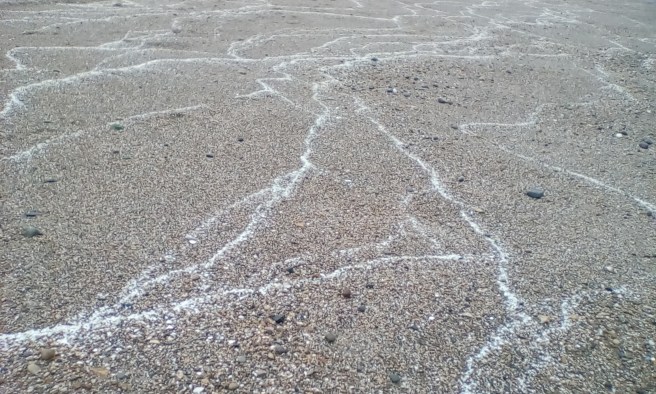
Shingle beach criss-crossed with white salt lines
Salt lines, Sutton-on-Sea beach, 2018. © Jordan Havell

I have attached some photos reflecting some of the above and of course some up-to-date pictures of the Acorn as she has recently given up more to see.

It’s amazing to see just how the tides have affected it over: over just a few days over the 21st to the 29th October 2018, the changes we could see were caused by shifting changes in the sand levels.

Acorn Oct 21 2018 1
The Acorn surrounded by water on 21 October 2018. © Jordan Havell

We took pictures on the 29th but couldn’t get as close due to the rising water levels around the wreck.

The Acorn 29th Oct 2018
The Acorn, 29 October 2018. © Jordan Havell

We will continue to monitor this wreck over the next few years in the hope that more starts to appear and I can then make another blog on it all to keep you up to date on it.

We’d like to thank Jordan for his detailed observations on the burial and exposure of this site over the last few years. It has turned into a fascinating case study on the processes and environmental context of wreck exposure in the inter-tidal zone on the east coast. It’s clear that the beach erosion revealing the Acorn and artefacts such as the Roman pottery (other Roman pottery was found locally in the 1950s) mirrors similar disturbances offshore, resulting in a variety of material being washed up.

We wish Jordan – and all our readers – a very happy festive season and all the best for 2019.


No.72: The Acorn

To end the year, today’s post showcases several of the main themes of 2014 in maritime archaeology: first, early 2014 was exceptionally stormy, with numerous reports of wrecks having been exposed in different locations around the UK as storms scoured sand off beaches. Many members of the public gave English Heritage fantastic reports of shipwreck material they had seen.

One such report was from Sutton-on-Sea, Lincolnshire. It gives me great pleasure today to introduce as my guest blogger this week Jordan Havell, who is 13. After seeing some timbers on the shore this year, he has been researching the story behind one of the wrecks in his local area, the Acorn, which was a barque laden with ice when she struck in Lynn Roads in 1898.

Jordan tells the story of her origins: 

I got very interested in this shipwreck, amongst others, while doing a local history project. I am 13 years old and home educated.

The Acorn was built in 1855 in Dundee, County of Forfar, Scotland. The register date is recorded as 05/03/1855, with the master’s name shown as Peter Anderson, in the hands of Andrew Low for the Tay Ship Building Company, dated 28/02/1855. The employment of the Surveying Officer, Joseph Northmore, is recorded as a tide surveyor. These details come from the Dundee Archives, for whose help I was very grateful.

The ship had one and a half poop decks, 3 masts and her length is recorded as 119 feet. She was a barque which had one gallery and a full female figurehead. The framework and planking were made of wood.

The subscribing owners were named as Peter Anderson – Master Mariner – 16 shares. The manufacturers are recorded as Matthew Low and John Morrison, both having 12 shares. It is noted there were 2 other owners.

Image courtesy of Dundee City Archives.
Original register entry for the Acorn, 1855. Image courtesy of Dundee City Archives.

The Acorn appears in various articles in Dundee newspapers from 1856 to 1873. By 1871 her master is listed as George Wilson. On the records from this time there are numerous notes, including a query shown in 1873 regarding conversions to cubic metres weight. In 1873 the ship is registered under the port of Grimsby. The Acorn was believed to have been carrying ice between Norway and Grimsby for use by the Grimsby Ice Company in the fishing industry.

It appears she ended her days on the beach at Sutton-on-Sea in 1901 and is recorded under the English Heritage wreck report 928347 and account of wreck site 1484623. I am very grateful to Serena Cant and her colleagues who gave me help with this project.

I am hoping to find out about more shipwrecks along this coast over time.

**********************************************************

Many thanks to Jordan for his essay, which I am delighted to include today. I think an ice barque is an appropriate seasonal theme on which to end the year! For more on Norwegian ice barques, have a look at a past entry here.

The sharp-eyed among you, like Jordan, will have spotted that she struck a sandbank in the Wash in 1898, but ended up further north on the Lincolnshire coast in 1901. I did some research myself and found that the vessel was recovered in 1898, when she was sold for £105. (1) This was very typical. For the Acorn‘s owners, in far-away Sandefjord, it would have been much more economical to cut their losses by selling the vessel, rather than try to get her repaired at their own cost.

This, I suspect, is how she eventually ended up at Sutton-on-Sea in what has proven to be a ship graveyard, another theme which has emerged strongly in maritime archaeology over the last few years. These tend to be groups of vessels beyond economical repair, drawn up for breaking and then perhaps abandoned. The Acorn was one of six vessels which were recorded by partial excavation along this stretch of beach in 1997. (2)

I think there is plenty more for us to find out – what happened to the Acorn between 1898 and 1901, and what is the story of the other ships which may still remain under the sand at Sutton-on-Sea and elsewhere in the locality? Over to you, Jordan! I hope you will continue to be as fascinated by shipwreck archaeology as we are.

Wreck of post-medieval or early modern fishing vessel, Mablethorpe, 2007, first recorded 1997. Image courtesy of John Buglass.
Wreck of unidentified post-medieval or early modern fishing vessel, Mablethorpe, 2007, first recorded 1997. Image courtesy of John Buglass.

(1) Hull Daily Mail, 13 April 1898, No.3,902, p4

(2) Buglass, J 1997: The remains of six sailing ships and other archaeological features in the inter-tidal zone between Sutton-on-Sea and Mablethorpe, Lincolnshire; Buglass, J and Brigham, T 2008: Rapid Coastal Zone Assessment, Yorkshire and Lincolnshire: Donna Nook to Gibraltar Point, Humber Archaeology Report No.236