No.81 Gallipoli

Diary of the War No.9

To commemorate the centenary of the Gallipoli landings, which commenced on 25 April 1915, today’s post takes as its theme two wrecks in English waters: one which participated in those landings, and another transporting Anzacs (Australian and New Zealand Army Corps), so closely associated with the Gallipoli campaign.

Colour poster of a swimming man, captioned 'It is nice in the surf but what about the men in the trenches'
‘Win the War League’ poster promoting Australian recruitment during the First World War. IWM PST 12232. http://www.iwm.org.uk/collections/item/object/25051

The Fauvette was constructed in 1912 for the General Steam Navigation Company, and employed on the London-Bordeaux run, from which she evacuated British nationals when war broke out. Like so many other civilian vessels, she was requisitioned for war service, becoming HMS Fauvette in February 1915, and heading straight for the Dardanelles. By April 1915 she was carrying stores for the Allied landings. On 21 April, the crew of HMS Fentonian, a requisitioned trawler, had difficulties offloading Fauvette‘s buoys: ‘the sinkers were enormous blocks of cement weighing 35 cwt.’ (1) Fauvette continued to see service in and around Gallipoli, Mudros and Suvla Bay until the following year.

On her return to England on 9 March 1916 she struck two mines laid by UC-7 approximately 1.75 miles NE of the North Foreland and sank with the loss of 14 lives. Her position has been securely recorded since 1916 and she was earmarked for post-war dispersal, achieved by 1921. She lies within half a mile of the Emile Deschamps, whose story is told in a previous post, also mined close to home but in a different war.

A few weeks later, 25 April 1916 saw the first Anzac Day commemorating the contribution of Australian and New Zealand troops in the ill-fated Gallipoli campaign. Ironically, it was on the second Anzac Day on 25 April 1917 that today’s second featured wreck was lost. The Ballarat, a P&O liner built for the Australian emigrant service, was another requisitioned ship, serving as a trooper, shuttling to and from Australia.

On her final voyage the men were being mustered for an Anzac Day service when a torpedo, or “Tinned Fish” as one survivor put it, struck her aft on her port side, tearing off her propeller. (2) She began to settle by the stern, so the order was given to abandon ship, but when the engineer reported that the vessel was capable of limping on, the men were recalled and volunteers requested to man the stokehold. As luck would have it, the Ballarat was carrying men of the Railway Operating Division, who were well used to stoking steam engines, albeit on the rails rather than on the high seas!

However, the engine was flooded, so once more all were lined up to abandon ship. Well over 1,500 people were safely evacuated, including the hospital cases: the Times reported that the two nurses and three chaplains aboard assisted the men to fasten their lifebelts. The parade itself, and the continuous boat muster drill they had practised during the voyage, could be said to have prevented this from becoming another tragedy of the Great War. The men were allowed to take photographs, including one extraordinary view of serried ranks of soldiers awaiting evacuation and during the evacuation itself, leaving behind a well-documented wreck. Efforts to save the ship continued, and she was taken in tow, only to sink 7 miles SW of the Lizard, Cornwall.

Wartime censorship meant that the loss was only officially announced on 2 May. The press and the Australian High Commission praised the orderly evacuation, and the sang-froid of the survivors who sent ‘representatives to London to get a souvenir of the event printed in the form of the last number of the Ballarat Beacon, which was being distributed when the ship was torpedoed.’ (3) And a final word: the Times took care to note that 15 of those rescued were also survivors of the ordeal at Gallipoli.

More Gallipoli news: Historic England has just listed war memorials associated with Gallipoli.

Hand-drawn black and white magazine cover depicting the Ballarat steamship at sea, flanked by two beacons, and a cartouche in contemporary lettering with the title 'The Ballarat Beacon'
Front cover of the Ballarat Beacon, Vol.1, No.1, 1917, National Library of Australia, http://nla.gov.au/nla.cat-vn3304869

(1) “Dardanelles: Narrative of Mine-Sweeping Trawler 448, Manned by Queen Elizabeth: the landing at “Z” Beach, Gallipoli” Naval Review, Vol.IV, No. 2, 1916, pp185-197. URL: http://www.naval-review.com/issues/1910s/1916-2.pdf 

(2) Memoirs of Hector Creswick, 15 Company Railway Operating Division, http://www.australiansatwar.gov.au/stories/stories_war=W1_id=103.htm

(3) The Times, No.41,468, 3 May 1917, p6
No.80 The Strange Case of the Madonna del Rosario . . .

Today’s wreck holds the record, I think, for having the longest name on our database of shipwrecks around the English coast: normalised to the modern spelling as far as I can make it, she was the Madonna del Rosario Sant’Antonio di Padova e la Stella delle Mare.

Ongoing research means that we often have to substantially revise our records for documented wreck events. This usually entails adding more detail or narrowing down the area of loss to a more specific location from the initial vague reports ‘near’ or ‘off’ a particular place. The length of the name in this case gave me room for some doubt since it is not unknown for the names of ships lost in company in the same location to be run together, particularly if they were foreign, and I had wondered if this long name masked more than one wreck event. It did, but not in quite in the way that I expected!

The first we knew about this wreck was a report that the ‘Catharina . . . and Madonna del Rosario and St Antonio de Padova e la Stella delle Mare, Captain Mellin, are both lost in Bristol Channel.’ (1) I had hoped that we would be able to revise their location to somewhere more specific, but what I was completely unprepared for was to find that the specific position for the Madonna del Rosario would be on the other side of the country!

She next turns up in the press in the Ipswich Journal, which states that a ship of that name (so we are clear that there were no multitudes of vessels hiding behind the one name), a Venetian, had struck on the Shipwash on 29 December 1781, on the approaches to the Thames off Suffolk, and that the crew had escaped and landed at Aldeburgh. (2) This was the preamble to an appeal to salvors from the area to come forward to receive ‘legal salvage’, but it also warned that there was a reward of ‘Five Guineas’ (£5 5s, or £5.25) for the discovery of any person concealing salvaged goods.

This is all very specific, so why did she end up being reported in the Bristol Channel instead? The confusion probably arose because of another Venetian vessel that was indeed lost off the Bristol Channel coastline of Wales, on Friday 28 or Friday 21 December 1781:

‘Extract of a Letter from Swansea, dated Jan. 5.

“Last Friday Se’nnight in the morning (3) a large Venetian Ship, laden with Cotton, Marble, and Coral, was stranded on the Skerr-Rocks, in this County. Soon after the Accident, the Country People commenced the barbarous Practice, usual on such Occasions, of plundering the Distressed and Helpless . . .’ (4)

I haven’t yet traced the Catharina in the contemporary press, although her voyage, also from Livorno to London or Ostend, suggests that she was also more likely to have been lost in the North Sea rather than the Bristol Channel, but there is the possibility that she can indeed be identified with the ship lost off Wales. There is no record of a Catharina or of a Venetian ship indexed in the region in the Shipwreck Index of the British Isles, Vol. 5: West Coast and Wales (Larn and Larn, 2006), nor are the arrivals and departures lists in Lloyd’s List any help (although often very helpful, they are selective at best, and the distinctive name of the Madonna del Rosario was absent).

Can anyone help with either vessel? If the Catharina is distinct from the Welsh wreck and was also lost on the east coast, then it would also be great to relocate the record for this wreck and help build up a more accurate picture of the archaeological potential around the English coastline. At the moment it looks as if she may be ‘lost’ in the other sense in the Bristol Channel . . .

(1) Lloyd’s List, 4 January 1782, No.1,324

(2) Ipswich Journal, 12 and 19 January 1782, No.2,242 and 2,243, both p3

(3) Se’nnight, that is, ‘seven-night’, cf. fortnight, still in use. January 5 was a Saturday so it might mean either ‘a week [counting from] the Friday just gone’, i.e. ‘a week ago yesterday’, or ‘a week ago on Friday last week’ depending on local usage. Interestingly newspapers of this time often copied news items verbatim from other papers, and the date of loss can vary by a week or two depending on how many times it was copied, and whether or not the local editors changed the date accordingly, or how they understood ‘Friday last’!

(4) Oxford Journal, 12 January 1782, No.1,498, p3

No.79 James Eagan Layne

In this week’s post, we commemorate the loss of the US Liberty Ship James Eagan Layne 70 years ago on 21 March 1945, torpedoed while bound from New Orleans, last from Barry in Wales, for Ghent with what was then termed ‘Government stores’. Translated, that meant military vehicles and other war materials destined for the liberation of Europe as the war was drawing to a close. Historic recoveries from this vessel have included numerous shell cases. (1)

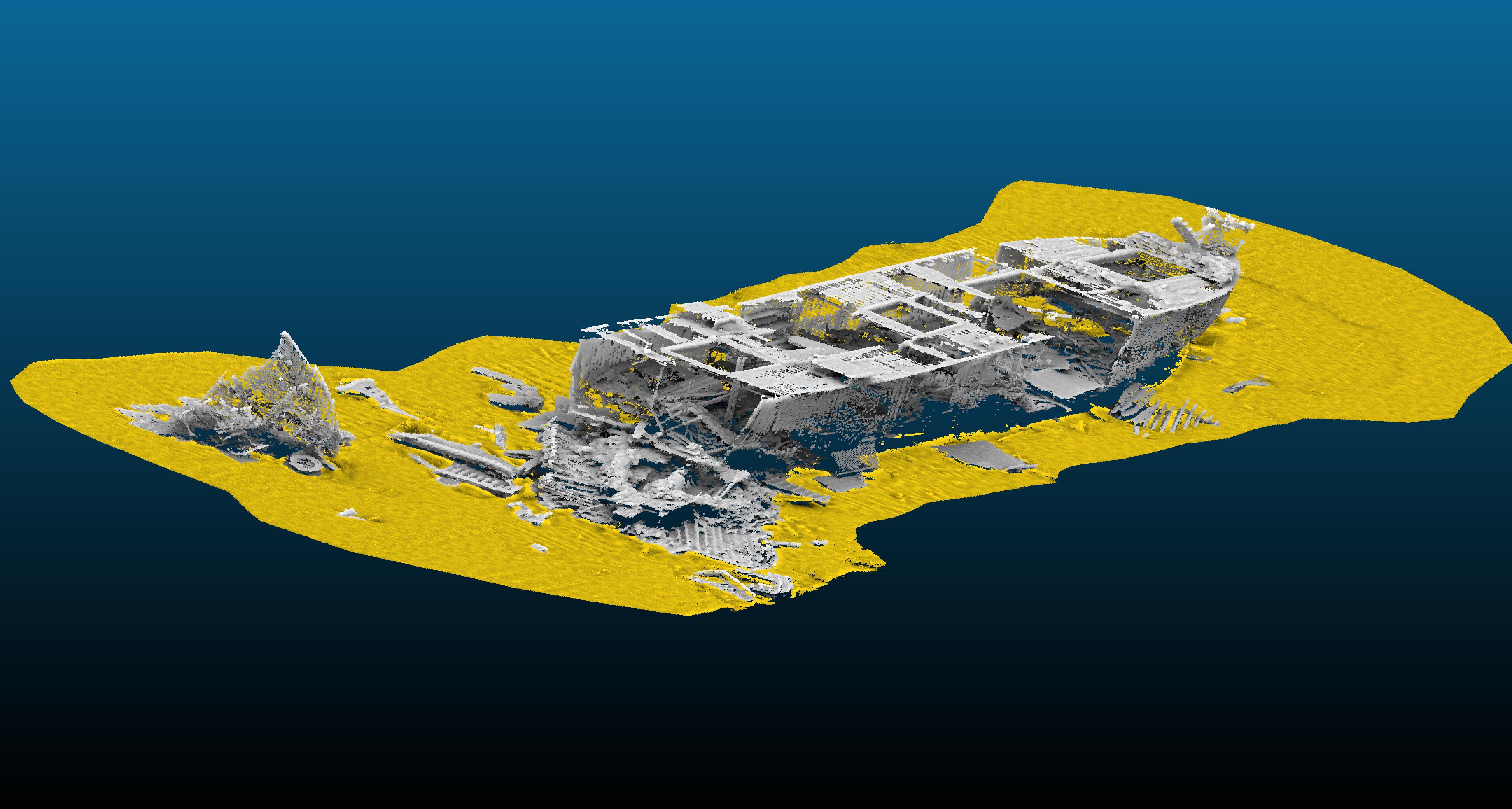
The forward section of the James Eagan Layne wreck, using modern bathymetric imagery allowing a view into the ship
Forward section of the James Eagan Layne, by courtesy of MSDS Marine and Swathe Services. There is much scattered debris, evidence of extensive post-war salvage.

The James Eagan Layne was one of several Liberty ships and other vessels bound for Belgium in the spring of 1945, following the successful conclusion of the Battle of the Bulge in January 1945. The Allies had repulsed the German advance, or ‘bulge’ in their lines, with heavy loss of life, particularly among the US troops who bore the brunt of the fighting. Allied access to the Belgian ports was now secured, barring minefields and U-boats, resuming the communication links severed by the fall of Belgium in 1940.

The pattern of wrecks on the seabed mirrors the fate of those communication links. Ten ships, bound either to or from Belgian ports, were sunk in English waters following the declaration of war in September 1939. It was a similar figure in early 1940 prior to the fall of Belgium in May, with 11 ships sunk by mine or torpedo on the same route.

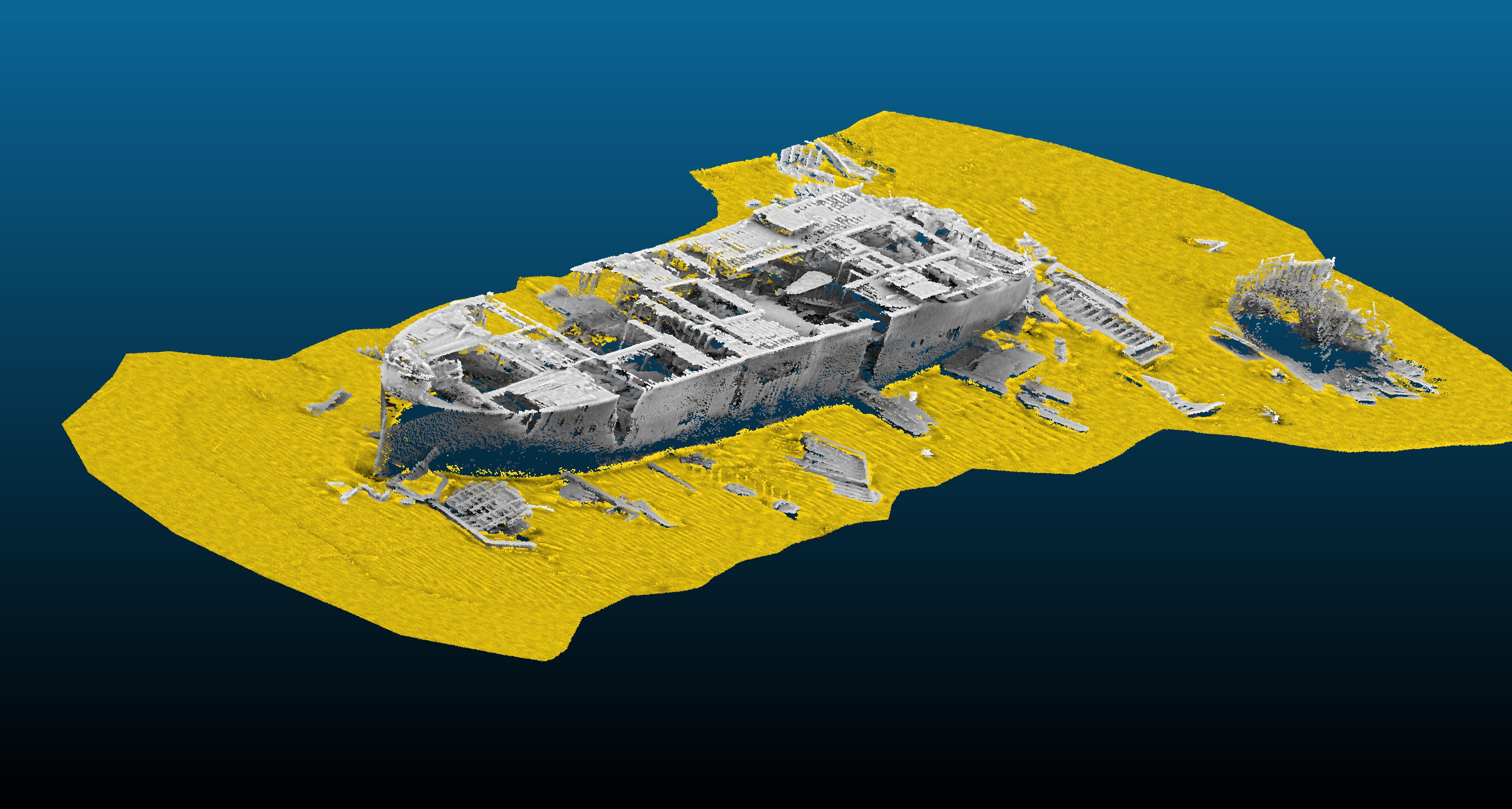
The aft section of the James Eagan Layne wreck, using modern bathymetric imagery allowing a view into the ship, and showing scattered debris
Aft section of the James Eagan Layne, by courtesy of MSDS Marine and Swathe Services. This image allows an insight into the box-like construction characteristic of the Liberty Ship.

Transport links with occupied Belgium were then severed and are reflected in the lack of corresponding wrecks from late 1940 to early 1945: then, as Allied ships were once more able to reach Antwerp and other ports, there was also a recurrence of wreck events. Between January and May 1945, 10 ships are known to have been sunk in English waters en route to or from Belgium: they included other Liberty Ships, the Henry B Plant and the James Harrod. The John R Park was also torpedoed the same day as the James Eagan Layne, albeit on a different route, bound from England for the United States.

For more on the James Eagan Layne, please have a look at the dedicated SHIPS (Shipwrecks and History in Plymouth Sound) and Promare Liberty 70 site.

(1) Receiver of Wreck droits.

With many thanks to MSDS Marine and Swathe Services for permission to reproduce these beautiful images.

No.78 U-8, Straits of Dover

Diary of the War No.8

On 4th March 1915 the first confirmed loss of a German U-boat in English waters during the war took place with the capture of U-8 off Dover, the culmination of a hunt that began when she was spotted in the Channel by HMS Viking. Viking opened fire, forcing U-8 to submerge but not without returning fire with a torpedo which missed its target, and U-8 was lost to sight.

Black and white illustration of U-8 submarine on the surface being approached by a destroyer, the crew assembled on the conning tower appealing for help.
Postcard of a contemporary illustration of U-8 being approached by a British destroyer. It is a work of subtle, as well as overt, propaganda, the text being complemented by the viewpoint from the side of a British destroyer, her lifeboat hanging from its davits, suggesting British humanity in coming to the rescue of an enemy crew appealing for help. By courtesy of Mark Dunkley

As the submerged U-8 continued on her way through the Straits of Dover, she became enmeshed in an anti-submarine net barrage. The requisitioned drifter Roburn spotted movement in the nets, and alerted the destroyers of the Dover patrol for assistance. The destroyer Ghurka* towed an anti-submarine sweep wire. These wires were fitted with explosive charges which detonated on contact with the target. Successful contact forced U-8 to the surface, whereupon Ghurka and Maori opened fire.

The crew were taken off and an attempt was made to tow the submarine back to Dover, but she foundered approximately one and three-quarters of a mile west of the southernmost tip of the Varne Bank, where she has now been positively identified by internal features.

The rescued crew, now firmly in British custody, were lined up at Dover on arrival. As the Daily Telegraph for 6 March 1915 (p9) had it: “The Germans were for the most part sturdily-built fellows – no doubt the pick of the German naval service mans the submarines”. The prisoners were marched through the town, escorted by the garrison of the Castle, and a crowd of local sightseers curious to see the enemy, to the Castle itself.

A view of Dover Castle on top of the hill, with the town below.
Dover Castle viewed from the High Street, Dover DP049659 © English Heritage Picture Library

The official Admiralty communiqué quoted in the paper gave away few details, stating only that U-8 had been sunk in the Channel off Dover, but the human interest aspect of the prisoners’ reception more than made up for it, as did the speculation over the intelligence value of the submarine (p8) and what it was thought to reveal about the U-boat war.

As for Roburn and Ghurka, they resumed their successful patrols off Dover, but they, too, were destined to fall victim to enemy action in the Straits of Dover. Roburn sank on 27 October 1916, after being shelled in a Channel raid by German torpedo boat destroyers. She was lost together with a Tribal class destroyer, which formed the nucleus of the Dover Patrol (Ghurka, Maori and Viking, as their names implied, were also Tribal class ships). Ghurka herself was mined on 8 February 1917 off Dungeness, and is one of those vessels whose remains are designated under the Protection of Military Remains Act.

The seabed of the Straits of Dover reveals a common heritage of sunken British and German vessels, a memorial to the warfare on the surface a century ago.

*not a misspelling: she was indeed Ghurka, rather than Gurkha.

No.77 The London wreck today

2015: Telling the story of the London today

A CGI reconstruction of the wreck of a wooden vessel lying on her side with holes blown in her structure.
A CGI reconstruction of the London wreck on the seabed. © Touch Productions

The ordnance, so crucial to the story of the lost London, as described in the previous post, and the salvage of the vessel in the aftermath, is also the theme of her more recent story. A gun was found on the site in 1962, and further investigation of the site in 1985 concluded that its iron content was too great to indicate a 17th century vessel (because the ordnance aboard the London was believed to be predominantly brass). Archaeological investigation in 2006, before dredging for the London Gateway project began, identified two discrete sites close to one another. In 2007 two bronze cannon said to be from the site were reported to the Receiver of Wreck, suggesting a threat sufficient to trigger an assessment of the site’s national importance as a candidate for designation under the Protection of Wrecks Act, which was achieved in 2008.

Local volunteers, under the site Licensee Steve Ellis, began monitoring the site in 2010. The Thames Estuary is a challenging environment for divers and for the wreck itself, which is also under threat from natural forces: the sediment mobility in the area and the effects of climate change, in which warm-water organisms have migrated northward with the potential to impact on wooden wrecks such as the London, leading to a noticeable loss of artefacts from the site.

Steve illustrates another major challenge facing archaeologists on the site, at the edge of a busy shipping channel:

A huge container ship dwarfs the dive vessel as it passes close by.
A large container ship passes close to the dive vessel near the London site. © Steve Ellis

These environmental threats in turn triggered a programme of finds recovery, with a very successful season in 2014 involving a collaboration between English Heritage, Cotswold Archaeology, Licensee divers, Southend Museums, and local volunteers, who sorted the recovered finds. Over 70 items were recovered, 41 by Cotswold Archaeology and 35 by the Licensees, a time capsule of life aboard a 17th century vessel, including bottles and personal items such as clay pipes and shoes.

A largely intact black leather latchet shoe viewed from above, next to an i
A well-preserved latchet shoe recovered from the wreck of the London. © Steve Ellis

Dan Pascoe, one of the site archaeologists, resumes the story with an account of recent archaeological activity concentrating on the guns:

‘The excavation thus far has revealed tantalizing clues towards determining which part of the ship survives on the seabed at site 2. The discovery of an intact gun carriage with the trucks situated against the remains of a deck, suggest the survival of parts of the gundeck. Directly either side of the carriage cheeks were the associated gun tackle, furniture and even gunner’s implements. The deck and carriage are situated on the vertical rather than horizontal, identifying that the remains of this part of the ship are on its side. Full excavation and recovery of the carriage this season will hopefully reveal the side of the hull and gun port.

South of the deck line, which would be below the gundeck, the excavation has uncovered  numerous cut logs of fired wood, galley tiles and bricks. In large ships, like the London, built prior to the mid-1660s, the cook room was found on a partial deck or platform within the forward part of the hold. Also found have been sections of partition planking, probably related to the internal structures of the ship, such has cabins and storerooms. The litter of hundreds of musket and pistol shot points to a possible location near the gunner’s storeroom. The present thinking is that site 2 is part of the bow from at least the gundeck down to hold, which includes the remains of a partial deck or platform. The excavation continues this spring and will hopefully be able to confirm the team’s initial thoughts and theories.’

The remains of a wooden gun carriage truck in poor visibility in the Thames
Gun carriage truck in situ in the Thames, which also illustrates the challenges of working in limited visibility. © Steve Ellis

Steve Ellis, the site’s Licensee, says:

‘It has been a fantastic experience working on such a fascinating wreck site, especially the discoveries we have come across to help us all understand more about life aboard a 17th century British naval ship. This would not have been possible if it wasn’t for the full support that we had from English Heritage, seeing that we are only amateur archaeologists.’

A photographic exhibition documenting the finds opens later this month at the Beecroft Art Gallery, Southend-on-Sea, Essex; underwater investigations are due to resume in summer 2015 and can be followed via the Twitter hashtag #LondonWreck1665.

With many thanks to Dan and Steve, who have contributed so much to this post.

No. 76: The London Blows Up, 7 March 1665

To commemorate the 350th anniversary of the loss of the warship London in the Thames Estuary on 7 March 1665, I would like to take a look at the London in 1665 and in 2015, in a two-part blog. In this first part we look at the story of the wreck event in the words of those who were there at the time, and in the next part on Monday we will hear from those working on the London today.

1665

Pen and ink ship portrait of the hull of the London in broadside view, with flag at her stern.
The London, circa 1660, Willem van de Velde, © National Maritime Museum, Greenwich, London. Van de Velde was a Dutch marine artist and specialist in ship portraits, and played a role in documenting the battles of the Anglo-Dutch wars.

The London was a stalwart of the Commonwealth Navy, built in 1656 under Cromwell, but had also been part of the fleet accompanying Charles II on his return from exile in the Netherlands in 1660. On 7th March 1665, the London was bound from Chatham Dockyard to the Hope Reach in the Thames, a key location at a tense time, since war had just been declared between Charles II’s England and the United Provinces of the Netherlands on the 4th. The national mood was sombre, and it was also a cold day: thirty miles north, Ralph Josselin, vicar of Earls Colne in Essex, noted that his water pump had frozen that day. (1) Undoubtedly what happened next would have made headlines had there been such a thing as newspapers in England, but the first edition of the London Gazette would not come out until 7th November 1665. However, as Josselin’s journal shows, this was a time of assiduous diary-writing and administrative record-keeping, which allows us a window into the past.

Between Chatham and the Hope Reach lies the Nore: as so often, a safe deep-water anchorage, which was, and remained, a traditional assembly point for battle fleets and convoys up to and including the Second World War, lay next to a hazard, the notorious Nore sandbank. Yet it was not the Nore that was to claim the London.

A letter written on the 8th to Sir Joseph Williamson reported: ‘The brave ship London has blown up near the Hope’, leaving behind only her hull and stern. (2) On the same day Samuel Pepys, in his capacity as Clerk of the Acts to the Navy Board, provides us with more detail on the ‘sad newes of the London‘ in his personal diary: ‘a little a’this side the buoy of the Nower [that is, on the London side of the buoy, not the seaward side], she suddenly blew up.’ He tells us that only 24 persons were saved out of a complement of over 300, ‘the ship breaking all in pieces, with 80 pieces of brass ordinance.’ (3)

Portrait of Samuel Pepys in old age, wearing a wig and facing right against a dark background, in a gold frame.
Samuel Pepys, 1689, by Godfrey Kneller. © National Maritime Museum, Greenwich, London. Pepys was one of the key figures of the 17th century Navy and a very capable administrator. He had been asked to distribute the Articles of War to the fleet in the Hope just a few days previously.

Another letter, this time to Henry Bennet, 1st Earl of Arlington, passes on coffee-house gossip, blaming the easy availability of gunpowder ’20s a barrel cheaper than in London’ and therefore by implication suspect in provenance and quality. (4) On the 9th, John Evelyn, the other famous diarist of the period, ‘went to receive the poor creatures that were saved out of the London frigate, blown up by accident, with above 200 men,’ for he had been appointed one of the Commissioners for sick and wounded seamen by Charles II. (5) The Dutch ambassador, Michiel van Gogh, had more specific intelligence on numbers than Pepys, or perhaps more details were known by the time of his letter on 10th March: ‘The London, prepared for Vice-Admiral Lawson, was blown up while sailing up the river, and only 19 out of the crew of 351 saved.’ (6)

On the 11th Pepys recorded the results of an inspection of the wreck by Sir William Batten and Sir John Mennes: ‘out of which they say, the guns may be got, but the hull of her will be wholly lost’. (7) Those guns continued to be the focus of administrative attention for a good 30 years afterwards: recoveries made in 1679 caused some wrangling that surfaced in 1694-5, as the salvor attempted to leverage payment of a debt. (8)

What happened next? Part 2 on Monday will bring the story of the London up to date.

CGI reconstruction of the London, showing her gun decks and masts
CGI reconstruction of the London © Touch Productions

(1) Diary of Ralph Josselin, 7 March 1665

(2) Calendar of State Papers Domestic, Charles II, 1664-5, Vol.114, No.84

(3) Diary of Samuel Pepys, 8 March 1665

(4) Calendar of State Papers Domestic, Charles II, 1664-5, Vol.114, No.90

(5) Diary of John Evelyn, 9 March 1665

(6) Copy, Holland Correspondence, March 10, 1665, in Calendar of State Papers, Domestic, Charles II, 1664-5, Vol.114

(7) Diary of Samuel Pepys, 11 March 1665

(8) Calendar of Treasury Papers, Vol. 1, 1556-1696, May 17, 1694, and November 26, 1695

No.75 Andromeda (Diary of the War No.7)

One hundred years ago, on 13 February 1915, the English steel barque Andromeda struck the rocks while inbound for Falmouth, en route to London, with 3,000 tons of grain from Oregon.

Her inclusion in the War Diary for this month illustrates the fact that while ships faced new threats from enemy action in time of war, they continued to be just as vulnerable as ever to environmental hazards. It could be said that wartime voyages were doubly hazardous. For the year 1915 there were some 59 recorded strandings on beaches, sandbanks, and rocks, or approximately one eighth of all wrecks recorded for that year. (1)

The Andromeda is a snapshot in time: in the early 20th century the barque became a specialist carrier of grain cargoes, and her manner of loss was linked to another aspect of seafaring heritage: for she was inbound to Falmouth ‘for orders’. In effect, when a vessel was loaded at her departure port, her master and crew did not necessarily where the final leg of the voyage would take them. It would only be in making landfall in England at Falmouth, with its noted anchorage, that crews would receive their ‘orders’ for their final destination.

When the Andromeda ‘spoke with’ an armed patrol vessel off the Isles of Scilly on 12 February messages were exchanged: the patrol vessel warned of U-boat activity in the Channel, while the Andromeda requested a message be sent to Falmouth requesting a pilot to take her in there.

The vessel got into difficulties off Falmouth as squally, stormy weather ensued and the master continued to wait, with reduced sail, for a pilot who failed to materialise. As so often, the loss of the Andromeda was the result of a chain of circumstances. To quote the Board of Trade Inquiry report into the loss:

‘his implicit reliance on the wireless message of the patrol officer, the warning as to submarines, his knowledge that pilotage was compulsory at Falmouth, his anticipation that the harbour was mined’ kept him waiting off Falmouth, exposing his vessel to difficulties on a lee shore onto which she could not but be driven ashore. (2)

Thus it was that while not a war loss, the Andromeda was wrecked through environmental hazards – the weather driving her onto local rocks – in circumstances shaped by the heightened fear of wartime conditions.

With many thanks to Mark Milburn, who has located the bow of the Andromeda off Killigerran Head, east of Falmouth, and researched her history, enabling us to update our records.

(1) Source: National Record of the Historic Environment (NRHE) database

(2) Board of Trade Wreck Report for Andromeda

No. 74 The Bramble Bank

Hoegh Osaka aground on the Bramble Bank: Maritime and Coastguard Agency

Inspired by the vicissitudes of the car carrier Hoegh Osaka on the Bramble Bank since January 3, and her safe arrival last night (January 22) in Southampton, I thought I’d take a look this week at wrecks on the Bramble Bank.

Our earliest recorded shipwreck in the locality is an anonymous brig which was reported in Lloyd’s List as going ‘on the Brambles’, and ‘since bulged’, that is, bilged, or ending up with a hole in the bottom of her hull, after a ‘hard gale at NW’ on 18 December 1790. (1)

It can sometimes be very difficult to know the date of the earliest shipwreck on a particular feature: quite apart from the issues of the selective survival of documentary evidence, there is also the vagueness of contemporary reports, characteristic of the 18th century and earlier. It is likewise quite possible that contemporary or earlier wrecks or grounding incidents (in which the ship was, like the Hoegh Osaka, refloated) are masked by the brevity of such reports: a place of loss might simply be specified as ‘near Southampton’, ‘near Portsmouth’, and so on.

From the 19th and 20th centuries, however, a handful of wreck incidents involving the Bramble Bank are recorded, illustrating more regular and accurate reporting, rather than the bank becoming an increasing hazard to maritime traffic.

The most recent wreck to leave archaeological remains was Bridge No.4, formerly a chain ferry across the River Medina on the Isle of Wight, in 1976. Replaced by Bridge No.5 in 1975, she was decommissioned and foundered off the Bramble Bank en route to the breakers at Southampton in early 1976. This wreck demonstrates the diversity of 20th century wreck archaeology and is in good company with the remains of the King Harry Ferry, similarly lost off St. Agnes’ Head, Cornwall, en route to the Clyde in 1936. Chain ferries still remain in operation at Cowes and Falmouth.

The Bramble Bank also has another unusual heritage: an annual cricket match on the bank at low tide, probably inspired by similar matches on the Goodwin Sands, which we will revisit next week with a follow-up to the Turner post.

(1) Lloyd’s List, 21 December 1790, No.2,257

No.72: The Acorn

To end the year, today’s post showcases several of the main themes of 2014 in maritime archaeology: first, early 2014 was exceptionally stormy, with numerous reports of wrecks having been exposed in different locations around the UK as storms scoured sand off beaches. Many members of the public gave English Heritage fantastic reports of shipwreck material they had seen.

One such report was from Sutton-on-Sea, Lincolnshire. It gives me great pleasure today to introduce as my guest blogger this week Jordan Havell, who is 13. After seeing some timbers on the shore this year, he has been researching the story behind one of the wrecks in his local area, the Acorn, which was a barque laden with ice when she struck in Lynn Roads in 1898.

Jordan tells the story of her origins: 

I got very interested in this shipwreck, amongst others, while doing a local history project. I am 13 years old and home educated.

The Acorn was built in 1855 in Dundee, County of Forfar, Scotland. The register date is recorded as 05/03/1855, with the master’s name shown as Peter Anderson, in the hands of Andrew Low for the Tay Ship Building Company, dated 28/02/1855. The employment of the Surveying Officer, Joseph Northmore, is recorded as a tide surveyor. These details come from the Dundee Archives, for whose help I was very grateful.

The ship had one and a half poop decks, 3 masts and her length is recorded as 119 feet. She was a barque which had one gallery and a full female figurehead. The framework and planking were made of wood.

The subscribing owners were named as Peter Anderson – Master Mariner – 16 shares. The manufacturers are recorded as Matthew Low and John Morrison, both having 12 shares. It is noted there were 2 other owners.

Image courtesy of Dundee City Archives.
Original register entry for the Acorn, 1855. Image courtesy of Dundee City Archives.

The Acorn appears in various articles in Dundee newspapers from 1856 to 1873. By 1871 her master is listed as George Wilson. On the records from this time there are numerous notes, including a query shown in 1873 regarding conversions to cubic metres weight. In 1873 the ship is registered under the port of Grimsby. The Acorn was believed to have been carrying ice between Norway and Grimsby for use by the Grimsby Ice Company in the fishing industry.

It appears she ended her days on the beach at Sutton-on-Sea in 1901 and is recorded under the English Heritage wreck report 928347 and account of wreck site 1484623. I am very grateful to Serena Cant and her colleagues who gave me help with this project.

I am hoping to find out about more shipwrecks along this coast over time.

**********************************************************

Many thanks to Jordan for his essay, which I am delighted to include today. I think an ice barque is an appropriate seasonal theme on which to end the year! For more on Norwegian ice barques, have a look at a past entry here.

The sharp-eyed among you, like Jordan, will have spotted that she struck a sandbank in the Wash in 1898, but ended up further north on the Lincolnshire coast in 1901. I did some research myself and found that the vessel was recovered in 1898, when she was sold for £105. (1) This was very typical. For the Acorn‘s owners, in far-away Sandefjord, it would have been much more economical to cut their losses by selling the vessel, rather than try to get her repaired at their own cost.

This, I suspect, is how she eventually ended up at Sutton-on-Sea in what has proven to be a ship graveyard, another theme which has emerged strongly in maritime archaeology over the last few years. These tend to be groups of vessels beyond economical repair, drawn up for breaking and then perhaps abandoned. The Acorn was one of six vessels which were recorded by partial excavation along this stretch of beach in 1997. (2)

I think there is plenty more for us to find out – what happened to the Acorn between 1898 and 1901, and what is the story of the other ships which may still remain under the sand at Sutton-on-Sea and elsewhere in the locality? Over to you, Jordan! I hope you will continue to be as fascinated by shipwreck archaeology as we are.

Wreck of post-medieval or early modern fishing vessel, Mablethorpe, 2007, first recorded 1997. Image courtesy of John Buglass.
Wreck of unidentified post-medieval or early modern fishing vessel, Mablethorpe, 2007, first recorded 1997. Image courtesy of John Buglass.

(1) Hull Daily Mail, 13 April 1898, No.3,902, p4

(2) Buglass, J 1997: The remains of six sailing ships and other archaeological features in the inter-tidal zone between Sutton-on-Sea and Mablethorpe, Lincolnshire; Buglass, J and Brigham, T 2008: Rapid Coastal Zone Assessment, Yorkshire and Lincolnshire: Donna Nook to Gibraltar Point, Humber Archaeology Report No.236

No.71: Remember Scarborough!

Diary of the War No.5

Scarborough Castle from the air
Scarborough Castle from the air:  N061078, © English Heritage Picture Library

One hundred years ago this week three German warships loomed out of the North Sea in the early morning of 16 December 1914, and commenced shelling Scarborough, Whitby, and Hartlepool. Whitby Abbey was struck by the light cruiser Kolberg, causing considerable damage, and Scarborough Castle by the battle cruisers Derfflinger and Von der Tann. Civilians going about their ordinary morning business were also killed in this, the first attack on English soil of the First World War.

Whitby Abbey, West Front as seen from the east. This window was badly damaged in the shelling of 1914.  N080802 © English Heritage Photo Library
Whitby Abbey, West Front as seen from the east. This window was badly damaged in the shelling of 1914. N080802 © English Heritage Photo Library

Local residents and heritage sites were not the only victims of the raid, which screened the Kolberg‘s true objective of laying a minefield. That minefield claimed three victims the same day: the British collier Elterwater, bound from the Tyne for London, which sank in three minutes, three miles east of Scarborough itself; the Norwegian collier Vaaren, bound with Tyne coal for Palermo; and the British cargo vessel Princess Olga, laden with a general cargo, from Liverpool for Aberdeen. As the days and weeks went by, Kolberg‘s mines claimed further victims.

The mines off the Yorkshire coast were continually replenished during the war, designed to catch victims such as the Elterwater and Vaaren, and to strike at the coal trade on which Britain depended so heavily for heating, lighting, and export. The North Sea off the Yorkshire coast became a field of death and destruction, with the fishermen of Grimsby and Hull in the front line, manning the requisitioned trawlers turned minesweepers: as fast as they swept, more mines were laid, and as fast as they were laid, they were swept again.

Remember Scarborough! became the slogan of a recruitment poster. One hundred years on, we remember not only Scarborough, Whitby and Hartlepool, but also the deadly Scarborough minefield.

This is the first of a Christmas double bill: there will be another Wreck of the Week on Monday.