As part of our occasional summer season (and before the summer comes to a final end) with a leitmotif of German wrecks, I’d like to turn now to the Rickmers Line, which had its origins in the shipbuilding firm founded by Rickmer C Rickmers in 1836. Rickmer Rickmers was born and bred to the sea in Heligoland in 1807, the son of a fisherman and pilot, and learned the trade of ship’s carpenter, which led naturally to the establishment of his shipbuilding interests. In turn this developed by mid-century to a shipowning empire, which specialised in the grain trade – rice from the Far East and wheat from the United States.
Inevitably his ships had to pass through the English Channel as they went to and fro on their oceangoing voyages, with consequent losses. We have records for four Rickmers ships lost within English waters. The earliest wasEtha Rickmers, named after the owner’s wife, lost in September 1870 with all hands on the Goodwin Sands en route from New York, last from Queenstown, with coffee, tobacco, and staves for Rotterdam.
She overtook a ship in the Channel on the 9th, whose master then recognised a ship in distress off the Goodwins on the 10th as the same vessel, as he himself arrived in the Downs. On the 11th she struck and part of the wreckage was described as “an American-built ship of between 700 and 800 tons, painted black and copper fastened, and apparently from two to three years old. The upper portion of the copper was painted green, the lower mast and bowsprit white, the double topsail yards scraped bright and the rigging was of wire.” (1) As descriptions go, this wasn’t a bad one, for the Etha Rickmers was only four years old.
The next loss did not concern the company, as it involved one of their former ships which had, however, retained the name of Ellen Rickmers when sold on in 1875. This ship sank off Plymouth while inbound with a cargo from Guayaquil, Ecuador, in 1882.
Two years later, the crew of the Deike Rickmers (named for the owner’s mother) spent what must have been a cheerless and exhausting Christmas Day when their barque stranded and broke her back in snow squalls on the Long Sand off Harwich. They were fortunate because the new lifeboat house at nearby Walton-on-the-Naze had just been commissioned, on the 18th of November 1884. (2)
Thus one of the earliest services of the Walton lifeboat was to attend the Deike Rickmers in the dark of Boxing Day morning, picking the men up at 8am. It took them nearly 12 hours to battle back to shore with all 25 hands from the Deike Rickmers saved. History does not record whether both rescuers and rescued were treated to a slap-up Christmas dinner, but they all surely deserved one!
The final ship of the Rickmers Line lost within English waters was the steel full-rigged ship Erik Rickmers, homeward-bound to Bremerhaven with rice from Bangkok. She struck Scilly Rock in the same dense fog that also led to the loss of the French barque Parame, in October 1899. She remains SE of Scilly Rock, where she struck more than a century ago. It may have been this loss, among other reasons, that prompted the sale of the line’s Far Eastern ships to Norddeutscher Lloyd in 1899. (3)
The history of a German mercantile family can be traced in wrecks around the coast of England.
(1) Liverpool Daily Post, 19 September 1870, No.4,732, p7
It gives me great pleasure this week to welcome our guest blogger Philip Ashford of the Somerset Archaeological and Natural History Society, with his blog considering the documentary evidence for a wreck of the early 1640s at Minehead.
The period leading up to the English Civil War was one of high political and religious tension at home and abroad. Given this, the reporting of wrecks was very low priority, despite the fact that trade continued and, besides naval movements, troops were moved by ship. Wrecks from the 1640s are therefore under-represented in the record.
Philip’s blog uncovers part of a much bigger story from that period, a tale of refugees who suffered shipwreck. He writes:
Mysteries regularly become more intriguing and opaque after a little investigation. Inevitably, the more that is known, the more questions arise, perhaps never to be fully or completely answered.
Such a mystery surrounds the fate of the Swallow as it arrived at Minehead Quay: even its date is somewhat unclear. In October 1641 an Irish rebellion by Catholics against Protestant settlement began, and as it intensified Protestants and their goods were evacuated from Munster to England or Wales by ship. The trail of the Swallow begins with the depositions in late 1642 of surviving Protestants referring to events at some point in late 1641 or early 1642.
Robert Fennell, a merchant of Cork shipping butter, beef, Irish wool and ‘Irish Freize’, a form of coarse woollen cloth, from Cork to Minehead during the latter 1630s and in January 1642 in various Irish and Minehead vessels, [1] claimed to have lost personal items in the Swallow.
Fennell stated on 5 August 1642 that he had stowed his ‘shop goods’ on the Swallow which was ‘droven a ground att the kay of Mynhead and ther sunken, being overflowen with watter, ‘droven’ implying that a storm was responsible for the wreck. Fennell thus suffered a further £200 loss of goods beyond those he had already lost through the rebellion from his farm and corn in the ground at John’s Town, Cork ‘on or about Candlemas last past’ (2 February), suggesting the shipment of his goods after that date. [2]
Also on board the same ship were goods and books belonging to the archdeacon of Ross, Thomas Frith, books that had been left him by his late brother, a Cork gentleman. Frith stated that the Swallow ‘had overset by the key of Mynhead’ and his books and goods were underwater for two days and therefore lost. [3]
It is also probable that books belonging to William Chappell, Bishop of Cork, Cloyne and Ross, were stowed in the Swallow. Chappell had escaped the uprising by taking a passage from Dublin to Milford Haven in December 1641. Eventually he arrived in Bristol in March 1642 to be greeted with the news that a ship sailing from Cork to Minehead with his effects and precious books aboard had been ‘lost near Minehead’ [4] in an incident with striking similarities to the Swallow.
Ships can only enter Minehead harbour at high tide. It appears that the Swallow might have been approaching Minehead but was unable to delay its arrival, because of strong winds, until the correct state of the tide, the anchors clearly not holding as it was driven towards the shore.
A first mystery is whether the Swallow was wrecked and broken up or whether it grounded and ‘overset’, but was then salvaged once both saveable and ruined goods had been offloaded. There is an indication in Frith’s testimony that his goods were removed after two days. Given that both Fennell’s and Frith’s depositions state that the incident took place at or near Minehead Quay, it is certain that at low tide the vessel would have been lying on pebbles or sand which stretch for hundreds of metres to the north of the quay, so it would have been possible to remove goods from the stricken vessel and, using blocks and tackle, right the ship. However, no documentary reference to either eventuality, wreck or salvage, has been found. All that we can say for certain is that the vessel certainly underwent some sort of damaging event.
A second mystery is the identity of the Swallow. As so often at this time, there was more than one vessel of that name and a similar mystery concerns the identity of a vessel known as the Swan, implicated in the wreck of 1653 at Duart Point. [5] Fennell stated in his deposition that the ‘Swallowe’ was ‘my Lord Waricks’ vessel. Robert Rich (1587-1658), second Earl of Warwick. was commander of the Parliamentary fleet from May 1642. This Swallow of 160 tons, 150 men and 34 guns, [6] appears in a number of historical documents. Parliament voted in November 1641 that it should be one of the armed vessels that accompanied troopships to Munster [7] but it is not clear when it arrived on station. On 17 December 1641 Sir William St Leger wrote to the first Earl of Cork relating to his idea of loaning money for the ‘setting forth’ of the Swallow, so it appears it had not arrived in Munster by then. [8] It is likely that the first escort duty was, however, in February 1641/42, [9] and it was off the Irish coast in March 1642. [10] For certain, the Swallow remained on station off the Irish coast during the summer of 1642. [11] The vessel saw further action in the Bristol Channel area including taking part in an assault on Tenby in 1644, [12] and also seems to have been off Kinsale and the southern coast of Ireland again in 1648. [13] It is known that ships of the Royal Navy did organise the rescue of people and goods to the Somerset coast during this time of difficulty. For example, on 3 April 1642, under the warrant of Captain Kettleby, 145 people were disembarked at Minehead from Kinsale in the Curteen of London, John White master. [14] Kettleby was none other than the Captain of the Swallow.
So, was Fennell correct? Was it the Swallow of the Parliamentary Navy which foundered off Minehead? If so, there is no record of the affair found so far. If the incident did relate to this Swallow, it was clearly salvaged and back in operation in a very short time. It is certainly the view of Elaine Murphy, who has researched and published significant work on the Navy at this time that the Swallow involved was not one of the ships of the Parliamentary Navy. [16]
A number of overseas customer and controller port books remain for Minehead for the 1630s and 1641-2. It is clear from these, that neither Minehead nor ports in Ireland such as Cork or Youghal owned a ship named Swallow trading with Minehead at the time. In fact, no Swallow appears in any of those port books as having entered or left Minehead with customable goods except one entry. On 15 February 1641/2 the Swallow of London, 80 tons, Henry Forms master, entered Minehead from Cork. February, of course is a winter month with increased possibility of stormy winds that might have driven the vessel ashore. Various entries in the port book show that it was carrying Irish wool, tallow and Irish frieze owned by various merchants but, significantly, the first mention of the vessel indicates that Robert Fennell had tallow and hides aboard. [17] Over the next four days the various goods belonging to other merchants were entered into the customs accounts. This eventuality was not unusual, but the particular length of the Swallow entries might indicate a speedy but difficult job of offloading, possibly at low tide across a beach from a damaged vessel on its side. For comparison, the 50-ton Abraham of Youghal which entered Minehead on the same day was still being unloaded well into March. Robert Fennell’s tallow and hides could have survived salt water submergence, but, as his original deposition indicates, other ‘shop goods’ he had on board, as well as the non-customable books belonging to Frith and Chappell were lost through water damage. The Swallow did not take on customable goods at Minehead to return to Ireland or sail to France as most vessels , and there is no coastal port book for Minehead for that year so the trail has gone cold. So the question remains, is the Swallow of London the likely candidate?
Other Swallows sailing in the Bristol Channel appear in various records in subsequent years. The Swallow of Youghal, a post-barque en route from Youghal to Bristol, was taken as a prize by the Spy frigate in June 1644, also the Swallow of Flushing was taken as a prize into Dungarvon in southern Ireland in 1649. [18] In the early 1650s there was a Swallow of Ilfracombe and a Swallow of Bristol. Both had dealings with Ireland. [19] If either of these Swallows is the candidate, then, as with the Swallow of the Parliamentary Navy, they operated after the event near the quay of Minehead, indicating the vessel was re-floated. However there is no real corroborating evidence to put any of these vessels ‘in the frame’.
Now there are several more than two Swallows, has summer arrived? Is it possible to properly conclude this mystery with a definitive statement? The best answer perhaps is as with unsolved police investigations, ‘the file is still open’. Hopefully, advances in research, if and when further evidence comes to light, will help bring the matter to a conclusion. However, given the fact that Robert Fennell had goods on the Swallow of Cork arriving in Minehead in February 1642 New Style, at the right time and the right place, this vessel seems to be the prime suspect. Perhaps the dislocation and stress of the rebellion caused Fennell to confuse his Swallows, as no doubt he would have been aware of the operation of the navy’s candidate in and around Cork and that his goods were to be embarked on the Swallow. Notwithstanding the identity, was the event an accident that was righted or a wreck that was broken up?
Many thanks to Philip for his researches on this one wreck event – which has improved our knowledge of wrecks for England as a whole in 1641-2 by 20% – which underlines how little we know about wrecks for the period unless they are involved with the political strife of the time.
[1] Fennell shipped butter and beef in December 1635, Irish wool in December 1636 and ‘Irish Freize’, in January 1642 from Cork to Minehead. TNA, E190/1088/12, 1088/15, 1089/9. Prior to the adoption of the modern Gregorian ‘New Style’ Calendar in 1752 in England and Ireland, the Julian Calendar continued in use, with the calendar and legal year running from 25th March to 24th March annually. Thus, in contemporary sources, 1 January 1641 Old Style was the day after 31 December 1641, i.e. 1 January 1642 New Style, not the first day of 1641.
[2] Robart Ffennell’s depositon. 1641 depositions, Trinity College Dublin found at http://1641.tcd.ie MS 824 234r.
[3] Thomas Fryth’s deposition. 1641 depositions, Trinity College Dublin found at http://1641.tcd.ie MS 825 124r. Frith does not name the vessel in his deposition of November 1642, so it is my reasonable assumption, given that the location, origin of the voyage and refugee context are clearly the same, that his testimony refers to the same event that Fennell mentions.
[4] A Kippis, Biographia Britannica 2, (London, 1748), 1284-5.
[5] C Martin, A Cromwellian Warship wrecked off Duart Castle, Mull, Scotland, in 1653 (Edinburgh, 2017)
[6] E. Peacock (ed.), The army list of Roundheads and Cavaliers: 1642 (London, 1874), 63, under the subtitle ‘His Majesties ships for the Irish seas’.
[7] M Lea-O’Mahoney, The Navy in the English civil war (University of Exeter D.Phil thesis, 2011), 33.
[8] A. Grossart (ed.), The Lismore papers: The private and public correspondence of Sir Richard Boyle, first and great Earl of Cork 4 (London, 1888), 229-30.
[13] C. McNeill, The Tanner letters: Original documents and notices of Irish affairs in the sixteenth and seventeenth centuries (Dublin, 1943), 302.
[14] W. Coates, et al, The private journals of the long parliament (1992), 406. There is no mention of the Curteen in Minehead’s overseas customs book of December 1641-December 1642 (TNA, E190/1089/9).
‘He has made several attempts to break our fence . . . ‘
Over the summer of 1918, following the German gains of the Spring Offensive on the Western front, things were changing rapidly as the Allies began to regain territory. The French counter-attacked on the Marne on 18 July, while from 8 August onwards the Battle of Amiens saw the Allies advancing, pushing the Germans back eastward in the final push, a period known as the 100 Days’ Offensive.
At sea too, things were changing rapidly, as demonstrated by UB-109‘s final voyage. Throughout the war the Straits of Dover had been a heavily contested area with high levels of submarine activity and both British and German minefields. Over 1917-18 the Straits were increasingly fortified both on land and at sea, taking advantage of new surveillance technologies and improving the Dover Barrage, which became a formidable defence against U-boats. (1)
At this stage of the war British newspapers were making bold claims about the success of the Dover Barrage: ‘The enemy has found it such an annoyance, and so great a barrier to the activities of his U craft, he has made several attempts to break our fence, but his attacks have only resulted in severe losses for him. Blocked by our old sunken cruisers, barred by the Dover barrier, and bombed without cessation from the air, the German Flanders flotillas have become almost useless.’ claimed one paper. (2)
Another stated: ‘All Ostend and Zeebrugge submarines have now been practically barred from going through the Straits of Dover. Those only capable of short distance work turned to the North Sea . . . The short distance fleet having been practically wiped out, Germany reinforced her Flanders flotillas with long distance submarines. These are not going through the Straits of Dover in any numbers. Some, manned by men of a sporting type, who volunteer to make a dash for it, do get through. We get others in the attempt.’ (3)
One of those who ‘got through’ was UB-109, which slipped out of Zeebrugge in the early hours of 28 July 1918. She was making a long-distance voyage for a U-boat of her UBIII class, which were normally used on coastal torpedo attack operations and as such were normally operational in the North Sea and English Channel. Under the experienced command of Kapitänleutnant Kurt Ramien, who had previously commanded UC–1 and UC–48, she was bound for an Atlantic patrol off the Azores.
It certainly required courage to negotiate the Dover Barrage, which could justifiably be described as a sea ‘fence’, as described in the newspapers. At this late stage in the war it was a double fence at either end of the Straits of Dover (illustrated Figure 9 in the UB-109 report) with a net barrage between the Goodwins and Dyck in Belgium to the north-east, reinforced by an array of deep mines SE of the South Foreland, as if it were a moat or trench behind the line. To the south-west the Folkestone Mine Barrage stretched between Folkestone and Cap Gris-Nez in France, broken only by the dangerous sandbank of the Varne. This barrage was laid in rows with mines in each row set at increasingly greater depths westward. so that submarines were either forced to surface, when they stood a great chance of being spotted by patrols, or dive, when they would be forced to battle through mines laid at varying depths.
Ramien and UB-109 just scraped through unscathed outward-bound, after lying submerged on the Bligh Bank off the Belgian coast during daylight hours. (4) The westward flow of the tide eased their passage through the barrage, but technical problems with the hydroplane motor forced them to break surface, where they were attacked by patrol vessels near the Folkestone Mine Barrage and forced to dive once more.
In the meantime, of course, this minefield presented an obvious problem for the British, Allied and neutral shipping which also had to pass through the Straits of Dover. There was actually a gap in the ‘fence’ just off Folkestone maintained for friendly shipping, known as the Folkestone Gate, and the depth of the mines was calculated to increase the risk to submarines and minimise the risk to surface vessels. However, while Ramien was out in the Atlantic, the British closed the ‘gap in the fence’ with a field of shore-controlled mines.
These defences were in place by the beginning of the second week of August. Some time after 8 August, UC-71 struck one of these new mines, but managed to limp through the barrage back to base and resume patrol in September 1917. Her escape alerted the German authorities to the new deployment and a radio warning was put out. (5)
For some reason UB-109 was apparently unaware of the warning as she began her return voyage after 16 August. Secondary sources attempt to explain this away by the removal of his radio masts but this is not substantiated in contemporary source material – could he simply have been out of range? His submarine’s return passage can be marked by her victims: one ship sunk on 19 August NE of the Azores, and two off the coast of Brittany on 25-26 August.
In the early hours of 29 August Ramien attempted once more to pass through the supposed ‘gate’. As usual in these First World War narratives, accounts of what happened next differ slightly, but essentially a patrol vessel blocking the ‘gate’ forced UB-109 to alter course and as the U-boat submerged she entered a shore-controlled minefield. It is also unclear exactly how the field was controlled: attributed either to a listening station at Shakespeare Cliff, Dover, or to a Bragg or induction loop (similar to modern assistive technology now employed to help deaf and hard-of-hearing people hear in public places) although other sources attribute no operational successes to the Bragg loop until October 1918. (6)
British interrogation reports reveal that the survivors couldn’t hear each other as they tried to escape, temporarily deafened by the change in air pressure as water rushed in. (7) After a struggle to open the conning tower hatch, there was another struggle to get free as Ramien and two other survivors became wedged in together. Out of a crew of 36, only eight would survive, to be taken prisoner.
The wreck was found and buoyed ‘broken nearly in half’ on the following morning by the famous ‘Tin Openers’ (naval intelligence divers) who searched the wreck for any revealing material. Possibly because of secrecy surrounding their operations, there is no apparent history of the wreck being charted in 1918, however – the site would not be charted for another 60 years when it was rediscovered. It is seen to be lying in two parts, certainly at least characteristic of mine blast damage. More specifically, she is noted to have greater damage aft of the conning tower, consistent with contemporary ‘Tin Opener’ reports which noted this.
Multibeam image of wreck, the probable remains of UB-109, seen on an NW-SE axis. Wessex Archaeology.
Her propellers are no longer in situ but reports suggest that one was stamped UB-109 and the other UB-104, possibly indicating a shortage of spare parts within the Flanders Flotilla in a service context (antedating the loss of UB-104 in September 1918). (8)
However, these propellers, which could hold the key to the vessel’s identification, remain untraced. There are some alternative explanations for the UB-104 reading: corrosion damage, superimposed numbering, or misreading of the stamp: numbers on metal from a maritime context can be extremely difficult to decipher (which we will cover again in a forthcoming post). On the balance of probabilities, this wreck is very likely to be UB-109.
(7) Messimer, D. 2002. Verschollen: World War I U-boat Losses Annapolis: Naval Institute Press; Wessex Archaeology 2015
(8) Wessex Archaeology 2015
(9) Endress, F. c.1919 (facsimile edition 2012) Handgeschriebene Schriften: Schriftenvorlagen für einfache und leichtauszufuhrende Beschriftungen in verschiedenartiger Anwendung, in der Technik, fur Gewerbe, Schule und Haus, auch fur den Selbstunterricht zusammengestellt Mainz: Verlag Hermann Schmidt
Q-ship Stock Forcewas the only ship to sink off the coast of Devon on 30th July 1918, despite her best efforts to sink the attacking U-boat. In fact it seems she may have been the only Allied vessel to have sunk anywhere in the world that day (although there were some unsuccessful U-boat attacks on the same day that damaged, but did not sink, the victims). (1)
Yet it could be said that Stock Force was not the only ship which sank as a result of that day’s engagement. There was a (very) delayed knock-on effect which came about through the post-war publicity generated by news of the event and the celebrity attached to her successor Suffolk Coast, which went on tour with the same crew. There were many popular naval memoirs, too, including Auten’s own. (2)
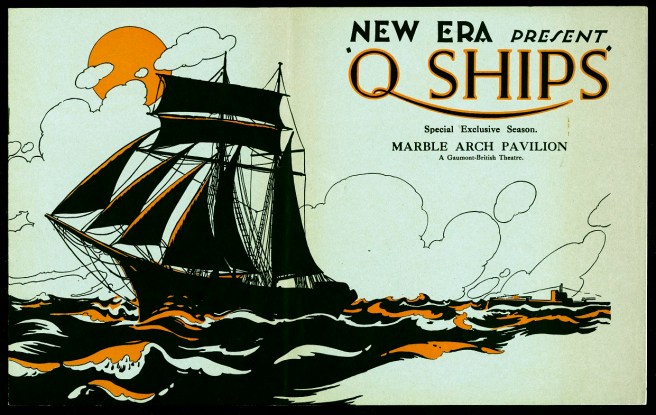
This suggested that even in the crowded market of wartime films a movie on the theme of Q-ships would be popular, and it was announced in late 1927. (3)
Its authenticity was a major selling point: ‘Reality and not “fake” will be the keynote of this production’. (4) Genuine and re-enactment footage were spliced together: as a review stated, ‘It is difficult to know at times when the “official topical” finishes and when the reconstruction of today starts, so fine is the production work and the editing.’ (5)
Harold Auten was a key stakeholder in the production: the film was largely based on his Q-boat Adventures and Stock Force‘s final battle, he was the film’s naval consultant, and he and five of his crew also reprised their wartime roles ten years on for the purposes of the film, together with ‘the actual gun’ from Stock Force.
William Butland, Chief Petty Officer of Stock Force (l), and Harold Auten (r), her commanding officer, shake hands during filming. By kind permission of the Butland family.
After all, they had form as actors in keeping up the role of merchant seamen for months on end while on the lookout for U-boats! A U-boat captain, Hermann Rohne, was taken on board as U-boat consultant, while Earl Jellicoe played himself as Admiral Jellicoe of Jutland fame.
The cast was the easy part. Re-enacting naval engagements was much harder, with a number of practical hurdles to overcome. First of all, the 1917-built Southwick replaced Stock Force, now at the bottom of the sea.
There were no longer any genuine U-boats, which had all been surrendered in 1918-19 and broken up in the early 1920s as directed by the Treaty of Versailles. However, two obsolete submarines were placed on the disposal list in 1927 and H-52 was accordingly purchased by producer E Gordon Craig as a stand-in for a U-boat.
She was intended to be sunk in a set-piece battle off the Eddystone in January 1928. but she was very nearly wrecked en route to being sunk (and in this resembles the real U-boats so often taken in tow post-war for breaking, when the sea accomplished the task intended for the breaker’s yard: see our previous post on this subject).
Under tow out to sea, she missed the harbourmaster’s launch by inches, crashed into a jetty without somehow managing to set off the demolition explosives with which she was packed, then broke tow. Arriving on location, they were forced to turn back and nearly lost the craft again when she went aground. (6)
On the final successful attempt, the submarine lay off the Eddystone, while guns from the Southwick, representing the Stock Force, fired 8 rounds into H-52, sinking the submarine and reversing the fortunes of the original event. ‘There was a sudden explosion and a high column of smoke and debris as the submarine blew up just fore of the conning tower. One hundred pounds of TNT had been stacked in her for this realistic touch, and this was set off by an electric lead to the naval boat.’ (7)
The wreck has been charted ever since January 1928, and has a detached bow and associated debris field consistent with her manner of loss. (8)
She joined a long heritage of naval vessels being repurposed at the end of their service lives – from 17th century accounts of wooden sailing vessels being used as foundations for new harbours, to 20th century warships and submarines being expended as gunnery targets, to the sinking of HMS Scylla as an artificial reef in 2004, but being expended for a film re-enactment is perhaps a little more unusual!
Another elderly vessel of mercantile origin, the schooner Amy, was also purchased to stand in for the schooner Prize in the film (the German schooner Else captured as a prize of war on 4 August 1914, hence her change of name). Prize was converted into a Q-ship and underwent three actions, being lost with all hands on her last battle with a U-boat. (The National Maritime Museum holds a watercolour of one of her previous actions.)
Amy was described as having been ‘one of the oldest sailing ships afloat’, built at Banff and 65 years of age on her first and last appearance on screen. This seems to refer to the Banff-built schooner Amy, official no.62443, which was, in fact, built in 1870 (and so was ‘only’ 58) and whose register was closed in 1928. (9)
Far from being a potential candidate for preservation, this ‘Grand Old Lady of the Sea’ (10) was selected to represent Prize in her final battle, which can also be viewed as an elegy for the sailing vessel in the light of the havoc wrought by the First World War.
She too was sunk ‘in action’ off the Bill of Portland in February 1928, and again it took several attempts, blamed on the removal of her figurehead as a souvenir. Much was made of this in the press, with superstitious sailors saying that to be successfully sunk she should have her figurehead with its ‘lucky squint’ reinstated! If nothing else, it was certainly a good story to drum up interest in the film. (11)
Amy has also been consistently charted at her position of loss since 1928 and has a unique place in the maritime heritage of England’s Channel coast. In being expended for re-enactment purposes, she can lay claim perhaps to being the final (indirect) victim of the First World War at sea in English waters (there were other direct post-war losses but we will cover that in a future edition of Wreck of the Week). She is also a rare, if not unique, example of the wreck of a Victorian sailing vessel documented in the early days of 20th century film. And finally, she has the sad distinction of being a counterpart to a genuine wartime loss, whose remains are yet to be discovered.
The Q-Ships film created – and documented in the very creation – a heritage of its own.
(1) Lloyd’s War Losses: The First World War: Casualties to Shipping through Enemy Causes 1914-1918, facsimile edition, 1990, London: Lloyd’s of London Press Ltd; uboat.net
(2) Q-boat Adventures, 1919, London: Herbert Jenkins Ltd.
(3) Western Morning News, Friday 25 November 1927, No.21,115, p5; Hampshire Telegraph, Friday 2 December 1927, No.3,114, p14
(4) Hampshire Telegraph, Friday 2 December 1927, No.3,114, p14
(5) The Stage, Thursday 28 June 1928, No.2,465, p24
(6) Western Morning News, Monday 2 January 1928, No.21,146, p5
(7)Belfast News Letter, Wednesday 4 January 1928, no issue number, p7
On 30 July 1918 a U-boat sighted a ship on a westbound course some 25 miles or so off the south Devon coast in the English Channel.
She had happened upon Stock Force, a modern steel-built collier of only 732 tons, launched in 1917, one of the little ‘rag-tag and bobtail of the seas’, under the command of Harold Auten. (1) Steaming westward without convoy, the Stock Force, though small, was better than nothing for a U-boat half-way through a hitherto unsuccessful war patrol.
At 5pm the U-boat launched a torpedo whose track was spotted by the crew of Stock Force, who tried their best to port the helm and put the engines full speed astern. Even so, they could not avoid the incoming torpedo, which struck their ship on the starboard side forward. The explosion caused a ‘tremendous shower’ of timber and a 40-foot hole in her side, and she began to settle down by the bows, with five men injured. (2) There was nothing for it but for the crew to put the long-rehearsed ‘abandon ship’ order into effect.
Not all the crew got away. There were some left behind . . . with five wounded taken below decks by the surgeon, working ‘up to his waist in water’, to have their hurts attended to. (3)
The U-boat surfaced half a mile distant and watched for some 15 minutes as the crew pulled away, then drew closer to investigate on the port beam, perhaps considering why, as you might too, why a modern vessel, and a collier at that, was throwing up such a shower of timber.
Thus began one of the most well-known duels between a U-boat and a Q-ship. In a sense Stock Force was indeed coasting in home waters, but she was on patrol in the hope of attracting just such attention from a U-boat. The timber was ballast bolted into her hold to keep her afloat in the event of being torpedoed – ‘floatation planks’. (4)
The men who got away were a ‘panic party’ for show: the remainder of a crew larger than usual for a collier of her size were now busy dropping all pretence along with her false sides as they opened fire with the ship’s hidden guns, minus her forward gun and some of the ammunition – the gun had been knocked out of action and the ammunition blown up in the explosion. One man was pinned underneath the forward gun and remained there ‘cheerfully and without complaint’ (5) while in a very real situation of danger. Nevertheless, forty minutes after the torpedo had struck, the Stock Force was engaging her enemy.
Manning the gun. Image courtesy of the Butland family, descendants of William Butland, Chief Petty Officer on board Stock Force.
They were all naval men wearing the clothes of merchant seamen, and such was the level of pretence there was even a ‘Board of Lies’ aboard the vessel, so that every man knew the story of each patrol by heart to account for the greater crew complement – the extra men were supposedly crew of one or more mined vessels (always mined, never torpedoed, to avoid the risk of the story not checking out).
The Stock Force continued to attack the U-boat, inflicting so much damage upon her periscope, conning tower, and finally also tearing a hole in the submarine’s hull. They ‘poured shell after shell until the submarine sank by the stern, leaving a quantity of debris on the water.’ (6) In turn the ferocity of the action contributed to the Stock Force‘s own demise and the water gained on them even as they tried to nurse her back towards land.
As Auten would later put it: ‘ . . . it was particularly hard to have got her almost within sight of land – the shore was only eight miles away – and then to lose her’ as ‘poor little Stock Force sank to her last home’. (7) She sank at 9.25pm with the crew taken off by two torpedo boats and a trawler. (8)
Another story of mutually assured destruction on the high seas? Not quite. There was more to the tale of the Stock Force than met the eye. Few, if any, details emerged of the action in the press, with greater prominence being given to other successes against U-boats, for example off the east coast by a British submarine and in the English Channel by a yacht (9) The key detail widely extracted in the press from a statement by David Lloyd George in Parliament was that U-boat losses now stood at 150. (10)
Details began to trickle out with crew honours gazetted, divorced from any context and prefaced only by the words that ‘The King has been graciously pleased to award the following honours . . . ‘ (11) Auten was awarded the Victoria Cross for his part commanding the action. Immediately after the war, details emerged of the Stock Force in action and it was there that the ‘kill’ of the submarine came to light. (12) The story was then widely taken up in the press, with double-page spreads and artists’ dramatic impressions of the U-boat upended and sinking below the waves, even as Auten and his crew met the public aboard Q-ship Suffolk Coast on tour. (13)
The lost U-boat was originally attributed to U-98, which can, however, be placed south of Norway with the sinking of Alkor on 31 July and was surrendered on 16 January 1919. The attacking submarine was UB-80, which sank only to rise again, for once again she was out on patrol in September 1918 following repairs and surrendered to Italy on 26 November 1918, but it is unsurprising that at the time she was credibly believed to have been lost. Both were broken up in the UK and Italy respectively. (14)
So, after all, there is only one ship on the seabed off the south coast of Devon as a result of the action of 30 July 1918. Camouflaged in service, the Stock Force also remained camouflaged on the seabed following her demise and was attributed to two different sites, both also probably contemporary war losses, before being identified in 2011 in a location much more consistent with Auten’s description of the position of loss than the previous two candidates, at some 7 miles SW off the Bolt Tail, Devon. (15)
Or is there? We will continue the story of Stock Forceacross this week as we commemorate the centenary of one of the most well-known of all Q-ship incidents and its significant contribution to the maritime heritage of Devon.
[With many thanks to Steve Mortimer and John Butland for their very kind help in telling this story over the week.]
(1) Intertitle,Q-Ships, 1928, New Era Productions
(2) Auten, Lt Commander Harold, 1919, Q-boat Adventures London: Herbert Jenkins Ltd; Keble Chatterton, E, 1922 Q-Ships and their Story London: Sidgwick and Jackson Ltd
(3)London Gazette, 19 November 1918, No.31,021, p13,695
(4) Auten 1919; Keble Chatterton 1922
(5) London Gazette, 19 November 1918, No.31,021, p13,695
(6) ibid.
(7) Auten 1919
(8) London Gazette, 19 November 1918, No.31,021, p13,695
(9) for example, Hull Daily Mail, 21 August 1918, No.10,265, p2, Gloucestershire Echo, 9 August 1918, extra, p1
(10) for example, Hampshire Telegraph and Naval Chronicle, 9 August 1918, No.7,167, p4
(11)London Gazette, 13 September 1918, No.30,900, p10,847
(12)London Gazette, 19 November 1918, No.31,021, p13,695
(13) The Sphere, 14 December 1918, No.986, pp196-197
For our second blog this week celebrating the 45th anniversary of the Protection of Wrecks Act 1973, enacted on 18 July 1973, where better to start than the very first wreck designated under the Act?
We welcome guest blogger Martin Read of Plymouth University, who was at school near the Cattewater Wreck during the 1970s excavations. He subsequently became an archaeological conservator for English Heritage and the Mary Rose Trust before returning to Plymouth.
He has also taken part in excavations such as the Mary Rose & Vliegent Hart. Since 2006, he has been a Licensee for the protected Cattewater Wreck, organising surveys and research work on this site carried out by local divers and University students. He has also carried out research on the 1970s excavation archive in Plymouth City Museum and Art Gallery and project manager for the Cattewater Wreck Archive Project (for Plymouth City Museum and Art Gallery), funded by English Heritage (now Historic England).
Martin writes:
Plymouth has been an important maritime port since medieval times and as a result the area is rich in marine archaeological resources. During the Medieval and Tudor periods the port carried out coastal and international trade in cargos such as salted fish, wine, cloth and tin. The Cattewater, the lower estuary of the river Plym, has been the main anchorage for Plymouth since medieval times.
The Cattewater Wreck is believed to be an unidentified armed wooden merchantman from the early Tudor period. The site was discovered in 1973 and partly excavated between 1976-8. A substantial portion of the remains of the wooden hull should still be present, buried beneath anaerobic sediments and is believed to be under no immediate threat of damage or destruction.
Dredging for air-sea rescue craft moorings in 1973 recovered timbers and iron guns identified as being from a Tudor shipwreck. As a result, the wreck site was designated under the Protection of Wrecks Act 1973 (Order No.1), becoming the first wreck given protection by the UK Government. The designation covers a radius of 50m centring on a position of 50°21’41.4”N 04°07’27.5”W. Within this area it is an offence to tamper with, damage or remove any part of a vessel lying wrecked on or in the sea bed, or any object formerly contained in such a vessel. This includes any diving, mooring or survey without a licence from the Government.
The site was surveyed and partly excavated under Government license (1976-8). Recovered finds included structural timbers, wrought iron swivel guns on wooden beds, stone & lead shot, lead waste, ceramics, shoes, a leather purse and textiles, as well as environmental evidence, including animal and fish bones. The finds could be characterised by function as being part of the ship and its working equipment, domestic artefacts, eating and drinking equipment and stores (Redknap 1997).
The excavation results suggested that the Cattewater wreck dated to the first half of the 16th century, and has been published as being ca.1530. The vessel was interpreted as operating as an English coastal trader (Redknap 1984).
Geophysical survey techniques mean that archaeologists can examine a wreck site without physical interference. Plymouth University teaches geophysical surveying as part of undergraduate and post-graduate degrees and, since 2006, has held a Government license to dive and to carry out geophysical surveys (including sub-bottom profiler, side-scan sonar and magnetometer surveys) of the wreck site. These have identified the probable location of the wreck to be approximately 20m east of the centre of the designated area, but still within the radius of protection. Sub-bottom profile images show the wreck to be about 1m below the seabed.
A team of local divers have been used to ground-truth targets generated by the geophysical surveys and have also carried out metal-detector and probe surveys of the site, locating the wreck in the area identified by the student surveys.
Archive Project
The archive from the 1970s excavation has been deposited in Plymouth City Museum and Art Gallery (Site Accession Number AR.1985.2). In 2011 English Heritage funded a project (under the National Heritage Protection Commissions Programme, Project Number: 5439 MAIN, Cattewater Wreck: Developing the Archive) to improve the long term care and management of the archive to modern archival standards and organisation. The principal outcome of this project was a more accessible archive, better able to survive in the long-term.
The project revealed that a significant proportion of the excavation archive (including about 50% of the finds) was missing, presenting difficulties when making any re-assessment of the site. The number of finds recovered during discovery and excavation is hard to be precise, 474 find numbers were used, but the same number was often used for multiple finds. The site database now consists of 790 artefact/sample/timber records, including 28 records of unlabelled finds.
A great deal of effort has been spent over the years to consolidate the site archive, including the relocation of missing elements. In 2013 the National Maritime Museum added to the archive a number of finds, samples and documents that they held.
The original archaeological studies into the finds were carried out over 30 years ago and finds research into, for instance, leather and ceramics have advanced over that period. New scientific techniques are also now available which can be applied to finds, allowing new interpretations to be made about this important site.
Ship construction
The wreck is believed to be of an unidentified armed merchantman, a 3-masted carvel-built vessel of standard form, of 186-282 tons (Redknap 1984). Evidence from the site, such as ship construction and some finds (such as ceramic tiles) now indicate that the ship was built in southern Europe, perhaps somewhere in SW France, Iberia or in the western Mediterranean (perhaps as far east as western Italy).
Carbon-14 dating was carried out on two wooden samples taken from the ships structure. A futtock was dated to AD 1420-1600 (340~80 BP, 1610~80 ad uncalibrated, HAR-3310), whilst an oak outer planking sample was dated to AD 1429-1509 (510~50 BP, 1390-1490ad uncalibrated, UB-2225).
Tree ring analysis (dendrochronology) was carried out on two of the structural timbers, the keelson and a floor timber. Comparison with tree-ring chronologies suggested several potential dates but none of these were acceptable, e.g. the keelson appeared to match at two places, giving dates for its outer ring of A.D. 1454 or 1457, but with no confidence.
Neither Carbon-14 or tree ring dating really helps with the dating of the ship, at present, though they are consistent with the other evidence.
It is believed that the carvel ship construction technique reached northern Europe sometime in the second half of 15th century. Until better dating can be obtained, this is the most likely date for the construction of the ship.
Working life
The majority of the finds recovered were identified as being English and the ballast included local Plymouth limestone and granite.
No English ceramics of the 15th-16th century were originally identified from primary wreck contexts. However, reinterpretation of the ceramics has led to the identification of one sherd of Tudor Green Ware (from the Surrey/Hants border) dating to the late 15th-17thc, whilst another unstratified sherd has been identified as possibly part of a cooking pot from South Somerset.
International links are shown from imported finds, including Dutch, Rhenish (Raeren and Siegburg), SW French and Iberian ceramics. The largest group of ceramics recovered were identified as being Dutch, but both the Dutch and Rhenish ceramics were commonly traded into England at this period.
The scarcity of ceramics from Iberia cast some doubt on a possible Iberian origin for the wreck (Redknap 1997). A number of sherds of Iberian ceramics were recovered from the scour deposits, so may not be directly associated with the wreck. A possible Merida-type glazed floor tile, which are very rare in the UK, was found in a primary wreck context and probably came from the galley hearth.
Ceramics from southern Europe, particularly from South-West France, Iberia and Italy, have commonly been found in medieval and post-medieval deposits on land sites in Plymouth showing strong links between Plymouth and Mediterranean Europe, a result of the port’s international trade. It may be significant that two fragments of ceramics identified as being from SW France were found in primary wreck deposits.
The ship seems to have been re-ballasted in Plymouth, but non-local stone was identified as originating from around the Southern English coast, from Bristol/South Wales to Kent. This was used to indicate that the vessel was acting as a coastal trader, possibly operating between Bristol and London, but other interpretations are possible. The ballast makeup could reflect local ballasting practice, incorporating residual ballast from the re-ballasting of previous ships and therefore the main background trade links of the port.
Wrecking, salvage and site formation
Recent re-dating of the leather shows that the ship must have been wrecked after 1500, with the most likely date being in the early 16th century. This is consistent with the re-dating of the ceramics (ca.1480-ca.1525), though the possibility remains that the actual date of wrecking might be later.
A study of historic records shows that the most frequent cause of shipwreck in the Cattewater was whilst either at anchor or entering/leaving the port during a storm, with the Cattewater being particularly exposed during south westerly storms. These are also the most likely causes for the loss of the Cattewater Wreck.
Another possible scenario is due to fire. There is some evidence in support of this, though this comes mostly from the scour layers and may not relate to the wreck.
The only known casualty of the shipwreck was a dog, which had probably been used to control rats on the ship. Four bones have been identified, and measurements indicate a withers height of about 50cm (just over 20 inches), the height of a whippet, border collie or spaniel.
The wreck site was shallow enough for the salvage of anything of value to have taken place. As a result it is uncertain what cargo (if any) the ship was carrying at the time. Finds included barrel parts and cod bones, with a suggestion that salted fish might have been a cargo (though they are more likely to be victuals).
Stable isotope analysis, carried out on some of the cod bones by York University, indicated that most fish were likely to have come from local (or relatively local) waters, but one fish came from outside the area, most likely from the North Atlantic.
Most finds that could be directly associated with the wreck, including the dog bones, were recovered from amongst the ballast or between the ships planking, but a large number probably originating from the wreck were found in other, later, contexts having been eroded out.
Several scour pits were excavated around the wreck, ceramic finds indicating they were formed (or at least filled) after 1700, most likely in the early 18th century.
Present Interpretation
The original scenario put forward as a result of the 1970s excavations may still be valid, with the ship operating in the English coastal trade between Bristol and London. There is some evidence to support the identification of the ship as being an international trading vessel, possibly with links to SW France or Iberia.
Martin Read, February 2018
For more information on ongoing research on the Cattewater wreck and the archive project, please visit:
Carpenter, A.C., Ellis, K.H. & McKee, J.E.G. 1974 Interim Report on the Wreck Discovered in the Cattewater, Plymouth on 20 June 1973 NMM Maritime Monographs and Reports 13.
Redknap, M. 1984 The Cattewater Wreck: the investigation of an armed vessel of the early 16th century National Maritime Museum Archaeology Series 8/British Archaeological Reports – British Series 131.
Redknap, M. 1997 ‘Reconstructing 16th-century ship culture from a partially excavated site: The Cattewater Wreck:’ in Redknap, M. (ed.) Artefacts from Wrecks Oxbow Monograph 84.
Henry V’s Grace Dieu – medieval England’s biggest ship
General view of the River Hamble looking north-west towards the site of the Grace Dieu, Bursledon, Hampshire
You might say that the opposite of ‘wreck’ is ‘launch’ and today, 16 July 2018, marks 600 years since the first date we can tie to the Grace Dieu in the whole of her long history, the majority of which has been spent as a wreck site in the River Hamble. In 1974 she was one of the earliest designations under the Protection of Wrecks Act 1973, which came into force 45 years ago this week, so a double ‘birthday’ so to speak!
Today’s guest blogger is Dr Ian Friel FSA, an independent historian, museum consultant and writer. He worked for 30 years in museums, including the National Maritime Museum, Greenwich and the Mary Rose Trust, and was involved in NMM fieldwork on the Grace Dieu and (potential) Holy Ghost wreck sites in the early 1980s. He is the author of three books on maritime history, including Henry V’s Navy (The History Press, 2015) and is currently working on a fourth.
Dr Friel writes:
Six hundred years ago, on 16 July 1418, William Barrowe, the Bishop of Bangor, received his travelling expenses for a trip from London to Southampton and back. What does this less-than riveting piece of information have to do with the theme of Wreck of the Week? The answer is that Barrowe’s mission was ‘to consecrate a certain King’s ship, there newly built, called the Gracedieu’.
The Grace Dieu was the last and biggest of four ‘great ships’ constructed for King Henry V of England between 1413 and 1420. ‘Great ship’ was a contemporary type name and these vessels played an important role in Henry’s plans to conquer France, because eliminating French sea power was one of the keys to a successful invasion.
Big naval battles were fairly rare in the Middle Ages, but they usually ended in a series of bloody boarding actions in which big ships with large crews had the advantage. This was clearly the chief raison d’etre of the great ships, though they also had propaganda value as symbols of English might.
The great ships were part of one of the most powerful royal war fleets ever seen in medieval England. Major operations relied on the participation of large numbers of conscripted English vessels and hired foreign shipping, but the ‘king’s ships’ were the spearhead of the English naval war effort. The first three great ships, the Trinity Royal (500 tons), Holy Ghost (740 tons) and the Jesus (1000 tons), were completed between 1415 and 1417. The Trinity Royal and Holy Ghost certainly went into battle, and it’s likely that the Jesus did, as well. The Grace Dieu’s naval career was shorter and much less eventful.
Construction of the ship began at Southampton in 1416, in a specially-dug dock. The work was overseen by an official named Robert Berd, but it’s unlikely he was anything more than a manager and bean-counter. There is little doubt that the Grace Dieu was designed by the project’s master shipwright, John Hoggekyn.
We know very little about the dedicated, workaholic Hoggekyn – he was eventually pensioned off after wearing himself out in royal service – but he deserves to be remembered as one of medieval England’s greatest engineers. His achievement was on a par with that of Brunel in building the huge steamship Great Britain in the 19th century.
The Grace Dieu was clinker-built, and each overlapping strake (line of planking) was composed of three layers of boards – presumably to prevent the huge structure from collapsing under its own weight. The ship was reckoned to be of 1400 tons burden (theoretical carrying capacity), making it the biggest vessel seen in England before Henry VIII’s time, a century later. Measurements of the Grace Dieu made in 1430 suggest that it was 50 m to 60 m in length and about 15 m in breadth (164-197 ft x 50 ft). It was not much smaller than Nelson’s HMS Victory of 1805, though the Grace Dieu and the other great ships will have looked very different. They probably resembled carracks – the carrack was a large medieval ship type of Mediterranean origin, used for both trade and war.
The Grace Dieu was built with a retinue of two oared fighting ships and four boats, and at least 3,906 trees were felled for the project. Most were New Forest oaks, though beech, ash and elm were also used, along many other timbers and boards. The ship had a huge mainmast, possibly over 50 m in height and carried two, or possibly three masts in total. Multi-masted ships were very new in England at the time – the purpose of the additional sails was doubtless to help propel and manoeuvre big ships. The Grace Dieu itself came with an eye-watering price-tag, costing an estimated £3,800, perhaps equal to £1,647,000,000 nowadays.
The blessing of the Grace Dieu by the Bishop of Bangor in 1418 may have marked the day on which the hull was floated out of its building dock. Though described as ‘newly built’ at that point, it was not ready for sea until 1420.
In the spring of that year it became the flagship of a powerful patrol group assembled at Southampton. The force included the three other great ships – it was the only occasion on which they sailed together. By this time, however, the naval war was virtually over. The English had broken French sea power back in 1417, allowing Henry to invade France for a second time. There were still fears in 1420 that France’s Spanish allies might attack England, but this threat never materialised.
Most English ships of the time were of less than 100 tons, so the Grace Dieu and the other great ships must made a deep impression on contemporaries. One of Henry’s brothers, Humphrey, Duke of Gloucester, wrote to the king: ‘… your great ship the Grace Dieu is ever as ready and is the fairest that ever men saw…’
However, all was not well. England was short of sailors, and the three earlier great ships were seriously undermanned, with between 50 and 70 per cent of their original complements of 200 mariners apiece. Even the Grace Dieu carried only 199 sailors, surely too few to properly manage such a big vessel.
Aside from the manpower problems, there was serious discontent in the fleet. Men were refusing to be mustered – to have their names taken for pay records – and it took a real effort to get the force to sea. The Grace Dieu finally sailed out into the Solent, but the voyage was cut short by a mutiny, led by some Devon men. They forced the ship to put in at St Helen’s, on the western end of the Isle of Wight, and that was the end of the Grace Dieu’s war service. Medieval England’s biggest and most expensive war machine sailed only slightly further than a modern Solent ferry.
The four great ships were taken back to the River Hamble, on the eastern side of Southampton Water, where there was a protected anchorage for the royal fleet. The government made serious efforts to keep them afloat, for they were still emblems of English royal power, even if there was no sea war to fight. The Grace Dieu was certainly used to impress at least one visiting Italian galley commander. Luca di Maso degli Albizzi was wined and dined aboard the ship in 1430, and later wrote in his diary that he had never seen ‘so large and splendid a construction’.
Despite the maintenance work, the great ships all began to leak more and more. The three older vessels were laid up between 1426 and 1430, and the Grace Dieu followed a few years after. In order to lighten the ship, much of its heavy gear was removed in 1432 and the top part of the great mainmast was cut off. Two years later, the Grace Dieu was towed upriver to Bursledon, and placed in a mud dock cut into the riverbank.
The great ship was abandoned, but it did not moulder for long. It was struck by lightning on the night of 7/8 January 1439, caught fire, and burned to the waterline. Nails and other ironwork were salvaged from the wreck, along with the charred stump of the mainmast, and royal officials continued to chronicle the storage or disposal of this junk (archeology to us) for years. However, in 1452 the record of the Grace Dieu came to a full stop.
Four hundred years later, a small stream on the bank of the Hamble changed course, and washed away some mud to reveal a big shipwreck. First mentioned in an 1859 local guidebook, it was identified as the remains of a Danish warship destroyed by King Alfred’s forces in the 9th century. The ‘Viking Ship’ became quite well known – and also suffered from the attentions of souvenir-hunters, who hacked bits off it.
Ironically, the worst vandal was a man who tried to record the wreck, Francis Crawshay (c 1811-78). He was a wealthy landowner who kept a yacht on the Hamble and evidently fancied himself as an archaeologist. Sadly, his principal excavation tool was gunpowder! In the end, the wreck was saved by Customs and Excise – not for any archaeological reason, but because Crawshay had failed to declare his finds to the Receiver of Wreck.
The ‘Viking Ship’ was finally identified as the Grace Dieu in 1933, by the historian R C Anderson. Anderson visited the site with a small team, at the instigation of a local man, Mr F C P Naish. They made the first modern survey of the site, conducted a limited excavation and revealed the wreck’s unprecedented triple-skin clinker planking.
There was other work on the wreck in later decades, including a series of investigations by the National Maritime Museum’s former Archaeological Research Centre in the early 1980s. The full shape and extent of the hull remains were revealed by sonar survey made in 2005 by the University of Southampton and the National Oceanography Centre. This showed that only the bottom 2 m of the Grace Dieu survives, but even this remnant is massive, measuring some 32.5 m by 12.2 m.
The wreck of the Grace Dieu was bought in 1970 by the University, and in 1974 it was designated as a Protected Wreck under the 1973 Protection of Wrecks Act. You can only visit the site of the Grace Dieu with special statutory permission, but at very low tides it is possible to see some of its timbers from the opposite riverbank in Upper Hamble Country Park – the wreck site is marked with a yellow PWA buoy.
The Grace Dieu is of international importance, one of a small number of known medieval wrecks in the UK, and one of the few in Europe of this period that can be named. The ship owed its existence to the warlike ambitions of one of England’s most famous kings, and shows medieval maritime technology operating at its limits. The wreck is also a monument to one of England’s most accomplished, but least known shipbuilders – John Hoggekyn.
Carpenter Turner, W.J., ‘The building of the Gracedieu, Valentine and Falconer at Southampton, 1416–20’, Mariner’s Mirror 40 (1954), pp.55–72
I Friel, ‘Henry V’s Grace Dieu and the wreck in the R. Hamble near Bursledon, Hampshire’, International Journal of Nautical Archaeology, Vol 22, 1993, pp 3-19
I Friel, The Good Ship. Ships, Shipbuilding and Technology in England 1200-1520, British Museum press, London, 1995
I Friel, Henry V’s Navy, The History Press, Stroud, 2015
Plets, R.M.K., J.K. Dix, J.R. Adams, J.M. Bull, T.J. Henstock, M. Gutowski and A.I. Best, ‘The Use of a High-resolution 3D Chirp Sub-bottom Profiler for the Reconstruction of the Shallow Water Archaeological Site of the Grace Dieu (1439), River Hamble, UK’, Journal of Archaeological Science, 36 (2009), pp.408–18
S Rose, ‘Henry V’s Grace Dieu and Mutiny at Sea: Some New Evidence’, Mariner’s Mirror 63 (1977), pp.3–6
S Rose (ed), The Navy of the Lancastrian Kings: Accounts and Inventories of William Soper, Keeper of the King’s Ships, 1422-1427, Navy Records Society Vol 123, London, 1982.
Crawshay obituary: Hampshire Advertiser, 9 November 1878, p 5 (via britishnewspaperarchive.co.uk)
Over the summer there will be a few wreck features with a German theme, inspired by my recent holidays on Germany’s northern seaboard with its strong maritime heritage – a shared history across the North Sea.
Not long ago a colleague in the Historic England Archives showed me a set of recently-acquired negatives, depicting a wrecked sailing vessel against some white cliffs with a very tiny lighthouse visible in the far distance. Those details, and a possible date of circa 1900 on technical grounds, were all we had to go on. No proper location, no real date, no identity for the vessel, no name for the photographer – and white cliffs aren’t unique to Dover.
Off I went to inspect the negatives on a lightbox, prepared for a patient elimination of white cliff and lighthouse combinations to identify the location, before then narrowing it down to a specific ship – but the ship herself proved to be extremely obliging and we struck lucky virtually at once.
At first glance the words ‘possible Flying-P liner’ came to mind, as she was clearly a very large vessel of steel-hulled construction – not unique to the ‘Flying-Ps’, which were, however, among the most celebrated sailing vessels of their day, the ‘windjammers’.
These windjammers of the late 19th and early 20th centuries made use of contemporary iron and steel technology to develop large cargo-carrying sailing ships which were predominantly or wholly square-rigged to take full advantage of the wind. Hence not only the collective name ‘windjammer’, but also the ‘Flying’ Reederei F Laeisz fleet, whose ships all began with ‘P’. The windjammers arguably extended the sailing vessel era until well into the 20th century, although, even as they were being developed from the 1880s onwards, steam had already overtaken sail as the principal means of propulsion.
Then I counted the masts in the negatives – five – and with that the ship yielded her secrets. Those white cliffs were indeed at Dover and the ship was indeed a ‘Flying-P’, the Preussen, the only five-masted full-rigged ship ever built. (1) She broke tow following a collision and stranded in Fan Bay, Dover, on 6 November 1910, en route from Hamburg on a typical windjammer run to Valparaiso, Chile, with a cargo which included pianos.
Wreck of the Preussen, Fan Bay, Dover. From this angle the masts seem to tower above the cliffs – a dramatic shot that suggests a photographer with an eye for composition.
So who was the photographer? Someone with the skills to take a photograph at sea from a moving object, namely another vessel. The image, sea conditions, the wreck itself, and the cliffs are all clearly defined, demonstrating continuing interest in the deteriorating condition of the vessel after the wreck event.
Compare this view of the same shipwreck immediately after she struck, by local resident and female photographer, Annette Evelyn Darwall, which was already in the Historic England collection. This, too, is a skilled photograph, including a section of cliff at left foreground for a sense of place and sense of scale which makes us realise that the viewpoint is everything.
The Preussen aground at low tide, seen from the cliffs above, photographed shortly after the wreck event in November 1910.
Returning to our ‘unknown’ collection, a further extraordinary photograph demonstrates the technical competence of our mystery photographer, in turn showing how photography advanced the recording of shipwrecks.
Traditional shipwreck paintings were largely creations after the event. During the Dutch Golden Age of the 17th century Willem van de Velde the Elder would sketch ships lost in action from his position aboard a galliot embedded in the Dutch fleet, but these scenes would later be formally worked up onto canvas. Paintings of tragic wreck events such as the Raft of the Medusa (Théodore Géricault, 1819, Louvre, Paris) or Disaster at Sea (Turner, c.1835, Tate, London) are highly-emotive reconstructions based on survivors’ accounts. In all of these paintings we are looking towards the shipwreck, though some artists concentrated on scenes of pathos within as passengers awaited their fate (Wreck of the Halsewell, Thomas Stothard, 1786, National Maritime Museum, Greenwich) but again these were retrospective ‘artists’ impressions’ based on first-hand accounts.
Photographers such as Frank Meadow Sutcliffe at Whitby or Gibsons of Scilly exploited the dramatic possibilities of artistic composition, placing the shipwreck firmly in its context as an alteration to the natural landscape, often broadside on, with the power of the waves captured naturalistically in real time.
Photographers soon began to record other aspects of shipwrecks such as daytrippers’ visits (in one Gibson photo of 1895 we’re looking at sightseers in Cornwall looking at a wreck from much the same sort of clifftop viewpoint that attracted Annette Evelyn Darwall to photograph the Preussen near Dover). It then became possible to record rescue in real time. Yet these photographs still frame shipwrecks in a landscape context, albeit as temporary alterations to the local environment (and all the more attractive as a subject for that reason).
The early years of the 20th century changed all that. It became possible to record shipwrecks from new perspectives as they were actually happening, which would come to the fore just before and during the First World War – from other vessels in company (HMHS Anglia post, 1915), or aerial photographs from the then new-fangled aircraft, or from within the wreck itself (Ballarat post, 1915).
As our mystery photographer demonstrates, it was also possible for an intrepid visitor to climb aboard a wreck and illustrate the wrecking process from within.
View looking astern on board the Preussen, awash amidships, c.1910. Note the sharpness and technical competence of the image aboard an unstable platform being pounded by the sea.
There seems to have been quite a trade in postcards of the event, not surprising at a time when wreck sites could become temporary seaside attractions. A quick Google gave me three possible photographers’ names so once more I prepared to research them, and once more the first hit seems to have been the correct one. A postcard from amidships in the opposite direction looking south towards the bows suggested the same photographer, named on the front as ‘Russell Jewry, Photo. Deal.’
I felt sure then that we had our man – the same modus operandi, and as a commercial photographer he would have had access to up-to-date professional equipment to stabilise his camera on board the wreck, and as a local man someone with the contacts to obtain access.
It’s likely that he was able to board her in conjunction with a survey or assessment visit, such as one noted in Lloyd’s List from 9 November, with a German lighter due in to begin offloading the cargo that afternoon. Further reports showed that the vessel continued to deteriorate following winter gales in December, finally breaking in two in January, while the salvagers themselves ran the risk of wreck. It looks as if the photographs were taken in winter conditions, probably in early December – so Russell Jewry took significant risks to obtain a commercial scoop. (2)
If only all archive mysteries were as easy as this! What a pleasure though to go from a completely unidentified image to one with a location, a subject, a photographer, and a date in one go!
To this day tall ships remain tourist attractions, and even at the time the windjammers were something of an anachronism. As we’ve shown in the War Diary, sailing ship numbers were drastically reduced during the First World War, and by the 1930s, even at the height of the long-distance grain races on which they remained commercially viable, they were positively old-fashioned and somewhat under-resourced – even before this time books had been written on the ‘last of the windjammers’! Aboard the Winterhude in 1934, an English sailor recorded that his ship was circled in mid-Atlantic by an American liner which diverted out of her course to allow her passengers to take in the sight, something of a novelty in its turn for the captain of the Winterhude! (3)
The Preussen‘s fellow Flying-P, Pamir, passed through many adventures, including two World Wars and changes of ownership. Before the Second World War she was owned by Finn Gustav Erikson of Mariehamn, who bought up many of these old sailing barques. In Wellington, New Zealand, in 1941, however, she was seized by the New Zealand government as a prize of war, and sailed under their flag for the duration.
Post-war she was something of a celebrity as one of the very last of the commercial sailing vessels. Her return to London in 1947 excited considerable interest, sailing back to New Zealand in 1948, when she was formally rendered back to Erikson. Later the same year she left once more for Australia to pick up grain in what was billed as the last grain race from Australia to England, together with her ‘sister’, Passat. Their final landfall in England in 1949 again made headline news. (4) Sadly, Pamir would founder at sea in mid-Atlantic in 1957. Following the loss of Pamir, Passat was taken out of service, but survives today as a museum ship at Travemünde, Germany.
Pamir in 1947-8 at Royal Victoria Dock, London. The neighbouring cranes give a sense of scale. Photographer: S W Rawlings
Whether as shipwrecks in 1910, a sight worth a diversion in mid-Atlantic in the 1930s, or as museum ships today, these grandes dames of the sea have always commanded attention, and never more so than in 1910 for a Deal photographer prepared to take risks for an outstanding shot.
Passat as a museum ship at Priwall, Germany, June 2018, seen from the Travemuende bank. By coincidence, this tourist photograph echoes the crane in the Pamir shot (1947) and the slightly deceptive sense of scale of the Preussen against Dover’s White Cliffs in 1910! Photograph courtesy of Andrew Wyngaard.
(1) Other five-masted vessels and above were available, so to speak, but they were never as common as three- and four-masted vessels, and seem to have been particularly in vogue around the early years of the 20th century. Wreck of the Week has previously covered the unique 7-masted Thomas W Lawson (1902-1907), lost off the Isles of Scilly. One of Preussen’s ‘Flying-P’ precursors was the five-masted barque Potosi(1894-1925). TheFrance II (1911-1922), and R C Rickmers(1906-1917) were also five-masted barques built with auxiliary engines, while there were a number of American five-masted schooners such as the wooden-hulled Paul Palmer(1902-1913) and Prescott Palmer (1911-1914). The SS Great Britain steamer (1843), is now displayed as originally fitted out, with six masts, one square-rigged, the others rigged fore-and-aft, but she was the reverse of the France II and R C Rickmers, with sail auxiliary to steam.
(2) Lloyd’s List9 November 1910, No.22,815, p9, and 19 December 1910, No.22,849, p9; Dundee Evening Telegraph, 12 January 1911, No.10,593, p1, and Dover Express, 13 January 1911, No.2,741, p5
(3) Geoffrey Sykes Robertshaw, Before the Mast: in the Grain Races of the 1930s, Blue Elvan Books, Truro, 2008. For further reading on the windjammers: Basil Lubbock, The Last of the Windjammers, Brown, Son & Ferguson, Glasgow, 2 vols., 1927-1929; Eric Newby, Learning the Ropes, John Murray, London, 1999
(4) See, for example, the eager reporting of Pamir‘s arrival in London in time for Christmas, December 1947, Western Morning News, 22 December 1947, No.27,430, footage of the then Princess Elizabeth and the Duke of Edinburgh visiting the Pamir in London in March 1948, and on the vessels’ return in 1949, Hull Daily Mail, 1 October 1949, No.19,926, p3; North Devon Journal, 6 October 1949, No.6,705, p7.
History has a habit of repeating itself, not least at sea. Today’s First World War wreck has a namesake with a very similar history in the Second World War: both vessels were owned by the same firm originally and were likewise lost to enemy action on Admiralty service in English waters, both with significant loss of life.
On 13 June 1918 HMS Patia was sunk by in the Bristol Channel in a position said to be 25 miles west of Hartland Point, while on service as an armed merchant cruiser. She was built in 1913 for Elders and Fyffes (of banana fame), whose early 20th century ships took advantage of modern refrigeration technology to transport bananas across the Atlantic to ensure fruit reached market in peak edible condition.
A photograph of her sinking is in the Imperial War Museums Collection online.
Their second Patia, built in 1922, entered Admiralty service first as an ocean boarding vessel, then underwent conversion to a fighter catapult ship. She too was sunk on 27 April 1941 off Beadnell Point, Northumberland, by an aerial attack, but not before her crew had downed the attacking aircraft – continuing the theme of mutually-assured destruction covered in last month’s post.
It’s worth reiterating that the War Diary has showcased the war service of many of the world’s commercial shipping fleets during the First World War, and these companies would reprise that service during the Second.
Wartime deployment would depend to some extent on their original civilian roles. We have already seen how trawlers became minesweepers, Scandinavian colliers were requisitioned and redeployed in British collier service, and ocean liners became troopships and hospital ships – and also armed merchant cruisers, a form of vessel we have not hitherto covered in the War Diary.
Patia‘s speed as a specialist banana carrier made her suitable for carrying out this auxiliary naval role, which she successfully performed from November 1914 right up until 13 June 1918, armed with 6 x 6in howitzers and 2 x 3pdr anti-aircraft guns. She served principally in the North Atlantic between Scotland and Iceland, and from 1917 took up convoy escort duties. Her logs survive up till 30 April 1918, showing that in February she had escorted a convoy home from Dakar (Senegal) before docking at Avonmouth on the 25th for maintenance. Subsequent entries reveal “chipping and painting” over the next month, that is, getting rid of rust before applying a fresh coat of paint. (1)
No further logs survive, highlighting one of the key difficulties in researching the events of a century ago. As usual, the Admiralty press release was extremely brief, hiding the location of loss:
‘The Admiralty on Monday night issued the following: – H.M. armed mercantile cruiser Patia, Acting Captain W. G. Howard, R.N., was torpedoed and sunk by a German submarine on the 13th inst.
‘One officer and 15 men, including eight of the mercantile crew, are missing, presumed drowned. The next-of-kin have been informed.’ (2)
The details which made it into the press at the time focused on the human interest aspect, including the deaths of local men, which had been depressingly regular reading in regional newspapers since the outbreak of war. For example:
‘CASUALTIES AMONG MIDLAND MEN.
‘The following additional particulars of local men killed have been supplied:-
‘Signalman William Harold B. Roe, RNVR, HMS Patia, lost his life through the Patia being torpedoed on the 13th inst. The elder son of Mr William Roe . . . he was educated at King Edward’s Grammar School, holding scholarships. On leaving school he entered Lloyds Bank and rapidly progressed. On January 10, 1918, he was married to Miss Alice Williams . . . ‘ (3)
Likewise, the Western Daily Press reported:
‘A Portishead man, Mr Leslie Victor Atwell, lost his life in the ill-fated Patia. He was a naval reservist and joined up on the outbreak of war. He was 35 years of age, married, and previously an employee of the Docks Committee.’ (4)
More happily, another feature referred to the ‘Exciting Experiences of Famous Young Walsall Violinist’:
‘One of the able seamen who was saved from the Patia was Harold Mills, Walsall’s brilliant young violinist. He arrived in Walsall after a short stay in an English hospital, and in a chat with a representative of the Observer, spoke on all subjects except his being torpedoed.’
It emerged that he spent an hour in a boat which then picked him up and transferred him to an American destroyer. Mills gave good copy:
‘Most of his kit was lost, including his violin, but, as he philosophically expressed it, it was not his best.’ (5)
The stories of the two Patias are not wholly similar, however. The second Patia is almost certainly identified off the Northumberland coast (6), whereas the location of the 1918 Patia is not fully clear.
A site formerly attributed to Patia has since proved to be the Armenian, another First World War casualty of 1915, identified by her bell. (7)Patia is now believed to lie in a different location in the Bristol Channel, itself further west than the stated position of 25 miles west of Hartland Point, although such positions are not necessarily reliably expressed. That site’s charting history reaches back to 1928 but no further: this does not necessarily preclude its identification with Patia, since, after all, many First World War vessels have only been discovered in recent years. (8)
The submarine which attacked the first Patia in 1918 was herself sunk in August of that year off Start Point by HMS Opossum. The Heinkel responsible for sinking the second Patia in 1941, and shot down in its turn, has to date not been located.
An unfortunate but trivial incident, since all hands had fortunately survived? Not quite.
The ‘HM Destroyer’ in this press release was HMS Fairy, 355 tons, under the command of Lt. Geoffrey Howard Barnish, RNR, sister ship to HMS Falcon, 375 tons, commanded by Lt. Charles Lightoller RNR, survivor of the Titanic (see previous post on Charles Lightoller). Falcon had been lost just weeks earlier after a collision with HM Trawler John Fitzgerald, 235 tons, during convoy esort duties on the North Sea coast.
In the early hours of 31 May Fairy was also on convoy escort duties in the North Sea, together with six armed trawlers and an armed whaler. However, history was not quite about to repeat itself.
Barnish considered that a destroyer escort should be “to seaward and a little abaft the beam of the rear ship of the convoy.” (2) In this way the escort could steam rapidly forward to the scene of any attack, rather than be forced to double back to deal with the attacker.
He was relieved to round Flamborough Head, for he considered a U-boat attack on a convoy south of Flamborough Head unlikely, because of the shoals in the area. That is enough information for us today to realise that it was a southbound convoy and thence to guess at its likely composition, so we can see why Admiralty press releases gave so little away. Statistically, however, his confidence was misplaced, and a cursory glance at wreck site remains for 1914-18 reported near Flamborough Head demonstrates that approximately half were indeed attacked south of Flamborough. (3)
That same night UC-75, displacing 417 tons on the surface, and under the command of Walther Schmitz, was also on war patrol seeking a target north of the minefield she had just laid to the south off the Outer Dowsing Shoal. A southbound convoy, laden with valuable cargo for London, presented a suitably attractive opportunity for an attack.
The convoy found her first. Around 2am, SS Blaydonian struck UC-75 as she passed overhead. As a southbound collier, she was laden with coal and low in the water, so UC-75 received quite a hefty blow that sounded to Barnish as if his worst fears had been realised with a torpedo fired among the convoy and he left his station to investigate.
Over on UC-75 the damage to her conning tower prevented the hatch being properly shut, leading to water ingress and forcing her to surface. In the meantime the convoy steamed on – to inflict more damage in the dark. SS Tronda was a Norwegian flying the British flag under the Shipping Controller (she would survive the war and revert to Norwegian ownership), and as was typical for Norwegian vessels under these circumstances, she went where she was most needed, on a coal run. She too ran over UC-75. Then the SS Peter Pan, owned by Furness, Withy & Co., one of the chief shipping companies in the coal trade, and therefore also a laden collier, was the next to strike UC-75. We can imagine the submarine reeling under each blow like a punch-drunk boxer on the ropes.
On arrival at the scene it was not yet clear to Barnish whether the submarine was friend or foe. There was sufficient history of U-boat operations off the Yorkshire coast and the apparent sound of a torpedo attack to make an enemy identification all too plausible, but there was still some doubt. Despite the report, there was no evidence of an actual attack and there was also the basic knowledge that British submarines were known to be operating on secret missions out of the northern ports.
In that new age of modern warfare, Barnish made his decision with the information he had available. He turned to an ancient tactic – he moved to ram his target, weaponising his vessel should the submarine prove to be German, but astern, a manoeuvre which would allow the crew to escape and avoid loss of life, should it prove to be British.
What happened next is not fully clear: Barnish and Schmitz’s versions were necessarily coloured by their respective viewpoints and the order of events has also been interpreted differently by subsequent commentators. Barnish then heard voices shouting ‘Kamerad! Kamerad!’, identifying the vessel as a U-boat, and proceeded to ‘order the coxswain to port the helm in order to hit her in a more vital spot’, but he felt that they were too close for that manoeuvre to be effective. (4) According to another (secondary) version, these voices were heard after the impact. (5)
Barnish recognised that the Fairy was probably damaged in this first pass but nevertheless renewed the attack, ordering the U-boat to be raked by gunfire as Fairy turned to ram the submarine once more, with the U-boat returning fire. Fairy‘s bows struck the U-boat aft of the gun, crumpling up on contact, so that they were under water within seconds and two of the German crew were able to climb from one vessel to the other, while others were picked up by Fairy. Not all, however, and Schmitz would go on to interpret the speed of the renewed attack and the accompanying gunfire as aimed at the crew in the water, as well as at their vessel. (6)
At this point in the war the seas off Flamborough Head (and elsewhere) were regularly perturbed with scenes of wartime strife. Similar allegations against U-boat crews would surface in early July with the discovery of a boat washed up at Flamborough, carrying dead bodies which bore signs of wounds inflicted by gunfire after getting into the boat. (They were identified as from the Madeleine, a French lugger damaged, but not, in fact, sunk, by UB-40 on 2 July 1918.) (7)
Reverting back to the events of 31 May, another life and death struggle was about to take place. Generally speaking, vessels lost in English waters either to accidental collision or deliberate ramming demonstrate that the colliding/ramming vessel usually escaped relatively unscathed, with the force transferring to the vessel in contact, but occasionally the force is so great that the former also sinks. (8) So it proved to be in this case: Fairy had taken on an enemy larger and more robustly built than herself and paid the price.
Barnish and his crew quickly realised that their ship was sinking too rapidly to make any attempt at beaching feasible, the nearest land being at least 10 nautical miles away, so the crew were sent off in the boats, along with the prisoners, who were thus shipwrecked for the second time in less than an hour. Barnish and two signal ratings remained behind to signal a message saying that they were about to abandon the vessel, then swam to a Carley float. All the British crew would survive, but only 14 out of 31 of UC-75‘s men would survive their double shipwreck to be picked up.
Barnish and his crew were decorated in 1918 and received prize bounty money in 1920 for this action. (9) Schmitz was made a prisoner of war and would die in the flu epidemic of 1919.
And still UC-75 and Fairy lie half a mile apart SE of Flamborough Head, sites of mutually assured destruction. Both have been identified by internal and structural evidence (identification on propellers in the case of UC-75 and the telegraph and pressure gauges in the case of HMS Fairy) and external damage. (10) Despite being struck by Blaydonian, UC-75‘s conning tower was reported in 2016 as still intact, while Fairy‘s bows bear the scars of her attack on UC-75. She lies seaward of UC-75, just as, a century ago, she had kept station seaward of her convoy.
(1) Widely reproduced in the UK press, for example, in the Newcastle Journal, 5 June 1918, p6.
(2) Barnish’s own words, reproduced in Dorling, T (“Taffrail”). 1931 Endless Story: being an account of the destroyers, flotilla-leaders, torpedo-boats and patrol boats in the Great War London: Hodder & Stoughton
(3) National Record of the Historic Environment (NRHE) database: 2018
(4) Dorling 1931; Edinburgh Gazette 20 September 1918, No.13,323, p3498
(5) Termote, T. 2017 War Beneath the Waves: U-boat Flotille Flandern 1915-1918 London: Unicorn Publishing Group
(6) ADM137/3898, German submarines UC-48-94: papers concerning details of vessels, interrogation of survivors, photographs and ship’s book of UC-92 (The National Archives, Kew)
(7) See, for example, the Scotsman, 6 July 1918, No.23,431, p7; uboat.net
(8) National Record of the Historic Environment (NRHE) database: 2018
(9) Dorling 1931: Edinburgh Gazette, 20 September 1918, No.13,323, p3498; 25 May 1920, No.13,598, p1305
(10) UK Hydrographic Office reports 8971 (UC-75) and 8974 (Fairy).