Diary of the Second World War – December 1943

Carentan (Chasseur 5)

Modern colour photograph of naval memorial in white to left of image, overlooking a harbour with blue sea, blue hills and blue sky in the background.
The cross of Lorraine combined with an anchor represents the Forces navales françaises libres (FNFL) on the memorial to the forces of the Free French Navy based on the Clyde
© Thomas Nugent CC BY-SA 2.0 DEED https://www.geograph.org.uk/photo/5023142

21st December 2023 marks the 80th anniversary of the loss of Chasseur 5/Carentan named after the port of Carentan on the Cotentin peninsula in Normandy. She was one of a number of French chasseurs sous-marins or submarine hunters ordered in 1937 and which entered service in the French Navy in 1940. [Images Défense gallery of official photographs of Chasseur 5 taken in early 1940 including remarkable views of a seaplane under tow.]

Along with Chasseurs 6 and 7, 9-11, 41 and 42, Chasseur 5 took part in Operation Dynamo, the evacuation of Dunkirk, over May-June 1940. [1] Sixteen Chasseur-class vessels were then stationed in Britain and entered the service of the Royal Navy as fast patrol and escort vessels. Although Chasseurs 6 and 7 were sunk off St. Alban’s Head under the White Ensign in October 1940, as early as July 1940 the Chasseurs began to be turned over to the Free French Navy (FNFL) and to be renamed in FNFL service after French coastal towns. For example, Chasseur 8 re-entered service under the FNFL in April 1941 as Rennes, to be attacked and sunk off the Lizard in one of the ‘tip and run’ raids of July 1942. [2]

Historic B&W photograph of seamen in white tropical uniforms gathering to listen to a speaker on board ship under the Free French flag towards top left. Other ships are visible in the distance to left beyond the flag.
Vice-Admiral Auboyneau, French Naval C-in-C, addresses Free French officers and men under the Cross of Lorraine aboard a corvette at Freetown, Sierra Leone, June 1943. (A 18529) Copyright: © IWM. Original Source: http://www.iwm.org.uk/collections/item/object/205151273

Chasseur 5 was similarly renamed Carentan, but in most British records seems to have kept the designation Chasseur 5 with no real consistency over the nomenclature, including HMS Chasseur 5, while French records similarly note the vessel as Chasseur 5 “Carentan”. [3] There is likewise some confusion over when the vessels actually entered Free French service, for example the July 1940 date, or, as some French sources state, in 1943 – the latter following a refit at Marvin’s (Coles) Yard, Cowes, Isle of Wight, where the Free French Chasseurs were stationed from 1940-1945, commanded by the 1st Destroyer Flotilla. The earlier date of 1940 seems more likely given the fact that they were assigned a base at Cowes from 1940, and named as the Chasseur Flotilla of French ships there in January 1942, including Carentan (Ch. 5). [4]

Historic B&W aerial photograph of Cowes, with a caption recording the date of photography and type of camera at the bottom, with a view of the entrance to Cowes at the bottom of the image, residential and green areas above, and the sea to the right of the image.
Contemporary aerial view taken on 21 June 1942 at the time Marvin’s Yard was in use as the Free French Chasseur base – seen on the west (upper bank in this view) at the entrance to Cowes.
RAF_HLA_623_V_6089 Source: Historic England Archive (RAF Photography)

As the war memorial to the Free French Submarine Chasers on the Isle of Wight states, in a bilingual inscription: ‘They were in the fighting line in the Channel, notably in the Cowes blitz, Bruneval and Dieppe raids, Liberation of France.’ [The Cowes blitz took place in May 1942.]

On 21 December 1943 Chasseur 5/Carentan, under Lieutenant de vaisseau Michel Pierre Sauvage, alias Sampson, was assigned to escort HMS Rorqual, a minelaying submarine of the Grampus class which were all named after sea creatures, from Brixham to Portsmouth. As they passed St. Alban’s Head that morning, the sea conditions deteriorated to force 7 (some sources state a SW force 9 gale) and when a huge wave struck her, she capsized.

Contemporary RNLI records state that a ‘strong and increasing south-west wind was blowing, with a heavy sea, and visibility was very poor at times’, while Met Office records show that conditions were consistently southerly force 5 between 0100 and 1300 that day off Portland Bill. These official observations were, however, point-in-time snapshots, and it appears likely, therefore, that the wind got up at mid-morning in the interval between the 0700 and the 1300 reports. [5]

At 10.27 the Swanage coastguard summoned the Swanage lifeboat Thomas Markby to go to the assistance of ‘an escort vessel which had capsized three miles south of Durlston Head.’ Less than 20 minutes later after the launch of the Thomas Markby, she reached what proved to be ‘Chasseur 5, a chaser of the French naval forces’. Rorqual was standing by as three men from Chasseur 5 clung to the capsized keel, and ‘it was only by skilful seamanship that they were rescued’ by the lifeboat. [5]

Rorqual then rescued four more of Chasseur 5‘s crew, but without tools the lifeboat Thomas Markby was unable to assist the remainder of the crew trapped in the vessel, who could be seen through a porthole. Thomas Markby arranged with Rorqual to ‘pump oil on the sea’, the classic ‘pouring oil on troubled waters’ to calm the sea in extremis, and returned to Swanage to land the rescued men and pick up saws and axes to break into the stricken vessel. However, on the return voyage the Thomas Markby was met with the news that Chasseur 5 had sunk with the remaining crew, three of whom were British.

Historic B&W photograph of ship seen in starboard profile view at sea, her guns visible fore and aft, and appearing rather battered.
HMS Diélette seen underway in British coastal waters under the White Ensign. This was Chasseur 14 operated by the FNFL from December 1942, of the same class as Chasseur 5/Carentan.
(A 14190)
Copyright: © IWM. Original Source: http://www.iwm.org.uk/collections/item/object/205119616

The site of Chasseur 5/Carentan has been identified since the 1960s 1.75 miles SE of Anvil Point, Dorset. It is now a well broken wreck but, with the loss of life involved, it clearly remains a maritime grave with ample evidence of its military purpose, including shells and depth charges still in situ.

Footnotes

[1] Association of Dunkirk Little Ships nd “All Known Ships”, Association of Dunkirk Little Ships website

[2] Fondation de la France Libre 2022 Hommage aux Forces navales françaises libres: Ils ont rejoint la France libre dès juin 1940: Hommage aux jeunes du Guilvinec et de Treffiagat-Léchiagat qui ont refusé la défaite, Fondation de la France Libre, published online

[3] British sources: e.g. RNLI 1943; Catalogue entry for TNA Kew ADM 358/3155 Patrol Vessel Chasseur 5: 21 December 1943; capsized and sunk online, part of the ADM 358 series Casualty Branch: Enquiries into Missing Personnel, 1939-1945 War; the Commonwealth War Graves Commission records for the three British crew killed in this loss name the vessel as HMS Chasseur 5. Dive sites reference this vessel as HMS Carentan. French sources: the names of those who perished as recorded on the French Ministry of Defence Morts pour la France portal reference the vessel as chasseur 5 “Carentan”.

[4] April 1943 according to France Libre 2022; operated by the FNFL from July 1940 as Carentan, Images de Défense; Chasseur Flotilla at Cowes, January 1942, Kindell, D nd “British and Other Navies in World War 2 Day-by-Day: Royal Navy Ships, January 1942, Home Waters, Part 2”, naval-history.net

[5] Shovlar, S 1996 Dorset Shipwrecks: A comprehensive guide to the shipwrecks of Purbeck and Poole Bay (Poole: Freestyle Publications Ltd.); Larn R & Larn B 1995 Shipwreck Index of the British Isles: Vol. 1 Isles of Scilly, Cornwall, Devon, Dorset (London: Lloyd’s of London Press); RNLI 1943 “Services by the Life-boats of the Institution, by Shore-boats and by Auxiliary Rescue-boats during 1943”, Lifeboat Magazine (RNLI: republished online); Met Office 1943 Daily Weather Report December 1943, 21 December 1943 online

[6] RNLI 1943

Diary of the Second World War – November 1943

Shuttling Between Theatres of War

Historic B&W photo of Landing Craft Tank ramp down in shallow water, with soldiers and tank preparing to exit. There are guns visible at the sides and on top of the vessel's bridge in the background to provide covering fire.
Landing Craft Tank Mark III, Northney, Hayling Island, Hampshire (A 10065) Copyright: © IWM. Original Source: http://www.iwm.org.uk/collections/item/object/205143821

Every wreck in wartime is part of a bigger picture connected with military events elsewhere: very often the wrecks covered in this blog were lost when the seas around Britain became a theatre of war in their own right – the offensive effort against Britain.

There is, however, often a global dimension and even as some ships went down in English waters there was still a connection to events elsewhere.

We associate landing craft with the June 1944 D-Day landings in Normandy, and this is, of course, correct, but the sheer scale of D-Day has tended to obscure the role of landing craft in other theatres of war at an earlier date. For example, landing craft served in Operations Corkscrew (Pantelleria), Husky (Sicily), and Avalanche (Salerno) during the Allied invasion of Italy over summer 1943.

Historic B&W photograph of a military lorry with a man standing on the top of its cargo, being driven off the ramp of a landing craft in a busy quayside, with further shipping seen to its left and in the background of the harbour.
Mk 3 LCT 397 discharging supplies for the advancing Allied armies at the port of Civitavecchia. The port clearance party had had to guide Allied landing craft past 46 wrecks in the harbour. (A 24318) Copyright: © IWM. Original Source: http://www.iwm.org.uk/collections/item/object/205119871

James Routledge, electrician aboard LCT 318, recorded what happened next to the craft which took part in the Italian landings: ‘In October 1943, when in Taranto, we were recalled to our base in North Africa . . . after which we took passage to Algiers . . .Such was the secrecy about our next assignment that speculation was rife, the most likely outcomes being home or the Far East.’ [1]

A convoy of 24 landing craft [some sources state that the convoy was 30 strong [2]] set out from Gibraltar on 3 or 4 November 1943 and after a period of calm weather for several days encountered Force 9 gales off the Bay of Biscay, scattering the convoy, during which time two men were lost overboard on passage.

[Exactly one year later in 1944, my own father would be on passage in the reverse direction in convoy KMF 36 (UKMediterranean Fast) under similar conditions of secrecy – also believing he would be sent to the Far East – and of rough weather off Biscay, gloomily contemplating the possibility of being lost overboard, which he described to me as ‘the loneliest feeling in the world’.] [3]

October 1943’s LCT convoy is very unlikely to have sailed as a convoy of landing craft alone. The LCTs do not seem to be listed in convoy records, but it is not unknown for omissions in such records to occur, sometimes for operational secrecy, and convoy MKS 29G (Mediterreanean-UK Slow ex Gibraltar) would fit the bill as it left Gibraltar for Liverpool on 3 November, even though apparently without LCTs. It is the right date of departure from the right port and the right type of convoy, i.e. slow. [4]

There is more detail available for Convoy MKS 30, which left Port Said, Egypt, on 2 November 1943, arriving at Gibraltar on 13 November, and en route picked up a group of Landing Ship Tanks from Oran, Algeria, bound for the UK, so it seems likely that ‘our’ convoy fits into that framework of landing craft movements from the Mediterranean around that time, and again it is a ‘slow’ convoy. [5]

LCT 318 became detached from the convoy and had to resort to hand-pumping fuel to the engines and navigating ‘in the general direction of where we thought England should be’. They continued in this fashion for a few more days until a Short Sunderland flying boat, out on a mission, encountered LCT 318 and put them on the correct course. Ten days out from Gibraltar, still battling the storm at sea, LCT 318 fetched up on a beach at St. Mary’s, Isles of Scilly. [6]

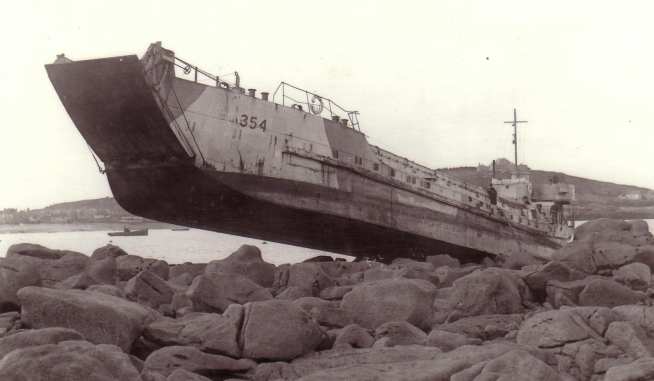
It was one of five which were able to beach on the Isles of Scilly: Routledge’s account includes a dramatic photograph of LCT 354 aground on the rocks at Newford Island, St. Mary’s, Isles of Scilly, but these were temporary groundings. Three vessels of this convoy did not make it, however, and were overwhelmed on either the 13th or 14th November: LCT 333, LCT 343 and LCT 385 all foundered in a gale off Land’s End or ‘in heavy weather in the SW Approaches’ as the report to the War Cabinet had it. [7]

The report to the War Cabinet noted these losses as taking place on the 13th; elsewhere they are recorded on the 14th. [8] When this sort of date discrepancy occurs, it suggests that the loss took place overnight between one day and another, most likely in the small hours. LCT 318 had lost radio contact and it is reasonable to assume that several of the others would also have done so in those conditions, and the convoy was scattered without witnesses necessarily being nearby. With the immediate thought of saving life rather than record-keeping, it is quite understandable that times and dates recorded by survivors or rescuers would be ‘out’ or unspecific, but at least on this occasion can be tied to sometime between dusk on 13 November and dawn on 14 November.

This would seem to be borne out by Routledge’s testimony in LCT 318: ‘At dusk . . . land was sighted. A suitable beach was identified and, in near dark, we ran up the beach . . . the next morning we discovered we had landed on St. Mary’s.’

Met Office observations for 1800 GMT on 13 November 1943 reveal that off the Isles of Scilly conditions were NNW force 8 and a gale warning was in force ‘in all districts’. Conditions at NW force 7 were little better at 0100 on 14 November and remained constant at NW x N force 7 at 0700, NW 7 at 1300, decreasing to NNW 6 at 1800 that day. [9]

It seems sad that after battling much worse conditions at force 9 for so many days that LCT 333, 343 and 385 finally succumbed in force 7 winds just as they were so very nearly home, but this is not an uncommon story for many of the shipwrecks around our coastline. Very often it happens in force 7, as here (we know of over 500 wrecks recorded as lost in force 7 ‘near gale’ conditions) [10] and frequently, too, after a sustained battle with the elements over a very difficult voyage.

If the pumps became overwhelmed and the crew exhausted, and with signs of stress on the hull, the outcome was often inevitable for any vessel and unsurprisingly so for a Landing Craft Tank. As described by Lt Commander Maxwell O Miller RN, who would command I Squadron of Landing Craft at D-Day, a landing craft was:

of very shallow draught and flat-bottomed so that she had very little hold on the water . . . it had never been the intention that they should be lived in. They had originally been designed to work from shore bases in the south of England and to be manned just long enough to enable them to run across the Channel, dump their loads, and come back again. [11]

Historic B&W photograph of a landing craft tank in bow view, with anti-aircraft guns mounted atop the bridge
LCT III (Landing Craft Tank Mark III) 398, 1943. (A 24492)
Copyright: © IWM. Original Source: http://www.iwm.org.uk/collections/item/object/205156360
Historic B&W photograph of Landing Craft Tank in port profile view (bows left, stern right)
LCT III (Landing Craft Tank Mark III), 1943. (A 24489)
Copyright: © IWM. Original Source: http://www.iwm.org.uk/collections/item/object/205156357

In this case, there appears to have been no loss of life other than the men lost overboard earlier in the voyage, but the landing craft of convoy OS 92/KMS 66 (Outbound South/UKMediterranean Slow) in October 1944, also in a gale off Land’s End, would be far less fortunate, and their story will be told in that instalment of the War Diary next year.

Footnotes

[1] Routledge, J nd “Landing Craft Tank (Mark 3) 318 – LCT (3) 318” Combined Operations online

[2] Larn R & Larn B 1995 Shipwreck Index of the British Isles: Vol. 1 Isles of Scilly, Cornwall, Devon, Dorset (London: Lloyd’s of London Press)

[3] Cant, R, 2012 unpublished oral history reminiscence, recorded and documented by Serena Cant

[4] The LCT Mk III made 10 knots, however it wasn’t only the achievable top speed, but also the range, voyage distance and type of ship that needed to be factored in. In 1943 there were no friendly ports on the European coastline between Gibraltar and the UK for convoys to refuel – they had to be capable of sustaining the voyage between the Mediterranean and the UK with the fuel that they had. My father’s ship was the proverbial ‘slowest ship in the convoy’ but could make 15 knots at top speed so it looks as if she were eligible to join a fast convoy, even if he recorded that he looked with envy at the Stirling Castle, also in his convoy, at 20 knots.

[5] Convoys MKS 29 G and MKS 30, convoyweb.org.uk

[6] Larn R & Larn B 1995 Shipwreck Index of the British Isles: Vol. 1 Isles of Scilly, Cornwall, Devon, Dorset (London: Lloyd’s of London Press); https://www.combinedops.com/HMLCT%20318.htm

[7] Weekly Résumé No.220 of the Naval, Military & Air Situation from 0700 11th November to 0700 18th November, 1943, part of the War Cabinet Papers, CAB 66, The National Archives, Kew

[8] British Vessels Lost at Sea 1914-18 and 1939-45, Section III, p54 [London: HMSO]

[9] Met Office 1943 Daily Weather Report November 1943, 13 and 14 November 1943 online

[10] Historic England wreck data

[11] Miller, M nd “Landing Craft Tank Squadron – Sword Beach, D Day”, Combined Operations published online

50th Anniversary of the Protection of Wrecks Act 1973

Part 2: A PWA50 Project

In the second instalment of our two-part special commemorating the 50th anniversary of the Protection of Wrecks Act, we look today at one of the projects funded by Historic England to commemorate 50 years of the Act.

Our guest blogger Michael Lobb from MSDS Marine writes about their innovative PWA50 project – Landlocked and Looking Out – to connect landlocked counties with England’s maritime heritage.

Modern colour photograph of three rock formations tilted upwards as if they were ships ploughing through seas, instead of the grass platform on which they sit, seen against a blue sky.
Three Ships rocks, Birchen Edge, Derbyshire: three large gritstone outcrops, so-called from their prow-like appearance, near a monument to Nelson.
© Graham Hogg CC BY-SA 2.0 https://www.geograph.org.uk/photo/1946715

Landlocked and Looking Out

Maritime archaeology, by its very nature, is concentrated around our coasts, and as a result, opportunities for the public to engage with it can be limited to coastal communities and those who have the means to visit them. People living inland do not always get the opportunity to participate in maritime archaeology projects, so, to address this, funding from Historic England enabled MSDS Marine to deliver fifty public pop-up events over summer 2023, specifically for schools and youth groups, to encourage active participation with maritime heritage.

All events were held in landlocked Derbyshire and Nottinghamshire, and as a result 17,066 individuals have attended at least one of these events. Not everyone who came will become a maritime archaeologist or volunteer: however, it is hoped that by having an understanding and appreciation of maritime archaeology, more people will value the hidden maritime heritage that surrounds the UK and start to believe it is of relevance to them, and this blog further highlights this work.

As part of the project MSDS Marine explored the links between historic figures, sites and artefacts from the landlocked counties of Derbyshire and Nottinghamshire, with maritime heritage and archaeology.

Shipbuilding and provisioning of ships

Copper mines at Ecton Hill, Staffordshire (scheduled as an ancient monument) produced copper sheathing to protect the timber hulls of Royal Navy ships in the age of sail, while a number of Peak District lead mines produced ingots for use as ballast in ships.

Derbyshire quarries also produced consumable items for ships, such as Morley Moor quarries which produced holystones for use on ships up to the Boer War (1899-1902) when the practice stopped. Holystones were pieces of gritstone used for scrubbing wooden decks, a regular part of a sailor’s morning routine. They were most likely called holystones because the sailors had to scrub the decks on their knees, reminiscent of kneeling in church. Large holystones were known as ‘Bibles’, while smaller ones for use in difficult corners were called ‘Prayer books.’

Historic sepia photograph of sailors in uniform, the front row on their hands and knees scrubbing a ship's deck, the back and side rows standing. It is clearly a posed photograph with all the men smiling or laughing at the camera.
Holystoning the decks on HMS Pandora (1900-1913)
Creative Commons

Perhaps of more interest to sailors were the stoneware rum bottles manufactured for the Royal Navy by Pearsons’ Pottery in Chesterfield. The most popular size was one gallon!

Other companies produced more specialised equipment for ships, such as the Haslam Foundry and Engineering Company Limited in Derby. The late 19th century downturn in the agrarian economy saw fears of a meat shortage in Britain, but at the same time farms in Australia were producing large herds of sheep. The solution was to develop and construct refrigeration systems to allow ships to transport frozen meat on the lengthy voyage from Australia to the UK. From 1881 ships fitted with Haslam machinery were transporting frozen meat from Australia and New Zealand to London. The factory backed on to the river Derwent, allowing the finished machinery to be shipped to coastal shipyards via the Trent.

Historic B&W photograph of a long row of pipes with a flow meter connected to feeder valves on the right. The pipes are angled upwards, across the ceiling, and run down again opposite, with two rows of valves.
Brine distribution pipes in the refrigeration unit, Highland Warrior, 1924. Highland Warrior’s owners, the Nelson Line, a specialist in meat from Argentina, installed refrigeration units from both Haslam and the Liverpool Refrigeration Co. Ltd across its ships, the latter in Highland Warrior. BL26996/001 Source: Historic England Archive

The Midlands also played a part in the development of shipbuilding technology: in 1799 Simon Goodrich was sent on a tour of the industrial Midlands by the Admiralty to see how emerging technologies could be incorporated into the Naval dockyards. Goodrich was shown around the cotton mill at Derby by William Strutt, which inspired technology later used at Chatham Dockyard. He also visited a stone quarry near Derby where the saws used to cut the stonework later influenced the design of timber cutting saws at Portsmouth Dockyard. At Belper he was shown the mills by George Strutt and visited Outram’s foundry, where he took a particular interest in the boring mill.

Shipping and Trade

The proximity of Derbyshire and Nottinghamshire to the river Trent, and the many canals linking up with it, including the Trent and Mersey canal, meant that a range of products manufactured in the Midlands were transported to the British coast and then further afield: for example, the wreck record shows that in 1818 the sloop Industry stranded on the Sunk Sand at the entrance to the Thames while bound from Gainsborough to London with household goods, ironmongery and earthenware pottery. [1]

Historic B&W photograph showing the corn mill seen from the canal towards the boat arch, with the text 'F E Stevens Ltd./Trent Corn Mills in the gable of the mill, with a plaque saying 'No.2 Mill' below a window.
B’ Warehouse at Trent Corn Mills, Shardlow, Derbyshire, showing the boat arch, in 1960, when still in use as a corn mill on the Trent and Mersey Canal. This warehouse was built in 1780, and from the 1820s was known as the ‘B’ Warehouse, almost exactly contemporary with the 1817 wreck of the Crown which foundered off the Farne Islands carrying barley from Gainsborough for Leith. For centuries produce from the agricultural hinterland was circulated domestically via river, canal and sea, not road or rail.
Eric de Maré AA60/04515 © Historic England Archive

From the 17th century cheese from the Midlands was transported down the Trent to Gainsborough, where it was loaded onto sea-going ships which navigated the river to the Humber, then coastwise to London. At a later date, wreck records show that the sloop Fanny, laden with cheese for Hull, capsized in the Trent in 1811, while in 1783 another sloop, the Acorn, stranded off Tynemouth while inbound to Shields with cheese from Gainsborough. Similarly, in the 17th century coal from Wollaton in Nottingham was transported to the Trent, thence to Hull on the Humber, where it was transhipped to London. [2]

The War Effort

During the First World War, Chetwynd Barracks, just outside Nottingham, was the site of Chilwell Filling Factory, a munitions plant which produced 19,000,000 shells, 25,000 sea mines and 2,500 aerial bombs over the course of the war. On the 1st July 1918 an explosion destroyed part of the factory killing 139 workers. A memorial to the workers is located inside Chetwynd Barracks, but many of them are buried nearby in a mass grave at Attenborough church. There were suspicions at the time that the explosion was the result of an act of sabotage (typical of rumours in wartime – similar rumours circulated when the warship London blew up in 1665) but it was most likely caused by the summer heat triggering an explosion.

Historic B&W photograph of long rows and rows of shells and mines of different types loaded on trolleys in a large factory.
National Shell Filling Factory, Chetwind Road, Chilwell, Notts. Melt House for Land, Sea and Air, photographed a few days before the Armistice in 1918. To the right are rows of rounded sea mines: sea mines were used by both sides and hundreds of ships were lost to mines in English waters over the First World War 1914-18. AA96/03598 Source: Historic England Archive

Many other industrial sites in Derbyshire and Nottinghamshire also contributed to the war effort in both World Wars: Stanton Iron Works just outside Ilkeston made experimental torpedo casings, while parts of Mulberry harbours for the Second World War Normandy landings were built at Hilton, just south-west of Derby.

Sailors

There has been a Royal Naval Reserve base at HMS Sherwood in Nottingham since the Second World War, with the Midland counties of Derbyshire, Leicestershire and Nottinghamshire at one point providing the most popular recruiting ground for the Royal Navy.

The roots connecting the Midlands to the sea and seafaring are ancient: Nottinghamshire was the home of Sir Hugh Willoughby, an early Arctic explorer who led an expedition to find the North-East Passage from the Atlantic to the Pacific. He died in 1554 when two ships from the voyage were locked in the Arctic ice.

Sir Hugh’s descendant Rear Admiral Sir Nesbit Josiah Willoughby (1777-1849) was born in Cossall, Nottinghamshire. He was knighted twice, court-martialled four times, and, as his obituary in the Annual Register noted:

He was eleven times wounded with balls, three times with splinters, and cut in every part of his body with sabres and tomahawkes: his face was disfigured by explosions of gunpowder, and he lost an eye and had part of his neck and jaw shot away . . . and at Leipzig had his right arm shattered by cannon shot.

(See our previous blog on disabled sailors and shipwrecks)

Historic B&W engraved half-length portrait of man in military uniform with a black patch over his eye.
Sir Nesbit Josiah Willoughby by William Greatbach, after Thomas Barber
mixed method engraving, published 1837
NPG D11236 © National Portrait Gallery, London CC BY-NC-ND 3.0

Another significant figure in British maritime history with a strong link to the Midlands was Samuel Plimsoll. Despite having been born in Bristol, he only lived there for a short time, and it was as the Liberal MP for Derby from 1868-1880 that he fought for amendments to the Merchant Shipping Act, introducing the famous ‘Plimsoll Line’ showing the safe level of loading for a vessel, preventing the loss of unseaworthy and overloaded vessels.

Modern colour photograph of sculpted bust of bearded man on plinth flanked by statues of a man and a woman looking down at a commemorative plaque in gratitude. The sculpture is seen against leafless trees and an ornate background on a bright winter's day with clear blue sky.
Memorial to Samuel Plimsoll, Victoria Embankment, London.
The central plaque is surmounted by a sailing ship: just visible above Plimsoll’s name is his load line. On the plinth the modern load line is seen, a barred circle with the letters LR for the classification society Lloyd’s Register, with load lines marked for different seasons and bodies of water. Wikimedia Commons CC BY-SA 4.0 http://tinyurl.com/5fcb6wen

Monuments

There are numerous monuments to Nelson and the Royal Navy throughout England, but at Birchen Edge in the Peak District the obelisk commemorating Nelson and the Battle of Trafalgar is accompanied by a slightly more unique memorial in the form of the natural feature of Three Ships Rocks [shown at the top of the blog], three large rock outcrops which are carved with the names of warships from Trafalgar – Nelson’s own flagship Victory, Defiance and Royal Soverin.

Modern colour photo of the word VICTORY incised on a rock and still legible despite erosion. The rock formations run from bottom left to top right of the image, are weathered in places, and have light coloured spots of lichen.
Carving of the name VICTORY on one of the Three Ships boulders at Birchen Edge, Derbyshire.
© Neil Theasby CC BY-SA 2.0 https://www.geograph.org.uk/photo/2959671

The grounds of Thoresby Park in Nottingham contain a monument to Nelson’s Navy and another in the shape of a pyramid commemorating the Battle of the Nile in 1798. The interior of the monument is inscribed with the names of the ships and men involved in the battle. Both monuments were constructed by Charles Pierrepont, 1st Earl Manvers who had been an officer in the Royal Navy, and whose son was a serving officer at the time of the monuments’ construction.

Modern colour photograph of stone pyramid with entrance porch flanked by classical columns, seen against a backdrop of tall trees on a cloudy day.
Pyramid, Thoresby Park
IOE01/16506/05 © Mrs Mollie Toy. Source: Historic England Archive

Perhaps one of the most unusual tributes to Britain’s naval heritage can be found at Newstead Abbey, just north of Nottingham. The 5th Lord Byron (1722-1798), great-uncle of Byron the poet (the 6th Lord Byron), was forced to leave his position in the Royal Navy when he inherited the estate and title. Frustrated at leaving the sea, he expanded the lake outside the house, and built cannon forts on either side so that he could stage mock naval battles. The battles were no small affair, involving numerous boats, including a twenty-gun schooner manned by professional sailors!

Modern colour photograph of blue lake with fort on the left bank and a forest landscape on the right bank. In the middle distance a swan swims towards the viewer.
Newstead Abbey, Newstead, Nottinghamshire, looking NW across the lake towards the Cannon Fort.
DP278046 © Historic England Archive

Thus we can see that in the Midlands, the furthest it is possible to get away from the sea in England, there is a strong connection to ships and shipbuilding in times of peace and of war, a heritage expressed in a legacy of wrecks and terrestrial landmarks alike.

Explore our other PWA 50 blogs:

50 Years of Protecting Shipwrecks – Hefin Meara, Historic England

The Cattewater Wreck – Martin Read, licensee of the Cattewater Wreck

Footnotes

[1] Historic England wreck records

[2] Historic England wreck records

50th Anniversary of the Protection of Wrecks Act 1973

Part 1: The Cattewater Wreck, the very first wreck designated under the Act

This post forms the first blog in our two-part end-of-year Christmas Special 2023 focusing on the Protection of Wrecks Act 1973, whose 50th anniversary Historic England has celebrated this year.

For this special edition we are once more delighted to host Martin Read, licensee of the Cattewater Wreck, who also celebrated the 45th anniversary of the Act in 2018 with a post on Cattewater on this blog.

This time Martin writes about some new findings on the Cattewater Wreck and how our understanding of the site has developed since it was first discovered in the 1970s.

Historic B&W aerial photograph of Plymouth showing the Cattewater and Plymouth Sound with some vessels moored off Mount Batten to the lower half of the image, and to the upper half a built-up cityscape.
The Cattewater, Plymouth, from the air on 28 May 1947.
RAF_CPE_UK_2105_RP_3156 Source: Historic England Archive (RAF photography)

The Cattewater Wreck was discovered on the 20th June 1973 by the Anglo-Dutch dredger Holland XVII whilst deepening moorings for air-sea rescue craft based at RAF Mount Batten in Plymouth. Each bucket of the dredger was described in a letter that autumn by the ethnographist of working craft around Britain, Eric McKee, who recorded the process, as ‘smaller than a Mini Clubman’. [1]

Modern photo of red J registration car at a car rally
A 1970 Mini Clubman of the kind that would have been common in 1973. Eric McKee’s description of the relative size of the dredger buckets in contemporary terms reveals a keen eye for the workings of coastal craft, but also hints at the implications for the wreck site.
Wikimedia Commons CC-BY-SA-3.0

This brought up timbers and fragments of ordnance that were identified as being Tudor in date. As a result, the wreck site was designated on the 5th September 1973 under the Protection of Wrecks Act 1973 (Order No.1), becoming the first wreck given protection in the UK.

The site was surveyed and partly excavated between 1976-8. Recovered finds included parts of the ship structure and fittings, ordnance, vessels for cooking and eating/drinking, clothing, personal possessions, as well as environmental evidence, such as fish bones. The only known casualty was represented by a few bones from a dog. [2]

I have held a Government license to dive and to carry out surveys on the site since 2006. Students from the University of Plymouth (and others) have carried out various geophysical surveys (including sub-bottom profiler, side-scan sonar and magnetometer surveys), identifying the probable location of the wreck. Nearby anomalies might be detached parts of the wreck. A team of local divers have ground-truthed targets on the surface of the seabed and carried out metal-detector and probe surveys of the site.

The archive from the 1970s survey and excavation was deposited in The Box (previously Plymouth City Museum and Art Gallery) Site Accession Number AR.1985.2, and in 2011 English Heritage funded a project to improve the long-term care and management of the archive to modern archival standards. [3] Material is still being added to the archive, with the Museum recently re-discovering a roll of plans and diagrams, which now need to be accessioned.

The project has made the archive far more accessible and easy to use. Finds from the archive have since been used to provide a better date for the site, with the leather shoes and ceramics indicating that the ship was wrecked after 1500, most likely in the early 16th century. [Why not explore the Cattewater Wreck Archive on the Archaeology Data Service?]

I thought I would look at one aspect of the research we have carried out on the finds. Amongst the samples recovered were a number of stones from the ship’s ballast. The original identification of their geology showed that most appeared to have been local Plymouth or Devon (limestone and granite), indicating that the ship had been reballasted locally. Others included chalk, flint and limestone originating from areas between Bristol/South Wales & London. As a result, the conclusion made was that the ship was a coastal trading vessel. However, no systematic methodology had been carried out to recover the ballast samples, making them potentially unrepresentative, and some of the identified geological origins were also problematic (including some from the Highlands of Scotland, which seemed unlikely).

Professor Malcolm Hart, Emeritus Professor of Micropaleontology, University of Plymouth, has looked at the remaining stone samples in the museum and been able to provide new identifications to some, as well as providing additional possible sources, such as Brittany and Ireland, which had strong trading connections with Plymouth.

One sample of local limestone (CW78 423.2) had been severely drilled by a piddock (Pholas, a marine mollusc), showing that it had been on the sea floor for a long time, possibly stored in a ballast pit or pile – something that was known to be common in later centuries, and may indicate some of the local ballasting practices at the time.

Archaeological record photograph of a piece of pitted brownish stone against a light background with a scale rule in front
Sample of Devonian limestone from the ballast of the Cattewater Wreck, severely drilled by piddock (Pholas), which means it had been on the sea floor for some time. Probably local to Plymouth or South Devon. Archaeology Data Service Stone AR.1985.24.1.110(b)

Plymouth has been an important maritime port and a meeting place for naval fleets since medieval times. Ships from the port carried out coastal and international trade in cargos such as salted fish, wine, cloth and tin. There were strong trading links with Ireland, Bordeaux, in south-west France, and with Iberia. Any of these sources might have provided stone for ballasting ships which could have been reused in Plymouth.

The original conclusion might be correct, with the ship being a coastal trading vessel operating between Bristol and London, with the new additions of Brittany and Ireland. However, other interpretations and conclusions are possible, and the ballast may be composed of what had been loaded by the local water bailiff in Plymouth, reflecting the trading relationships of the port, rather than of the ship. Or something between the two.

Explore the Protection of Wrecks Act further:

50 Years of Protecting Shipwrecks – Hefin Meara, Historic England

Landlocked and Looking Out, a PWA50 project – Michael Lobb, MSDS Marine

45 Years of the Protection of Wrecks Act (2018) – Martin Read, licensee of the Cattewater Wreck

Footnotes

[1] Eric McKee, letter to Valerie Fenwick, 7 October 1973, Cattewater Wreck Archive AR.1985.24, The Box, Plymouth; see McKee, E, 1983 Working Boats of Britain: their shape and purpose (London: Conway Maritime Press)

[2] Redknap, M. 1984 The Cattewater Wreck: the investigation of an armed vessel of the early 16th century National Maritime Museum Archaeology Series 8/British Archaeological Reports – British Series 131.

[3] Martin Read, Nigel Overton (2014) Cattewater Wreck Archive [data-set]. York: Archaeology Data Service [distributor] https://doi.org/10.5284/1024721