No.72: The Acorn

To end the year, today’s post showcases several of the main themes of 2014 in maritime archaeology: first, early 2014 was exceptionally stormy, with numerous reports of wrecks having been exposed in different locations around the UK as storms scoured sand off beaches. Many members of the public gave English Heritage fantastic reports of shipwreck material they had seen.

One such report was from Sutton-on-Sea, Lincolnshire. It gives me great pleasure today to introduce as my guest blogger this week Jordan Havell, who is 13. After seeing some timbers on the shore this year, he has been researching the story behind one of the wrecks in his local area, the Acorn, which was a barque laden with ice when she struck in Lynn Roads in 1898.

Jordan tells the story of her origins: 

I got very interested in this shipwreck, amongst others, while doing a local history project. I am 13 years old and home educated.

The Acorn was built in 1855 in Dundee, County of Forfar, Scotland. The register date is recorded as 05/03/1855, with the master’s name shown as Peter Anderson, in the hands of Andrew Low for the Tay Ship Building Company, dated 28/02/1855. The employment of the Surveying Officer, Joseph Northmore, is recorded as a tide surveyor. These details come from the Dundee Archives, for whose help I was very grateful.

The ship had one and a half poop decks, 3 masts and her length is recorded as 119 feet. She was a barque which had one gallery and a full female figurehead. The framework and planking were made of wood.

The subscribing owners were named as Peter Anderson – Master Mariner – 16 shares. The manufacturers are recorded as Matthew Low and John Morrison, both having 12 shares. It is noted there were 2 other owners.

Image courtesy of Dundee City Archives.
Original register entry for the Acorn, 1855. Image courtesy of Dundee City Archives.

The Acorn appears in various articles in Dundee newspapers from 1856 to 1873. By 1871 her master is listed as George Wilson. On the records from this time there are numerous notes, including a query shown in 1873 regarding conversions to cubic metres weight. In 1873 the ship is registered under the port of Grimsby. The Acorn was believed to have been carrying ice between Norway and Grimsby for use by the Grimsby Ice Company in the fishing industry.

It appears she ended her days on the beach at Sutton-on-Sea in 1901 and is recorded under the English Heritage wreck report 928347 and account of wreck site 1484623. I am very grateful to Serena Cant and her colleagues who gave me help with this project.

I am hoping to find out about more shipwrecks along this coast over time.

**********************************************************

Many thanks to Jordan for his essay, which I am delighted to include today. I think an ice barque is an appropriate seasonal theme on which to end the year! For more on Norwegian ice barques, have a look at a past entry here.

The sharp-eyed among you, like Jordan, will have spotted that she struck a sandbank in the Wash in 1898, but ended up further north on the Lincolnshire coast in 1901. I did some research myself and found that the vessel was recovered in 1898, when she was sold for £105. (1) This was very typical. For the Acorn‘s owners, in far-away Sandefjord, it would have been much more economical to cut their losses by selling the vessel, rather than try to get her repaired at their own cost.

This, I suspect, is how she eventually ended up at Sutton-on-Sea in what has proven to be a ship graveyard, another theme which has emerged strongly in maritime archaeology over the last few years. These tend to be groups of vessels beyond economical repair, drawn up for breaking and then perhaps abandoned. The Acorn was one of six vessels which were recorded by partial excavation along this stretch of beach in 1997. (2)

I think there is plenty more for us to find out – what happened to the Acorn between 1898 and 1901, and what is the story of the other ships which may still remain under the sand at Sutton-on-Sea and elsewhere in the locality? Over to you, Jordan! I hope you will continue to be as fascinated by shipwreck archaeology as we are.

Wreck of post-medieval or early modern fishing vessel, Mablethorpe, 2007, first recorded 1997. Image courtesy of John Buglass.
Wreck of unidentified post-medieval or early modern fishing vessel, Mablethorpe, 2007, first recorded 1997. Image courtesy of John Buglass.

(1) Hull Daily Mail, 13 April 1898, No.3,902, p4

(2) Buglass, J 1997: The remains of six sailing ships and other archaeological features in the inter-tidal zone between Sutton-on-Sea and Mablethorpe, Lincolnshire; Buglass, J and Brigham, T 2008: Rapid Coastal Zone Assessment, Yorkshire and Lincolnshire: Donna Nook to Gibraltar Point, Humber Archaeology Report No.236

No.71: Remember Scarborough!

Diary of the War No.5

Scarborough Castle from the air
Scarborough Castle from the air:  N061078, © English Heritage Picture Library

One hundred years ago this week three German warships loomed out of the North Sea in the early morning of 16 December 1914, and commenced shelling Scarborough, Whitby, and Hartlepool. Whitby Abbey was struck by the light cruiser Kolberg, causing considerable damage, and Scarborough Castle by the battle cruisers Derfflinger and Von der Tann. Civilians going about their ordinary morning business were also killed in this, the first attack on English soil of the First World War.

Whitby Abbey, West Front as seen from the east. This window was badly damaged in the shelling of 1914.  N080802 © English Heritage Photo Library
Whitby Abbey, West Front as seen from the east. This window was badly damaged in the shelling of 1914. N080802 © English Heritage Photo Library

Local residents and heritage sites were not the only victims of the raid, which screened the Kolberg‘s true objective of laying a minefield. That minefield claimed three victims the same day: the British collier Elterwater, bound from the Tyne for London, which sank in three minutes, three miles east of Scarborough itself; the Norwegian collier Vaaren, bound with Tyne coal for Palermo; and the British cargo vessel Princess Olga, laden with a general cargo, from Liverpool for Aberdeen. As the days and weeks went by, Kolberg‘s mines claimed further victims.

The mines off the Yorkshire coast were continually replenished during the war, designed to catch victims such as the Elterwater and Vaaren, and to strike at the coal trade on which Britain depended so heavily for heating, lighting, and export. The North Sea off the Yorkshire coast became a field of death and destruction, with the fishermen of Grimsby and Hull in the front line, manning the requisitioned trawlers turned minesweepers: as fast as they swept, more mines were laid, and as fast as they were laid, they were swept again.

Remember Scarborough! became the slogan of a recruitment poster. One hundred years on, we remember not only Scarborough, Whitby and Hartlepool, but also the deadly Scarborough minefield.

This is the first of a Christmas double bill: there will be another Wreck of the Week on Monday.

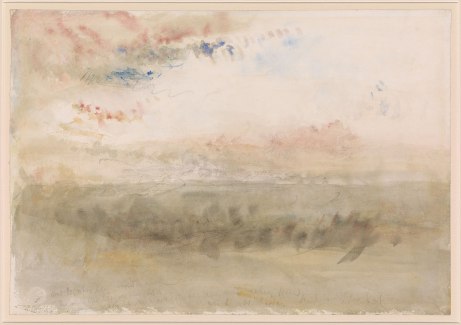
No.70 Wreck on the Goodwin Sands

The Morgan Library & Museum, New York. Bequest of Miss Alice Tully, 1996.67. Photography by Steven A. Crossot, 2014.
Wreck on the Goodwin Sands, J M W Turner. The Morgan Library & Museum, New York. Bequest of Miss Alice Tully, 1996.67. Photography by Steven A. Crossot, 2014.

This week’s wreck is a work of art and today I’d like to invite ‘audience participation’ focusing on wreck processes.

Wreck on the Goodwin Sands is currently on view at Tate Britain’s Late Turner exhibition as an excellent example of Turner’s late style, loose and impressionistic, yet amazingly precise in every detail. We see the skeleton of a wreck sitting upon the sands at low tide, with part of the sands exposed in streaks of yellow. Economical brushstrokes suggest the ribs of a vessel bowing out towards port and starboard, substantially more intact on both sides towards the middle and left of the painting, less so on the right, where one side is missing. A long downward stroke suggests a partially detached stem-post, with the ribs behind somewhat embedded in the exposed sand. Turner has pencilled some of his bleak poetry in lines only partially legible on the fallacy of hope, clearly identifying the wreck as one on the Goodwins. The view is from seaward of the Sands looking towards the white streak representing the famous cliffs of the Dover area.

My question this week is – what do you think happened to the ship Turner has shown here? Is it potential evidence for a wreck event?

Here are some potential clues: 

The Goodwin Sands were named as the ‘Great Ship Swallower’ as early as the 16th century, which has historically been characteristic of many of our designated wrecks in the vicinity, the Stirling Castle perhaps being the most dramatic of all, being found in a remarkably intact state, despite striking the sands in the ‘Great Storm’ of 1703.

There are other recorded wrecks, such as the Ogle Castle, an East Indiaman lost in 1825, where the ship disintegrated so comprehensively that much of her cargo was picked up in succeeding days as far afield as the Netherlands and Belgium.

Even those ships which floated off were often so badly damaged that they sank in deep water nearby, as happened with the Shepherdess in 1844.

Turner obsessively sketched what he saw and reused many sketches as details in paintings several years or decades later.

We have 24 wrecks recorded on the Goodwin Sands for the period 1840-1849, none for 1845 – the paper being characteristic of Turner’s sketchbooks for 1845. There is the possibility of some under-reporting, of course. Could it represent a wreck event we have not yet recorded?

Note the vertical brushstrokes suggesting ribs, but little in the way of horizontal brushstrokes to suggest the sides of the ship.

Responses will be collated and examined in a post in the New Year.

No.69 Diary of the War No.4

HMS Hood

The loss of HMS Hood, built 1916, and sunk in 1941, by shells from the Bismarck and Prinz Eugen in one of the Royal Navy’s worst disasters of the Second World War, is well-known. Less well-known is her predecessor of the same name, built in 1891 and disposed of on 4 November 1914.

Aerial view of Portland Harbour from the south-west. © English Heritage, reference 24688_028
Aerial view of Portland Harbour from the south-west, showing the gap between the breakwaters nearest the viewer: last resting place of HMS Hood. © English Heritage, 24688_028

Disposed? Surely a country at war needed all the warships it could get? The answer lies in her history and in the exigencies of war. Hood was the least functional of the Royal Sovereign-class warships, built in 1891. She was let down by her low freeboard (the side of the ship between the waterline and deck) which left her ill-equipped for rough British weather in rough British waters and serving principally in the Mediterranean or in static roles in home ports.

After three months of war the full scale of the threat at sea was not yet apparent. Most of the war losses in English waters between the declaration of war to 4 November 1914 were 27 ships sunk by mines, but the emerging picture worldwide was sobering:

Loss to Mines 3 August-4 November:

22 British ships for 24,609 tons; 4 Allied ships for 3,019 tons; 22 neutrals for 27,008 tons

Surface ships 3 August-4 November:

64 British ships for 189,229 tons; 5 Allied ships for 10,140 tons; 1 neutral for 3,804 tons (1)

One British ship had already been sunk by a U-boat off Norway on 20 October, the first recorded loss to U-boat activity, and on 31 October, HMS Hermes, Hood’s contemporary from the 1890s, fitted out as an experimental seaplane carrier, had been torpedoed in the eastern Straits of Dover.

This was a sign of things to come: British naval bases began to look vulnerable to submarine and torpedo attack. Portland, in the English Channel, followed Scapa Flow, Orkneys, in having blockships sunk for their protection. HMS Hood was scuttled for this purpose beside the entrance to the South Ship Channel between Portland’s inner and outer breakwaters, to prevent an attack on the base – where she still lies, a century after she was scuttled. She is now a well-collapsed wreck on which diving is now forbidden.

Sinking HMS Hood paradoxically extended her usefulness in a wartime role. Physically, she partially bridges the gap between the breakwaters. Conceptually, this use of Hood is also a link between the shore installations of naval and harbour infrastructure and the ships that used them, by transforming a ship into structure.

(1) Sourced from Lloyd’s War Losses 1914-18, pp1-5

No.68 HMHS Rohilla

Diary of the War Part III

One hundred years ago yesterday HMHS Rohilla, a liner requisitioned as, and converted to, a hospital ship, struck the rocks at Whitby while southbound from Queensferry and Leith for Dunkirk to pick up patients from the Western Front. I have written about her before but this week I would like to look again at her significance, while this weekend the Whitby RNLI commemorates the loss of the Rohilla with services and events, including a ‘live’ Twitter feed of the rescue as told by a survivor, Fred Reddiough.

Like another wreck in 1912, she was the product of the Harland and Wolff shipyard, and was also linked through one of her survivors to that wreck – Mrs Mary Roberts, who found the experience of being dashed on the rocks at Whitby far worse than experiencing the cold waters of the Atlantic from the Titanic. As with our survivors last week, Mrs Roberts’ experience illustrates that those who went to sea could expect to be shipwrecked at least once in their careers, frequently more often: undergoing multiple shipwreck was very common.

That experience of being so close to shore, yet so far from help on the rocks in the mountainous waves and cold seas of a North Sea storm, was what made the wreck of the Rohilla so terrifying. The storm continued unabated for three days as the ship was pounded by waves and began to break up, with the stern coming away on the Friday afternoon.

The Rohilla struck with such force that the Captain was convinced that she had been struck by a mine and reiterated this view at the inquest, which was also reflected in the findings of the jury, who found that the ship ‘struck something before grounding’. (1) If true, then she would have been the first mine casualty off the North Yorkshire coast, but she was not recorded as a war loss in official sources. The 22 recorded losses to mines up to this point of the war, mostly off Tynemouth or the Humber, suggest that a mine as the initial cause of the incident is perhaps less likely, and the shock felt simply that of the force with which she struck. (2)

The circumstances of her original loss, followed by time and tide, have ensured that the Rohilla is a scattered wreck, whose remains are partly confused with those of another wreck, the Charles, which stranded nearby in the Second World War.

The Whitby and other local lifeboats attempted the rescue under horrendous conditions, one even being lowered down a cliff, but it was not until the motor lifeboat was sent for from Tynemouth, speeding through the night, that a large-scale lifeboat rescue could be attempted. Modern technology was on the march and astonishing footage also exists of locals forming a human chain to bring survivors to shore.

Her story is perhaps one of the most moving shipwreck events of the whole war, and not only because of her difficult position in difficult conditions, and the associated loss of life. The Captain altered course to avoid minefields and was unable to make use of the usual navigational clues, since lighthouses were extinguished as a result of the war: wartime exigencies were already contributing to casualties. Her journey was one to fetch home war casualties, so that those who were travelling to help became those in need of help.

For previous posts in the War Diary, please click here.

(1) Times, Nov. 5, 1914, No.40,688, p5

(2) National Record of the Historic Environment shipwreck database, accessed October 2014

No.67 A Concatenation of Events

Last week I wrote about multiple wreck events in which two ships happened to come ashore at the same place at different times, so to continue this ‘multiple wrecking’ mini-series within the blog, I’d like to focus on crews who have been doubly shipwrecked in a short space of time.

In May 1940 Hervé Cras, a ship’s doctor aboard the French destroyer Jaguar, survived the S-boat attack which sank her at Dunkirk. He finally made it out of Dunkirk aboard the Emile Deschamps and later recalled how the Jaguar‘s survivors stood up to salute their ship as they steamed out of Dunkirk, but were barked at to sit down again, because the vessel was dangerously overloaded. The Emile Deschamps picked her way carefully to Kent, but was mined close to safety off the North Foreland, the very last vessel of the Dunkirk evacuation to be lost in English waters. Once more Cras survived to tell the tale – literally: he became a leading naval historian, including a book on Dunkirk itself. (1)

On 3 January 1891 the Caroline Robert de Massy foundered off Dungeness while bound from the Black Sea port of Batumi for Antwerp with oil, following a collision with the Raithwaite Hall. The crew were saved, as were the seven crew of the vessel Ferdinand van der Taelen of Antwerp, returning home on the de Massy instead of their own ship, sunk in the Mediterranean on 23 November 1891, homeward-bound from Nikolaiev with grain. (2) All on board were taken up by the Raithwaite Hall and landed at Dover, the Ferdinand‘s crew presumably awaiting the next passing ship for Antwerp. It must have taken them at least three ships to get home, possibly four, if they were picked up by another ship in the original incident before being transferred to the de Massy, as the next available vessel bound for Antwerp.

Similarly, one of the survivors of the Earl of Dalkeith packet off Boulmer in November 1807 turned out to have also been rescued from the wrecking of the Leith packet off the Humber just a few months earlier.

On a related note seamen usually (not always . . . !) exerted themselves to save the crews of other vessels in distress, since they were painfully aware that another time they would themselves be in need of help. So it proved for the crew of the Anne Henrietta: on Christmas Eve 1768 they saved the crew of the William and John: their courage was rewarded within a few weeks, when they were themselves picked up by a passing fishing smack after their ship went down off Norfolk.

This post prepares the ground for October’s edition of the War Diary, looking at a notable wreck of late October 1914.

******************************************************************

(1) under the pen name of Jacques Mordal, Dunkerque, 1968, Paris: Editions France Empire

(2) erroneously reported in the original source as Friedrich van der Taelen


No.66 Right Next to Each Other

102 years ago this week, on 15 October 1912, the French steamer Abertay went ashore in fog at St. Loy Cove in Cornwall. Nothing unusual about that you might think: indeed, going ashore in fog was once a common cause of loss in the good old British climate.

What was more unusual about this one was that another vessel loomed out of the fog right next to them.

‘She encountered very thick fog . . . The crew were astounded to find themselves alongside a large steamer; they shouted but got no reply from the vessel that towered over them, and they took her for an abandoned wreck. The Abertay was badly holed aft and, fearing she would sink, the crew clambered aboard the other vessel. The Newlyn lifeboat was launched at 6am, and the Mousehole lifesaving apparatus was on the scene but not required. By daylight, seeing there was no danger, the crew reboarded and saved their personal effects.’ (1)

That vessel was the South America, which had gone ashore only seven months earlier, and which was abandoned after attempts to refloat her had failed. A wreck had come to the rescue!

For an astonishing picture of the two together at St. Loy Cove, please mouse over the picture at the bottom here which then automatically enlarges. You can see how it would have been safer to clamber aboard until daylight came and the weather lifted, rather than jump into a sea of unknown depth, in an unknown location, and risk injury and death.  For scale look at the figures at bottom left.

Local dive guides note the wreckage of the two as now well mingled.

There are numerous ways in which multiple wreck events can occur at the same location; in the same weather event; by coincidence, months or centuries apart; or even as one wreck becomes a navigational hazard, which promptly causes others in short order. There are also cases of crews involved in multiple wreck events: more on that theme over the next couple of weeks.

In the meantime, for a previous post mentioning two U-boats wrecked under tow in the same event but in different locations, the second one fetching up next to an earlier wreck, please click here.

(1) original newspaper report, reproduced in Larn, Shipwreck Index of the British Isles, Vol.1, Isles of Scilly, Cornwall, Devon and Dorset.


No. 65 A Complete Absence of Fishermen’s Ganseys

[Blog originally written 2014, updated 2026]

It’s often said that ganseys (knitted sweaters) with traditional village-specific patterns have been used to identify the bodies of fishermen drowned at sea. It’s also often said it is a myth, so I thought the wealth of shipwreck data we hold would be an obvious place to shed light on this question!

In all my years researching wrecks, I do not recall ever coming across such a story, but I decided to take a more scientific approach: mining the database with its wealth of primary sources. The starting point was data for any fishing vessel lost in English waters 1750-1950, with 2,655 hits, using keywords for knitted clothing, bodies and the identification thereof. (1)

This approach yielded no results for any fishermen identified by their clothing, ganseys or otherwise.

The closest story was that of a French fishing vessel lost in October 1826 on the Kentish Knock at the entrance to the Thames. In early November some bodies washed ashore at Margate, ‘judged to be part of the crew of a French fishing boat, reported to have been lost on the Long Sand or Knock.’ This suggests their garb was distinctively French, but this clue was clearly combined with local knowledge of tides and currents and prior knowledge of the wreck.

By contrast, records of passenger vessel losses are rich in detail of bodies identified, and how, so here are just a few examples:

When the Elizabeth foundered in the Bristol Channel in 1781, the stockings on one victim identified him, but his clothing is likely to have been distinctive, since he was a Quaker. Again, when the Piedmont transport struck Chesil Beach, Dorset, in November, 1795, an officer was recognised by his scars (suggesting fairly rapid recovery of the body, consistent with a stranding).

In 1814, Captain le Coq of the Mentor, lost off Cornwall, is said to have been recognised by his gold watch and seal (from an as yet untraced citation from a primary source, indicating the body washed up fairly quickly afterwards). Who identified these individuals, all unknown in the communities where they met their final resting place?

In all three cases above there were survivors who would have provided corroborative information. Where the blanks could not be filled in, they were published in newspapers to aid identification. A night of carnage on the Bamburgh coast in 1774 resulted reports of bodies being washed ashore, among whom was a lady with ‘five diamond rings on her fingers, and gold ear-rings in her ears’.

The 1826 case on the Kentish Knock shows how difficult it was to identify fishermen washed up far from home and from the location of the wreck site. At the present state of knowledge there appears to be no reported evidence for the use of ganseys alone to identify drowned fishermen in English waters, unless a well-corroborated story comes to light.

Can anyone help?

Update, February 2026: Sailing the Shipping Forecast with Rev. Richard Coles on More4 (2025, repeated 2026) visited the Faroes in episode 2. The islands’ distinctive knitting patterns were discussed in the context of those at home waiting for the return of their menfolk from sea, and looking out to recognise their jumpers. That seems to me to be a much more plausible explanation for the origin of distinctive patterns – for recognition of the living men coming home, not of dead men washing up on unknown shores.

It is simply not reasonable to assume that coastal communities nationwide or even Europe-wide, kept up a mental tally of knitwear lore to identify individuals or their specific communities from far away.

(1) The National Record of the Historic Environment (NRHE), now National Marine Heritage Record (NMHR) curated by Historic England. Keywords were: gansey and its synonyms guernsey, jersey, sweater, jumper + knit-; body/ies, corpse(s), remains; identified, known, proved (as in ‘proved to be’), recognised

No.64: HMS Fisgard II (Diary of the War at Sea No.2)

The Royal Navy Gears Up for War

This week we commemorate the centenary of the loss of HMS Fisgard II on 17 September 1914, an example of a vessel designated under the Protection of Military Remains Act 1986.

Built as the Audacious-class steamer HMS Invincible on the Clyde in 1870, she started out as an ironclad with a central battery of armament, rather than the broadside arrangement of guns, which had been so typical of the sailing fighting ship, and thus marks a point in the evolution of the 19th century Royal Navy.

As with other superseded warships before and since, when no longer suitable for frontline warfare she continued in service in less active roles. By 1906 she had joined her sister ship HMS Audacious, renamed Fisgard I, at HMS Fisgard, a navy training establishment for engineers at Portsmouth, becoming Fisgard II: four Fisgard hulks, all former warships, made up the establishment.

In 1914 a pressing need to train men up for wartime naval duty became apparent, and to that end, although Fisgard II was on the disposal list, she was instead retained and despatched for Scapa Flow in September.

While under tow in the Channel it was seen that water was coming in through her hawse-pipes, so that Fisgard II and her tugs all turned about for Portland. Before they could make it, she foundered relatively close to safety within 3 miles SSW of the Bill of Portland, with the loss of 14 hands from the 64-strong crew.

Contemporary newspapers noted approvingly that: ‘Discipline was maintained throughout. Every man was cool and good order was kept to the last.’ The Coroner, however, did not mince his words: ‘ . . . the ship was entirely unfitted for the sea. The Admiralty might just as well have put the men into a tub and towed them into the Channel and then wonder why they lost their lives. It did not seem right to send out a ship in such a condition.’ (1)

Fisgard II was therefore lost not to war causes nor in action, but to the exigencies of a war to which she was by now ill-suited.

She would not be the first, nor the last, hulked naval vessel to be lost while under tow: they were vulnerable because they lacked the necessary propulsion to manoeuvre out of trouble. This point was picked up by a survivor at the inquest, who drew attention to her lack of steering gear. Nor was she the only training ship that got into trouble at sea, but the tale of training ships is an interesting one in its own right, which will be told in another post.

(1) The Times, 19 September 1914, No.40,640, p3

No.63 The Magdapur

75 years since the outbreak of the Second World War

[updated: 10.09.2019 for the 80th anniversary of the Second World War]

This week commemorates the first ships sunk in English waters following the declaration of war on 3 September 1939. The period between the declaration of war and the events of 1940 is often known as the ‘Phoney War’, in which nothing much happened militarily. Yet war at sea was already being waged on both sides.

The Goodwood and the Magdapur each foundered after striking a mine in different locations off the east coast, both on 10 September 1939.

They were not the first wartime losses at sea: that distinction belonged to the Athenia, sunk in the Atlantic by U-boat on 3 September. The toll of merchantmen lost on the Allied side worldwide would account for 808 pages of typescript in Lloyd’s War Losses for the Second World War, Volume I: British, Allied and Neutral Merchant Vessels Sunk or Destroyed by War Causes, with an average of five or six ships per page.

The first ship to go down in English waters on that day was the collier Goodwood, early in the morning off Flamborough Head. The Magdapur sank the same afternoon off Suffolk, calling out the RNLI for the first of their many wartime services over the ensuing six years as the Aldeburgh lifeboat sped to the scene. She was the victim of a minefield laid on 4 September, the day after the declaration of war, by U13. That same minefield would shortly afterwards claim the French ship Phryné, on 24 September. U13 would herself be lost off the same coastline at the end of May 1940 when she was depth-charged by HMS Weston, delineating a landscape of war linking attacker and victims, by which time the ‘Phoney War’ was well and truly over.

As her name implies, the Magdapur had strong connections with India. Her owners, the Brocklebank Line, had a long tradition of specialising in the India trade. She was thus one of many British ships who relied on lascars, or Indian seamen, many of whom traditionally worked below in the engine room. The Magdapur had a significant complement of 60 lascars among her 80-strong crew. Six men were lost, of whom four were lascars, commemorated on the dual rolls of honour kept at Bombay and Chittagong. (You can search for any casualty of the two World Wars or later through the Commonwealth War Graves Commission Advanced Search page by date of death and service, e.g. Merchant Navy.)

An interesting local history document shows photographs of the wreck event as the Magdapur sinks with her back broken, and some of the rescued lascars with locals: http://thebertonandeastbridge.onesuffolk.net/assets/History-Photos/S.S.-Magdapur-sunk-off-Sizewell.doc .

The number of lascars working aboard British ships means that their involvement in shipwreck events worldwide and in English waters is significant, particularly in the first half of the 20th century: both in peace (Mahratta I, 1909) and war (Sir Francis, June 1917; Medina, April 1917; Rewa, January 1918). Even in this early period of the ‘Phoney War’, the war was all too real and touched lives around the world.